

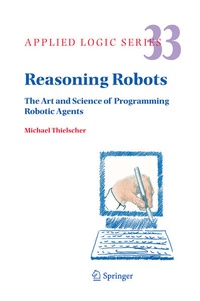
Reasoning Robots
The Art and Science of Programming Robotic Agents
Published on 5. July 2005
Book
Hardback
XIV, 328 pages
978-1-4020-3068-0 (ISBN)
Description
The creation of intelligent robots is surely one of the most exciting and ch- lenginggoals of Arti?cial Intelligence. A robot is, ?rst of all, nothing but an inanimate machine with motors and sensors. In order to bring life to it, the machine needs to be programmed so as to make active use of its hardware c- ponents. This turns a machine into an autonomous robot. Since about the mid nineties of the past century, robot programming has made impressive progress. State-of-the-art robots are able to orient themselves and move around freely in indoor environments or negotiate di?cult outdoor terrains, they can use stereo vision to recognize objects, and they are capable of simple object manipulation with the help of arti?cial extremities. At a time where robots perform these tasks more and more reliably,weare ready to pursue the next big step, which is to turn autonomous machines into reasoning robots.Areasoning robot exhibits higher cognitive capabilities like following complex and long-term strategies, making rational decisions on a high level, drawing logical conclusions from sensor information acquired over time, devising suitable plans, and reacting sensibly in unexpected situations. All of these capabilities are characteristics of human-like intelligence and ultimately distinguish truly intelligent robots from mere autonomous machines.
Reviews / Votes
From the reviews:
"This book presents the 'fluent calculus' as one possible approach to solve the frame problem in artificial intelligence. . The book is very understandable and recommendable for anybody who wants to solve AI problems by means of predicate logics and logic programming. It shows that this approach is more and more applicable to the solution of real-world problems. It will be an excellent textbook for appropriate AI or robotics courses and very appropriate for graduate students." (Christian Posthoff, Zentralblatt MATH, Vol. 1092 (18), 2006)
More details
Series
Edition
2005 ed.
Language
English
Place of publication
Dordrecht
Netherlands
Target group
Professional and scholarly
Research
Product notice
sewn/stitched
Cloth over boards
Illustrations
XIV, 328 p.
Dimensions
Height: 251 mm
Width: 174 mm
Thickness: 25 mm
Weight
691 gr
ISBN-13
978-1-4020-3068-0 (9781402030680)
DOI
10.1007/1-4020-3069-X
Schweitzer Classification
Other editions
Additional editions
Book
10/2010
Springer
€53.49
Shipment within 15-20 days
E-Book
12/2005
1st Edition
Springer
€53.49
Available for download
Content
Special Fluent Calculus.- Special FLUX.- General Fluent Calculus.- General FLUX.- Knowledge Programming.- Planning.- Nondeterminism.- Imprecision*.- Indirect Effects: Ramification Problem*.- Troubleshooting: Qualification Problem.- Robotics.