

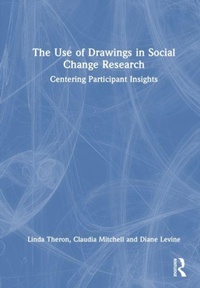
The Use of Drawings in Social Change Research
Centering Participant Insights
1st Edition
Will be published approx. on 30. June 2026
Book
Hardback
194 pages
978-1-032-76633-1 (ISBN)
Description
The Use of Drawings in Social Change Research is a practice-oriented guide to draw-and-write and draw-and-talk methods in qualitative research. It offers a clear, structured account of how drawing, paired with participant explanation, can be used to generate and interpret visual-narrative data in research concerned with social change. Grounded in applied work, the book demonstrates how these methods operate across diverse social, cultural, and institutional settings.
The book provides step-by-step guidance on designing prompts, supporting participants, and analysing drawings alongside written or spoken accounts. It addresses ethical questions of consent, power, language, and dissemination, equipping readers to work responsibly with visual material. Contributions from scholars working internationally show how drawing practices can surface nuanced accounts of lived experience across age groups, disciplines, and research aims. The final section extends the methodology into emerging areas, including creative and embodied approaches, comics-based research, and AI-supported practices.
This book is written for researchers, practitioners, and postgraduate students engaged in qualitative, arts-based, participatory, educational, health, or child-centred research, particularly those working on issues of social justice and social change.
The book provides step-by-step guidance on designing prompts, supporting participants, and analysing drawings alongside written or spoken accounts. It addresses ethical questions of consent, power, language, and dissemination, equipping readers to work responsibly with visual material. Contributions from scholars working internationally show how drawing practices can surface nuanced accounts of lived experience across age groups, disciplines, and research aims. The final section extends the methodology into emerging areas, including creative and embodied approaches, comics-based research, and AI-supported practices.
This book is written for researchers, practitioners, and postgraduate students engaged in qualitative, arts-based, participatory, educational, health, or child-centred research, particularly those working on issues of social justice and social change.
More details
Language
English
Place of publication
London
United Kingdom
Publishing group
Taylor & Francis Ltd
Target group
College/higher education
Professional and scholarly
Postgraduate, Professional Practice & Development, and Undergraduate Advanced
Illustrations
68 s/w Photographien bzw. Rasterbilder, 10 s/w Tabellen, 68 s/w Abbildungen
10 Tables, black and white; 68 Halftones, black and white; 68 Illustrations, black and white
Dimensions
Height: 246 mm
Width: 174 mm
ISBN-13
978-1-032-76633-1 (9781032766331)
Copyright in bibliographic data and cover images is held by Nielsen Book Services Limited or by the publishers or by their respective licensors: all rights reserved.
Schweitzer Classification
Other editions
Additional editions
Linda Theron | Claudia Mitchell | Diane Levine
The Use of Drawings in Social Change Research
Centering Participant Insights
Book
approx. 06/2026
1st Edition
Routledge
€53.50
Not yet published

Linda Theron | Claudia Mitchell | Diane Levine
The Use of Drawings in Social Change Research
Centering Participant Insights
E-Book
approx. 06/2026
Routledge
€56.49
Not yet available
Linda Theron | Claudia Mitchell | Diane Levine
The Use of Drawings in Social Change Research
Centering Participant Insights
E-Book
approx. 06/2026
Routledge
€56.49
Not yet available
Persons
Linda Theron is Professor of Educational Psychology at the University of Pretoria in South Africa, and affiliated with Optentia Research Unit at North-West University.
Diane Levine is Assistant Lecturer at the University of Leicester in the U.K., and affiliated with the Centre for Social Development in Africa at the University of Johannesburg, South Africa.
Claudia Mitchell is Distinguished James McGill Professor at McGill University in Canada and an Honorary Professor at the University of KwaZulu-Natal, South Africa.
Diane Levine is Assistant Lecturer at the University of Leicester in the U.K., and affiliated with the Centre for Social Development in Africa at the University of Johannesburg, South Africa.
Claudia Mitchell is Distinguished James McGill Professor at McGill University in Canada and an Honorary Professor at the University of KwaZulu-Natal, South Africa.
Content
Introduction
Linda Theron, Diane Levine, Claudia Mitchell
Part 1: The Theory Explained
Chapter 1: How to generate draw-and-write/talk data
Linda Theron, Diane Levine, Claudia Mitchell
Chapter 2: Making meaning with draw-and-write/talk data
Diane Levine, Claudia Mitchell, Linda Theron
Chapter 3: Image, ethics and audience
Nesa Bandarchian Rashti, Miranda D'Amico, Myriam Denov, Bori Godley, Warren Linds, Claudia Mitchell
Part 2: The Theory Illustrated
Chapter 4: The art and craft of facilitating drawing in research with adolescents in Mali
Kattie Lussier
Chapter 5: Drawings as visual indicators of resilience in street-involved children and youth (SICY) in South Africa
Macalane Junel Malindi, Johnnie Hay
Chapter 6: Multisystemic factors associated with resilience to COVID-19 challenges among emerging adults in India
Narayanan Annalakshmi, Deepak kumar S, Vijayan Gayathry, Chellamuthu Kishor
Chapter 7: Drawing, talking and writing in the context of feminist art practice
Maria Adams, Vicki Harman, Erin Power, Talitha Brown, Jon Garland, Daniel McCarthy
Chapter 8: Drawing the future: Co-designing health services communication through visual thinking
Evonne Miller, Kate Letheren, Rebekah Russell-Bennett
Chapter 9: Drawing to deepen understandings of gender concepts: Teachers' picture gender transformation in Sierra Leone
Lisa Starr, Jennifer Thompson, Grace Skahan, Claudia Mitchell
Part 3: The Theory Extended
Chapter 10: Artificial intelligence and the interpretation of draw-and-write data: Creative possibilities and epistemological limits
John Goodwin, Diane Levine, Morenike Oyenubi, Dov Stekel
Chapter 11: Comics as a catalyst: Innovative approaches to data engagement in research with Racially and Ethnically Marginalised (REM) communities
Fatmata Daramy, Osarenkhoe Ogbeide
Chapter 12: Leaving a mark: Conceptualising embodiment in art-making with refugee children and young people
Miranda D'Amico, Nesa Bandarchian Rashti, Shu-Hau Kang, Myriam Denov, Warren Linds, Claudia Mitchell
Linda Theron, Diane Levine, Claudia Mitchell
Part 1: The Theory Explained
Chapter 1: How to generate draw-and-write/talk data
Linda Theron, Diane Levine, Claudia Mitchell
Chapter 2: Making meaning with draw-and-write/talk data
Diane Levine, Claudia Mitchell, Linda Theron
Chapter 3: Image, ethics and audience
Nesa Bandarchian Rashti, Miranda D'Amico, Myriam Denov, Bori Godley, Warren Linds, Claudia Mitchell
Part 2: The Theory Illustrated
Chapter 4: The art and craft of facilitating drawing in research with adolescents in Mali
Kattie Lussier
Chapter 5: Drawings as visual indicators of resilience in street-involved children and youth (SICY) in South Africa
Macalane Junel Malindi, Johnnie Hay
Chapter 6: Multisystemic factors associated with resilience to COVID-19 challenges among emerging adults in India
Narayanan Annalakshmi, Deepak kumar S, Vijayan Gayathry, Chellamuthu Kishor
Chapter 7: Drawing, talking and writing in the context of feminist art practice
Maria Adams, Vicki Harman, Erin Power, Talitha Brown, Jon Garland, Daniel McCarthy
Chapter 8: Drawing the future: Co-designing health services communication through visual thinking
Evonne Miller, Kate Letheren, Rebekah Russell-Bennett
Chapter 9: Drawing to deepen understandings of gender concepts: Teachers' picture gender transformation in Sierra Leone
Lisa Starr, Jennifer Thompson, Grace Skahan, Claudia Mitchell
Part 3: The Theory Extended
Chapter 10: Artificial intelligence and the interpretation of draw-and-write data: Creative possibilities and epistemological limits
John Goodwin, Diane Levine, Morenike Oyenubi, Dov Stekel
Chapter 11: Comics as a catalyst: Innovative approaches to data engagement in research with Racially and Ethnically Marginalised (REM) communities
Fatmata Daramy, Osarenkhoe Ogbeide
Chapter 12: Leaving a mark: Conceptualising embodiment in art-making with refugee children and young people
Miranda D'Amico, Nesa Bandarchian Rashti, Shu-Hau Kang, Myriam Denov, Warren Linds, Claudia Mitchell