

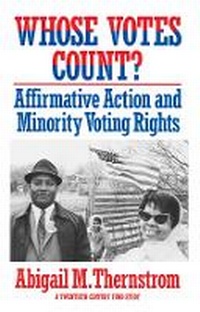
Whose Votes Count?
Affirmative Action and Minority Voting Rights
Published on 1. January 1989
Book
Paperback/Softback
308 pages
978-0-674-95196-9 (ISBN)
Description
The Fifteenth Amendment to the Constitution of the United States guarantees that all citizens have the right to vote without regard to their "race, color, or previous condition of servitude." For almost a century the Fifteenth Amendment was a dead letter. Throughout the South millions of nonwhite Americans were excluded from the political process by poll taxes, literacy tests, and other devices. The landmark Voting Rights Act of 1965 sought to end that injustice.
In this absorbing book, political scientist Abigail Thernstrom analyzes the radical transformation of the Voting Rights Act in the years since its passage. She shows how a measure carefully crafted to open the polling booths to southern blacks has evolved into a powerful tool for affirmative action in the electoral sphere-a means to promote black and Hispanic officeholding by creating "safe" seats for minority candidates. What began as an effort to give minorities a fair shake has become a means of ensuring a fair share.
Thernstrom demonstrates how voting rights have created a "political thicket" in which Congress, the courts, and the justice Department have been lost. Why this should be true, how small statutory changes led to large and unexpected results, how civil rights groups prevailed against a conservative Senate, how Republicans have benefited from gerrymandering to increase black officeholding-these stories are all part of Thernstrom's well-told tale.
Even though the concept of the right to vote retains an aura of moral simplicity, the issue of minority voting rights is perhaps the most complex, yet least studied, of all affirmative action issues. Whose Votes Count? should stimulate the overdue discussion that the subject deserves among all those concerned with American politics.
In this absorbing book, political scientist Abigail Thernstrom analyzes the radical transformation of the Voting Rights Act in the years since its passage. She shows how a measure carefully crafted to open the polling booths to southern blacks has evolved into a powerful tool for affirmative action in the electoral sphere-a means to promote black and Hispanic officeholding by creating "safe" seats for minority candidates. What began as an effort to give minorities a fair shake has become a means of ensuring a fair share.
Thernstrom demonstrates how voting rights have created a "political thicket" in which Congress, the courts, and the justice Department have been lost. Why this should be true, how small statutory changes led to large and unexpected results, how civil rights groups prevailed against a conservative Senate, how Republicans have benefited from gerrymandering to increase black officeholding-these stories are all part of Thernstrom's well-told tale.
Even though the concept of the right to vote retains an aura of moral simplicity, the issue of minority voting rights is perhaps the most complex, yet least studied, of all affirmative action issues. Whose Votes Count? should stimulate the overdue discussion that the subject deserves among all those concerned with American politics.
Reviews / Votes
Thernstrom blends a detailed understanding of legislative history, case law, and administrative politics with a strong concern for the plight of minorities and a keen sense of the give-and-take of electoral politics. Her book is a first-rate contribution on an issue of enormous significance...and her analysis is all the more welcome since the goal of proportional representation has occasioned so little public debate... Thernstrom tackles what others skirt, raising the tough questions about voting rights. -- Harold W. Stanley * New Republic * [The] evolution of the Voting Rights Act, Abigail Thernstrom writes in this fascinating study, is 'controversial policy that has somehow stirred no controversy.' The long awaited appearance of her book will change all that... Thernstrom's story, written with scrupulous balance and obvious sympathy for the cause of racial justice, reveals numerous ironies... To Thernstrom, the courts and the Justice Department have quietly perverted Congress's intent and have abused the judicial and administrative processes. -- Peter H. Schuck * Washington Monthly * This book is a perfect event. Nothing else in print provides the level of scholarship, balance, and perspective so conspicuous in this treatment. It avoids the disfigurement of advocacy scholarship. It is extremely clear-eyed and complete. Its overall development, its integration of case law of internal Washington administrative trends, of demographics, of Capitol politics, civil rights sociology, etc.-all are important pieces. This book cuts across disciplinary lines successfully, as previous writing has failed to do. It is necessarily the 'standard work' for anyone seriously interested in the politics, law, and modern history of the Voting Rights Act. -- William Van Alstyne, Duke University School of Law Thernstrom maneuvers successfully between the civil rights ideology and the requirements of democratic politics. She sustains a strong concern for the struggles of American blacks while conceding very little to the affirmative action or electoral quota position. Exactly right. This is a sad story, well told, well analyzed, with the right combination of strong criticism and moral sympathy. -- Michael Walzer, Institute for Advanced Study, Princeton The book is fascinating-powerfully argued, richly documented, fair and respectful to those who disagree. Not only is the scholarship excellent, but the public policy questions Thernstrom raises are important questions that deserve to be debated in public. -- Aaron Wildavsky, University of California, Berkeley, and past president of the American Political Science AssociationMore details
Series
Language
English
Place of publication
Cambridge, Mass
United States
Target group
College/higher education
Professional and scholarly
Weight
499 gr
ISBN-13
978-0-674-95196-9 (9780674951969)
Copyright in bibliographic data and cover images is held by Nielsen Book Services Limited or by the publishers or by their respective licensors: all rights reserved.
Schweitzer Classification
Person
Abigail Thernstrom is a senior fellow at the Manhattan Institute for Policy Research, a member of the Massachusetts State Board of Education, and the vice-chair of the U.S. Commission on Civil Rights.
Content
Foreword M. J. Rossant Acknowledgments Introduction 1. The First Five Years 2. Inadvertent Gains 3. The Mexican-American Connection 4. Travels in a Political Thicket 5. The Politics of Passage in the House 6. Liberal Power in a Conservative Senate 7. Amendment by Enforcement 8. Detours around the Law 9. The Meaning of Electoral Equality Conclusion Appendix: The Voting Rights Act Notes Glossary Index of Voting Rights Cases General Index