

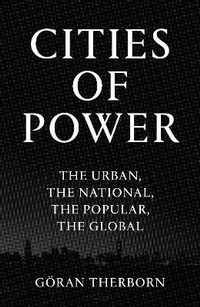
Cities of Power
The Urban, The National, The Popular, The Global
Published on 2. May 2017
Book
Hardback
416 pages
978-1-78478-544-4 (ISBN)
Description
In this brilliant, very original survey of the politics and meanings of urban landscapes, leading sociologist Goeran Therborn offers a tour of the world's major capital cities, showing how they have been shaped by national, popular, and global forces. Their stories begin with the emergence of various kinds of nation-state, each with its own special capital city problematic. In turn, radical shifts of power have impacted on these cities' development, in popular urban reforms or movements of protest and resistance; in the rise and fall of fascism and military dictatorships; and the coming and going of Communism. Therborn also analyzes global moments of urban formation, of historical globalized nationalism, as well as the cities of current global image capitalism and their variations of skyscraping, gating, and displays of novelty.
Through a global, historical lens, and with a thematic range extending from the mutations of modernist architecture to the contemporary return of urban revolutions, Therborn questions received assumptions about the source, manifestations, and reach of urban power, combining perspectives on politics, sociology, urban planning, architecture, and urban iconography. He argues that, at a time when they seem to be moving apart, there is a strong link between the city and the nation-state, and that the current globalization of cities is largely driven by the global aspirations of politicians as well as those of national and local capital.
With its unique systematic overview, from Washington, D.C. and revolutionary Paris to the flamboyant twenty- first-century capital Astana in Kazakhstan, its wealth of urban observations from all the populated continents, and its sharp and multi-faceted analyses, Cities of Power forces us to rethink our urban future, as well as our historically shaped present.
Through a global, historical lens, and with a thematic range extending from the mutations of modernist architecture to the contemporary return of urban revolutions, Therborn questions received assumptions about the source, manifestations, and reach of urban power, combining perspectives on politics, sociology, urban planning, architecture, and urban iconography. He argues that, at a time when they seem to be moving apart, there is a strong link between the city and the nation-state, and that the current globalization of cities is largely driven by the global aspirations of politicians as well as those of national and local capital.
With its unique systematic overview, from Washington, D.C. and revolutionary Paris to the flamboyant twenty- first-century capital Astana in Kazakhstan, its wealth of urban observations from all the populated continents, and its sharp and multi-faceted analyses, Cities of Power forces us to rethink our urban future, as well as our historically shaped present.
Reviews / Votes
Command of history and knowledge of the real world inform Goeran Therborn's thinking, making him one of the world's most engaging and intriguing sociologists. Cities of Power focuses our attention on the places where transforming events happen and helps us understand the current tensions between states and people, capitals and peripheries, populism and elitism, nationalism and globalism. -- Felipe Fernandez-Armesto, author of <i>Our America: A Hispanic History of the United States</i> Therborn is a highly conceptual thinker, allying the formal rigor of his discipline at its best with a command of a vast range of empirical data. The result is a powerful theoretical structure, supported by a fascinating body of evidence. * Nation * At a time when historians and economists tend to retire behind the barricades of their increasingly specialized professions, answering the big comparative questions about the pathways into and out of modernity, the global processes of inequality and the forces of possible change have been largely left to the sociologists. In my view, Goeran Therborn, probably Sweden's most distinguished social scientist, has made more essential contributions in these fields than anyone else, by a combination of analytical lucidity, common sense and an extraordinary command of international comparative data. -- Eric Hobsbawm, author of <i>The Age of Extremes</i> Cities of Power... is explicitly a riposte to the idea of the Global City, and the peculiar Monocle-magazine vision of trans-national, interconnected, intangible capitalism that it serves to alternately describe and vindicate... Few thinkers display such a genuinely global range -- Owen Hatherley * New Left Review * Therborn's description of what a global city is provokes legitimate reflection... Cities of Power is one more publication in a sparkling list of career accomplishments and might function as an important resource for many a sociology doctoral student. -- Luzia Lodder * PopMatters * The distillation of decades of scholarship in urban history and the sociology of nationalism ... Cities of Power does important work in connecting the look and feel of cities with their specific national histories. -- Max Holleran * Times Literary Supplement *More details
Language
English
Place of publication
London
United Kingdom
Illustrations
8pp b&w plate section
Dimensions
Height: 235 mm
Width: 156 mm
Weight
785 gr
ISBN-13
978-1-78478-544-4 (9781784785444)
Copyright in bibliographic data and cover images is held by Nielsen Book Services Limited or by the publishers or by their respective licensors: all rights reserved.
Schweitzer Classification
Other editions
New editions
Book
10/2021
Verso Books
€16.50
Shipment within 3-4 weeks
Additional editions
E-Book
05/2017
Verso Books
€24.49
Available for download
Person
Goeran Therborn is the Professor Emeritus of Sociology at the University of Cambridge, UK. He is also the former co-Director of the Swedish Collegium for Advanced Study in the Social Sciences at Uppsala. He has worked in, and on, all the populated continents of the world. His works have been published in at least twenty-four languages. He is also a civic intellectual, with a lifetime commitment to universal freedom and equality, a supporter of anti-imperialist and egalitarian social movements, and writes on Marxist and Radical theory. Since his retirement from Cambridge in 2010 he lives at Ljungbyholm, in southeast Sweden.