

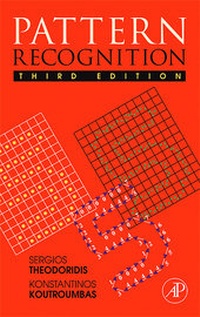
Pattern Recognition
3rd Edition
Published on 7. April 2006
Book
Hardback
856 pages
978-0-12-369531-4 (ISBN)
Description
Pattern recognition is a fast growing area with applications in a widely diverse number of fields such as communications engineering, bioinformatics, data mining, content-based database retrieval, to name but a few. This new edition addresses and keeps pace with the most recent advancements in these and related areas. This new edition: a) covers Data Mining, which was not treated in the previous edition, and is integrated with existing material in the book, b) includes new results on Learning Theory and Support Vector Machines, that are at the forefront of today's research, with a lot of interest both in academia and in applications-oriented communities, c) for the first time treats audio along with image applications since in today's world the most advanced applications are treated in a unified way and d) the subject of classifier combinations is treated, since this is a hot topic currently of interest in the pattern recognition community.
Reviews / Votes
"The book is written in a very readable, no-nonsense style. I found that there was just the right amount of text to describe a concept, without extraneous verbiage. The same is true for the mathematics, enough for description, not too much to overwhelm." --Larry O'Gorman, IAPR Newsletter, April 2006More details
Edition
3rd edition
Language
English
Place of publication
San Diego
United States
Publishing group
Elsevier Science Publishing Co Inc
Target group
College/higher education
Researchers, scientists and engineering professionals in comms & computer engineering; pattern recognition; informatics; data mining; content-based data retrieval; machine vision; speech recognition; image processing. 3rd/4th year & grad courses in Pattern Recognition at CS/CE/EE programs
Edition type
New edition
Dimensions
Height: 229 mm
Width: 152 mm
Weight
1383 gr
ISBN-13
978-0-12-369531-4 (9780123695314)
Copyright in bibliographic data and cover images is held by Nielsen Book Services Limited or by the publishers or by their respective licensors: all rights reserved.
Schweitzer Classification
Other editions
New editions
Konstantinos Koutroumbas | Sergios Theodoridis
Pattern Recognition
Book
11/2008
4th Edition
Academic Press
€100.50
Shipment within 3-4 weeks
Additional editions
Sergios Theodoridis | Konstantinos Koutroumbas
Pattern Recognition
E-Book
04/2006
3rd Edition
Academic Press
€60.95
Available for download
Previous edition
Sergios Theodoridis | Konstantinos Koutroumbas
Pattern Recognition
Book
03/2003
2nd Edition
Academic Press
€53.22
Article exhausted; check for reprint
Persons
Sergios Theodoridis acquired a Physics degree with honors from the University of Athens, Greece in 1973 and a MSc and a Ph.D. degree in Signal Processing and Communications from the University of Birmingham, UK in 1975 and 1978 respectively. Since 1995 he has been a Professor with the Department of Informatics and Communications at the University of Athens. Konstantinos Koutroumbas acquired a degree from the University of Patras, Greece in Computer Engineering and Informatics in 1989, a MSc in Computer Science from the University of London, UK in 1990, and a Ph.D. degree from the University of Athens in 1995. Since 2001 he has been with the Institute for Space Applications and Remote Sensing of the National Observatory of Athens.
Content
Introduction; Classifiers Based on Bayes Decision Theory; Linear Classifiers; Nonlinear Classifiers; Feature Selection; Feature Generation I; Feature Generation II; Template Matching; Context-Dependant Classification; System Evaluation; Clustering: Basic Concepts Clustering Algorithms I (Sequential); Clustering Algorithms II (Hierarchical); Clustering Algorithms III (Functional Optimization); Clustering Algorithms IV (Graph Theory); Cluster Validity