

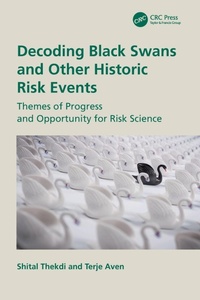
Decoding Black Swans and Other Historic Risk Events
Themes of Progress and Opportunity for Risk Science
1st Edition
Published on 31. October 2024
Book
Paperback/Softback
124 pages
978-1-032-55884-4 (ISBN)
Description
The field of risk science continues to learn from the long history of events to develop principles and practices that enable individuals, organizations, and societies to understand and manage future risk. Reflecting on these histories reminds us that risk and uncertainty are prevalent, yet it remains important to consider what is on the horizon: the possibility of future events, the consequences of those events, our vulnerability to those events, and how to recover from those events.
Decoding Black Swans and Other Historic Risk Events offers a guide to understanding risk events and how to act before they occur. This book explores past risk events and analyzes how risk science principles apply to those events and studies whether current risk science concepts and approaches could potentially have avoided, reduced the impact, or supported recovery following the risk event. New insights are obtained by applying recent research progress in understanding and managing risk, considering aspects including quality of evidence, information, and misinformation in risk studies. The analysis results are used to identify how risk science approaches contribute to the overall management of risk and societal safety, and where improvements can be obtained, allowing the reader to possess a toolkit for identifying and planning for unsafe events.
This title will be a critical read for professionals in the fields of occupational health and safety, risk management, civil engineering, mechanical engineering, energy, marine engineering, environmental engineering, business and management, and healthcare.
Decoding Black Swans and Other Historic Risk Events offers a guide to understanding risk events and how to act before they occur. This book explores past risk events and analyzes how risk science principles apply to those events and studies whether current risk science concepts and approaches could potentially have avoided, reduced the impact, or supported recovery following the risk event. New insights are obtained by applying recent research progress in understanding and managing risk, considering aspects including quality of evidence, information, and misinformation in risk studies. The analysis results are used to identify how risk science approaches contribute to the overall management of risk and societal safety, and where improvements can be obtained, allowing the reader to possess a toolkit for identifying and planning for unsafe events.
This title will be a critical read for professionals in the fields of occupational health and safety, risk management, civil engineering, mechanical engineering, energy, marine engineering, environmental engineering, business and management, and healthcare.
More details
Language
English
Place of publication
London
United Kingdom
Publishing group
Taylor & Francis Ltd
Target group
Professional and scholarly
Academic and Professional Reference
Illustrations
26 s/w Abbildungen, 20 s/w Photographien bzw. Rasterbilder, 6 s/w Zeichnungen, 1 s/w Tabelle
1 Tables, black and white; 6 Line drawings, black and white; 20 Halftones, black and white; 26 Illustrations, black and white
Dimensions
Height: 234 mm
Width: 156 mm
Thickness: 8 mm
Weight
222 gr
ISBN-13
978-1-032-55884-4 (9781032558844)
Copyright in bibliographic data and cover images is held by Nielsen Book Services Limited or by the publishers or by their respective licensors: all rights reserved.
Schweitzer Classification
Other editions
Additional editions
Shital Thekdi | Terje Aven
Decoding Black Swans and Other Historic Risk Events
Themes of Progress and Opportunity for Risk Science
Book
10/2024
1st Edition
CRC Press
€185.40
Shipment within 10-20 days
Shital Thekdi | Terje Aven
Decoding Black Swans and Other Historic Risk Events
Themes of Progress and Opportunity for Risk Science
E-Book
10/2024
1st Edition
CRC Press
€56.49
Available for download
Shital Thekdi | Terje Aven
Decoding Black Swans and Other Historic Risk Events
Themes of Progress and Opportunity for Risk Science
E-Book
10/2024
1st Edition
CRC Press
€56.49
Available for download
Persons
Shital Thekdi is a professor of analytics and operations at the University of Richmond. She has co-authored many papers on risk management and decision-making. She has a Ph.D. in systems and information engineering from the University of Virginia and an M.S.E. and a B.S.E. in industrial and operations engineering from the University of Michigan. She has several years of experience working in industry, with extensive supply chain management and operational analytics experience.
Terje Aven has been a professor in risk science at the University of Stavanger, Norway, since 1992. Previously, he was also Professor (adjunct) in risk analysis at the University of Oslo and the Norwegian University of Science and Technology. He has many years of experience as a risk analyst in industry and as a consultant. He is the author of many books and papers in the field, covering both fundamental issues and practical risk analysis methods. He has led several large research programs in the risk area, with strong international participation. He has developed many master programs in the field and has lectured on many courses in risk analysis and risk management. Aven is the Editor-in-Chief of the Journal of Risk and Reliability, and Area Editor of risk analysis in policy. He has served as president of the International Society for Risk Analysis (SRA) and chairman of the European Safety and Reliability Association (ESRA) (2014-2018).
Terje Aven has been a professor in risk science at the University of Stavanger, Norway, since 1992. Previously, he was also Professor (adjunct) in risk analysis at the University of Oslo and the Norwegian University of Science and Technology. He has many years of experience as a risk analyst in industry and as a consultant. He is the author of many books and papers in the field, covering both fundamental issues and practical risk analysis methods. He has led several large research programs in the risk area, with strong international participation. He has developed many master programs in the field and has lectured on many courses in risk analysis and risk management. Aven is the Editor-in-Chief of the Journal of Risk and Reliability, and Area Editor of risk analysis in policy. He has served as president of the International Society for Risk Analysis (SRA) and chairman of the European Safety and Reliability Association (ESRA) (2014-2018).
Content
Foreword
About the Authors
Acknowledgments
Chapter 1: Framework Used to decode the Risk Events
Chapter 2: Historical Events to be Decoded
Global Pandemics
Industrial Accidents
Infrastructure Failures
Natural Disasters
Acts of Terrorism and War
Food Safety
Chapter 3: Historical Perspective on Risk
Chapter 4: Historical Precedent for Remembering and Understanding Risk Issues
Chapter 5: Characterization of Surprise and Unpredictability
Chapter 6: Severity of Consequences in Relation to Uncertainties and Knowledge
Titanic case - Evaluation of Consequences
Chapter 7: Uncertainty Characterizations
Fukushima Daiichi Case - Evaluation of Probabilistic Risk Assessment at Nuclear Plants
Chapter 8: Types of Knowledge That Inform Understanding of Risk
9/11 case - Classification of Knowledge
Chapter 9: Credibility of Knowledge
Food Additives Case - Credibility of Knowledge
Chapter 10: Factors Influencing Understanding and Communication of Risk, Uncertainties, and Probabilities
Cuyahoga River Fire - Communication of Risk-Related Information
Chapter 11: Biases, Misinformation, and Disinformation
Biases and Moral Hazards - East Palestine Train Derailment and Similar Freight Accidents
COVID-19 Misinformation and Disinformation
Chapter 12: Balancing Various Dimensions of a Risk Application
BP Oil Spill - Dimensions of Risk for Oil and Gas Operations and Related Regulation
Chapter 13: The Weight Given to Resilience
Hurricane Katrina - Why New Orleans Was Vulnerable and How Resilience Emerged
Chapter 14: The Big Picture of Risk Science Surrounding Major Historical Events
Tornadoes - The Big Picture Around Risk Issues
Smoking, Social Media, and Processed Foods - Linking Three Global Risk Issues
Chapter 15: How Risk Science Improves the Ability to Address the Gaps in the Themes Presented
Chapter 16: Who Is the Risk Analyst and What Are the Expectations
Chapter 17: Unresolved Issues in Risk Science Identified in the Presented Themes
Abraham Lincoln Assassination - Hindsight Bias versus Noise Leading to a Risk Event
Chapter 18: Conclusions
Further Reading
Index
About the Authors
Acknowledgments
Chapter 1: Framework Used to decode the Risk Events
Chapter 2: Historical Events to be Decoded
Global Pandemics
Industrial Accidents
Infrastructure Failures
Natural Disasters
Acts of Terrorism and War
Food Safety
Chapter 3: Historical Perspective on Risk
Chapter 4: Historical Precedent for Remembering and Understanding Risk Issues
Chapter 5: Characterization of Surprise and Unpredictability
Chapter 6: Severity of Consequences in Relation to Uncertainties and Knowledge
Titanic case - Evaluation of Consequences
Chapter 7: Uncertainty Characterizations
Fukushima Daiichi Case - Evaluation of Probabilistic Risk Assessment at Nuclear Plants
Chapter 8: Types of Knowledge That Inform Understanding of Risk
9/11 case - Classification of Knowledge
Chapter 9: Credibility of Knowledge
Food Additives Case - Credibility of Knowledge
Chapter 10: Factors Influencing Understanding and Communication of Risk, Uncertainties, and Probabilities
Cuyahoga River Fire - Communication of Risk-Related Information
Chapter 11: Biases, Misinformation, and Disinformation
Biases and Moral Hazards - East Palestine Train Derailment and Similar Freight Accidents
COVID-19 Misinformation and Disinformation
Chapter 12: Balancing Various Dimensions of a Risk Application
BP Oil Spill - Dimensions of Risk for Oil and Gas Operations and Related Regulation
Chapter 13: The Weight Given to Resilience
Hurricane Katrina - Why New Orleans Was Vulnerable and How Resilience Emerged
Chapter 14: The Big Picture of Risk Science Surrounding Major Historical Events
Tornadoes - The Big Picture Around Risk Issues
Smoking, Social Media, and Processed Foods - Linking Three Global Risk Issues
Chapter 15: How Risk Science Improves the Ability to Address the Gaps in the Themes Presented
Chapter 16: Who Is the Risk Analyst and What Are the Expectations
Chapter 17: Unresolved Issues in Risk Science Identified in the Presented Themes
Abraham Lincoln Assassination - Hindsight Bias versus Noise Leading to a Risk Event
Chapter 18: Conclusions
Further Reading
Index