

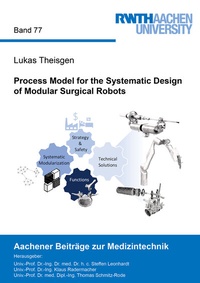
Process Model for the Systematic Design of Modular Surgical Robots
1st Edition
Published on 21. August 2024
Book
Paperback/Softback
175 pages
978-3-8440-9595-1 (ISBN)
Description
The potential of robot-assisted surgery is huge in terms of surgical outcome, safety, ergonomics, and cost efficiency. Yet, most commercial robots and research projects focus on optimizing certain aspects while unwittingly worsening others. The manufacturing industry, on the other hand, uses systematic modularization to harmonize conflicting goals during product development. A prerequisite for the adaptation to surgical robotics is the adequate consideration of intraoperative hazards, deficits of current robots, and the safety and usability of emerging intraoperative interfaces.
Here, a process model was developed for the systematic modularization of surgical robots with integrated risk estimation (MORE), and recommendations for the design of intraoperative interfaces. Key results are the modularization method for surgical robots, the Point-of-View (PoV) framework, the Catalogue of Hazards (CoH), the Reference Architecture Model (RAM), and the Design-for-Intraoperative-Assembly (DfIA) checklist.
The modularization method uses 11 reference functions to suit various use case scenarios and 59 module drivers as quality criteria based on the analysis of 15 surgical robots and the feedback from 51 experts. The PoV framework expands the search area for hazards suggesting 7 predefined perspectives while the CoH provides a database to complement future and systematic risk analyses. PoV and CoH were initially tested on the example of robotically assisted laminectomy, which led to the identification of 133 hazards and 108 hazardous situations. The RAM approach provides structural and procedural rules between functional and physical system elements based on SysML. The DfIA checklist contains 44 control questions of which 18 refer to hygiene and 26 to the assembly process.
Here, a process model was developed for the systematic modularization of surgical robots with integrated risk estimation (MORE), and recommendations for the design of intraoperative interfaces. Key results are the modularization method for surgical robots, the Point-of-View (PoV) framework, the Catalogue of Hazards (CoH), the Reference Architecture Model (RAM), and the Design-for-Intraoperative-Assembly (DfIA) checklist.
The modularization method uses 11 reference functions to suit various use case scenarios and 59 module drivers as quality criteria based on the analysis of 15 surgical robots and the feedback from 51 experts. The PoV framework expands the search area for hazards suggesting 7 predefined perspectives while the CoH provides a database to complement future and systematic risk analyses. PoV and CoH were initially tested on the example of robotically assisted laminectomy, which led to the identification of 133 hazards and 108 hazardous situations. The RAM approach provides structural and procedural rules between functional and physical system elements based on SysML. The DfIA checklist contains 44 control questions of which 18 refer to hygiene and 26 to the assembly process.
More details
Series
Thesis
Doctoral thesis
2024
RWTH Aachen University
Language
English
Place of publication
Düren
Germany
Target group
Professional and scholarly
Product notice
Unsewn / adhesive bound
Illustrations
75
75 farbige Abbildungen
75
Dimensions
Height: 21 cm
Width: 14.8 cm
Weight
259 gr
ISBN-13
978-3-8440-9595-1 (9783844095951)
Schweitzer Classification