

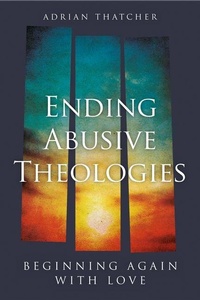
Ending Abusive Theologies
Beginning Again with Love
Will be published approx. on 30. June 2026
Book
Paperback/Softback
240 pages
978-0-334-06768-9 (ISBN)
Description
Following various church abuse scandals, there is now a growing realization that bad theology and bad outcomes are deeply connected. Ending Abusive Theologies attributes the widespread decline of Christian belief in the West in part to harmful, indeed abusive, doctrines. At the same time, there has been a widespread failure of theology to equip the Church to engage with a world that has lost interest in, and patience with, the Church, while retaining its interest in all things 'spiritual'.
Adrian Thatcher argues that we should start thinking of abusive theology as a category of theology; Ending Abusive Theologies widens and deepens this notion and its catalogue of harms, linking it firmly to the abuse crises in the churches, yet also suggesting the shape of a post-abusive alternative. The book charts a course back to living faith via an unflinching exposure of abusive teachings, abusive Bible readings, and abusive depictions of God that have no place in a gospel-centred theology of justice and love. In this way, we are taken on a rough voyage through seas of controversy, ending calmly in the welcome harbour of an all-loving and non-abusive God.
Adrian Thatcher argues that we should start thinking of abusive theology as a category of theology; Ending Abusive Theologies widens and deepens this notion and its catalogue of harms, linking it firmly to the abuse crises in the churches, yet also suggesting the shape of a post-abusive alternative. The book charts a course back to living faith via an unflinching exposure of abusive teachings, abusive Bible readings, and abusive depictions of God that have no place in a gospel-centred theology of justice and love. In this way, we are taken on a rough voyage through seas of controversy, ending calmly in the welcome harbour of an all-loving and non-abusive God.
Reviews / Votes
Safeguarding entails protecting people from abusive behaviours. It also means exposing the various toxic beliefs that can lead to such control and damage. No matter how wide the smile as these are preached, or how justified they are by literalisms and certainties, many lives are diminished and injured as a result. By contrast, love is unarmed and disarming, and is the loudest protest to deep hurt given to a soul or a body. Adrian Thatcher names the evil done when theology is beset with our demons. We can only be grateful for the light he shines in some frighteningly dark places. -- Mark Oakley What if the reason for the decline of Christianity is that people no longer find our doctrines credible, recognizing them instead as abusive and dangerous? And how can we find better ways of reading the Bible? Unflinching in its honesty about our troubled heritage on sexual and other forms of abuse, this is a hopeful book which suggests how we can find better ways to read the Bible. -- Helen King Adrian Thatcher writes here for people 'injured' by abusive theology and harmful beliefs, doing two things with grace and strength. First, he makes a fearless assessment of 'bad theology' in Bible, church and doctrine. But then he offers lively 'sketches of the divine Mystery' which articulate what a 'positive, post-abusive theology' looks like.Admittedly this book is disturbing as well as exhilarating. Yet it is not only the injured who might read Ending Abusive Theologies, but also pastors and preachers concerned to do no harm, themselves in need of a vision of Christian faith 'that does not endorse violence of any kind'. In this, Adrian Thatcher is an expert guide and this book is an excellent sounding. Much to be recommended. -- Stephen Burns Ending Abusive Theologies is one of those rare books that can make even the most jaded reader sit up and take notice. It balances a clear-eyed insistence on attending to the uncomfortable truth that violence and abuse is hard-baked into biblical texts with a daring re-examination of Love's promise centred on the figure of Jesus. A bracing, insightful, and often appropriately uncomfortable addition to the burgeoning corpus of constructive theology. -- The Ven. Dr Rachel Mann
More details
Language
English
Place of publication
London
United Kingdom
Dimensions
Height: 234 mm
Width: 156 mm
ISBN-13
978-0-334-06768-9 (9780334067689)
Copyright in bibliographic data and cover images is held by Nielsen Book Services Limited or by the publishers or by their respective licensors: all rights reserved.
Schweitzer Classification
Person
Adrian Thatcher is Honorary Professor of Theology at the University of Exeter. He has taught at several universities and is a recent editor of Modern Believing. He is an Anglican and the author (or editor) of 19 books, including most recently Vile Bodies: The Body in Christian Teaching, Faith and Practice.
Content
Part 1 Abusive Theologies
Chapter 1 Abusive Theology: The Wisdom of Unbelief
Chapter 2 Abusive Theology: A Case Study
Chapter 3 Abusive Theologies: the Foundation and the Task
Chapter 4 'Christian Doctrine: 'Gift' or 'Poison'?
Chapter 5 A divine binary? Abusive Theologies of Sex and Gender
Part 2 An Abusive God?
Chapter 6 The God of the Hebrew Bible? The Problem and the Evidence
Chapter 7 The Abusive God? Consequences for Belief
Chapter 8 Endless Excuses?
Chapter 9 The Violent God: An Embodied Giant?
Chapter 10 Violence in the New Testament?
Chapter 11 Divine Child Abuse?
Part 3 Revelling in the Mystery - Towards a Post-Abusive Theology
Chapter 12 Transformations
Chapter 13 The Mystery of Being: Discerning the Divine Body
Chapter 14 The Mystery of Life
Chapter 15 The Mystery of Spirit
Chapter 16 The Mystery of God: God is Love
Chapter 1 Abusive Theology: The Wisdom of Unbelief
Chapter 2 Abusive Theology: A Case Study
Chapter 3 Abusive Theologies: the Foundation and the Task
Chapter 4 'Christian Doctrine: 'Gift' or 'Poison'?
Chapter 5 A divine binary? Abusive Theologies of Sex and Gender
Part 2 An Abusive God?
Chapter 6 The God of the Hebrew Bible? The Problem and the Evidence
Chapter 7 The Abusive God? Consequences for Belief
Chapter 8 Endless Excuses?
Chapter 9 The Violent God: An Embodied Giant?
Chapter 10 Violence in the New Testament?
Chapter 11 Divine Child Abuse?
Part 3 Revelling in the Mystery - Towards a Post-Abusive Theology
Chapter 12 Transformations
Chapter 13 The Mystery of Being: Discerning the Divine Body
Chapter 14 The Mystery of Life
Chapter 15 The Mystery of Spirit
Chapter 16 The Mystery of God: God is Love