

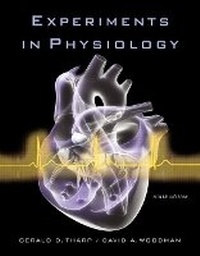
Experiments in Physiology
9th Edition
Published on 22. February 2007
Book
Paperback/Softback
288 pages
978-0-8053-4907-8 (ISBN)
Description
Experiments in Physiology, Ninth Edition covers all the material of a one-semester physiology laboratory course and can be used with any text and a variety of laboratory equipment. The Ninth Edition has been revised to keep pace with changing technologies-many activities have been updated with instructions on use of new digital equipment, including the Vernier (R) and PowerLab (R) computer data acquisitions systems.
Experiments in Physiology, Ninth Edition contains 90 exercises organized into 23 chapters and is suitable for a two- or three-hour laboratory period.
Experiments in Physiology, Ninth Edition contains 90 exercises organized into 23 chapters and is suitable for a two- or three-hour laboratory period.
More details
Edition
9th edition
Language
English
Place of publication
Upper Saddle River
United States
Target group
Professional and scholarly
Dimensions
Height: 276 mm
Width: 216 mm
Weight
621 gr
ISBN-13
978-0-8053-4907-8 (9780805349078)
Copyright in bibliographic data and cover images is held by Nielsen Book Services Limited or by the publishers or by their respective licensors: all rights reserved.
Schweitzer Classification
Other editions
New editions
Gerald D. Tharp | David A. Woodman
Experiments in Physiology
Book
04/2010
10th Edition
Pearson
€102.91
Article exhausted; check for reprint
Previous edition

Gerald D. Tharp | David A. Woodman
Experiments in Physiology
Book
01/2002
8th Edition
Pearson
€33.47
Article exhausted; check for reprint
Persons
Dr. Gerald D. Tharp is a Professor Emeritus at the University of Nebraska-Lincoln (UNL). He received his Bachelor of Science in Pharmacy from UNL in 1958, his Master of Science in Physiology from UNL in 1961, and his Ph.D. from the University of Iowa in 1965. He has been presented with two Distinguished Teaching awards from UNL and has done extensive research in Exercise Physiology with numerous papers. Dr. Tharp is a fellow of the American College of Sports Medicine.
Dr. David A. Woodman is a Senior Lecturer in the School of Biological Sciences at the University of Nebraska-Lincoln. He received his Bachelor of Science in Zoology and Botany and his Master of Science in Marine Zoology from Bombay University and his Ph.D. from the University of Nebraska. He has taught General Biology, Ichthyology, Zoology, and Vertebrate Zoology at UNL but since 1990 has been teaching Anatomy and Physiology lectures and supervising the laboratories for these large courses. He is the recipient of a Distinguished Teaching Service Award from the College of Arts and Sciences, and several Outstanding Contributions to Students awards from the UNL Parents Association.
Dr. David A. Woodman is a Senior Lecturer in the School of Biological Sciences at the University of Nebraska-Lincoln. He received his Bachelor of Science in Zoology and Botany and his Master of Science in Marine Zoology from Bombay University and his Ph.D. from the University of Nebraska. He has taught General Biology, Ichthyology, Zoology, and Vertebrate Zoology at UNL but since 1990 has been teaching Anatomy and Physiology lectures and supervising the laboratories for these large courses. He is the recipient of a Distinguished Teaching Service Award from the College of Arts and Sciences, and several Outstanding Contributions to Students awards from the UNL Parents Association.
Content
Fundamental Physiological Principles
Movement Through Membranes
Renal Physiology
Neuroanatomy
Membrane Action Potentials
Reflex Functions
Sensory Physiology I: Cutaneous, Hearing
Sensory Physiology II: Vision
Reproductive Physiology
Digestion
Smooth Muscle Motility
Insulin Regulation of Blood Glucose
Measurement of Metabolic Rate
Thyroid Function
Nerve-Muscle Activity
Cardiac Function
Human Cardiovascular Function
Respiratory Function
Regulation of Circulation and Respiration
Blood Physiology I: Erythrocyte Functions
Blood Physiology II: Leukocytes, Blood Types, Hemostasis
Physical Fitness
Physiology of Exercise
Appendix A: Precautions for Handling Blood
Appendix B: Solutions
Appendix C: Tables and Nomograms
Appendix D: Data Acquisition Units
Movement Through Membranes
Renal Physiology
Neuroanatomy
Membrane Action Potentials
Reflex Functions
Sensory Physiology I: Cutaneous, Hearing
Sensory Physiology II: Vision
Reproductive Physiology
Digestion
Smooth Muscle Motility
Insulin Regulation of Blood Glucose
Measurement of Metabolic Rate
Thyroid Function
Nerve-Muscle Activity
Cardiac Function
Human Cardiovascular Function
Respiratory Function
Regulation of Circulation and Respiration
Blood Physiology I: Erythrocyte Functions
Blood Physiology II: Leukocytes, Blood Types, Hemostasis
Physical Fitness
Physiology of Exercise
Appendix A: Precautions for Handling Blood
Appendix B: Solutions
Appendix C: Tables and Nomograms
Appendix D: Data Acquisition Units