

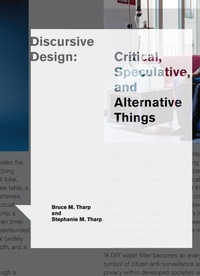
Discursive Design
Critical, Speculative, and Alternative Things
Published on 22. November 2022
Book
Paperback/Softback
640 pages
978-0-262-54655-3 (ISBN)
Description
Exploring how design can be used for good-prompting self-reflection, igniting the imagination, and affecting positive social change.
Good design provides solutions to problems. It improves our buildings, medical equipment, clothing, and kitchen utensils, among other objects. But what if design could also improve societal problems by prompting positive ideological change? In this book, Bruce and Stephanie Tharp survey recent critical design practices and propose a new, more inclusive field of socially minded practice: discursive design. While many consider good design to be unobtrusive, intuitive, invisible, and undemanding intellectually, discursive design instead targets the intellect, prompting self-reflection and igniting the imagination. Discursive design (derived from "discourse") expands the boundaries of how we can use design-how objects are, in effect, good(s) for thinking.
Discursive Design invites us to see objects in a new light, to understand more than their basic form and utility. Beyond the different foci of critical design, speculative design, design fiction, interrogative design, and adversarial design, Bruce and Stephanie Tharp establish a more comprehensive, unifying vision as well as innovative methods. They not only offer social criticism but also explore how objects can, for example, be used by counselors in therapy sessions, by town councils to facilitate a pre-vote discussions, by activists seeking engagement, and by institutions and industry to better understand the values, beliefs, and attitudes of those whom they serve. Discursive design sparks new ways of thinking, and it is only through new thinking that our sociocultural futures can change.
Good design provides solutions to problems. It improves our buildings, medical equipment, clothing, and kitchen utensils, among other objects. But what if design could also improve societal problems by prompting positive ideological change? In this book, Bruce and Stephanie Tharp survey recent critical design practices and propose a new, more inclusive field of socially minded practice: discursive design. While many consider good design to be unobtrusive, intuitive, invisible, and undemanding intellectually, discursive design instead targets the intellect, prompting self-reflection and igniting the imagination. Discursive design (derived from "discourse") expands the boundaries of how we can use design-how objects are, in effect, good(s) for thinking.
Discursive Design invites us to see objects in a new light, to understand more than their basic form and utility. Beyond the different foci of critical design, speculative design, design fiction, interrogative design, and adversarial design, Bruce and Stephanie Tharp establish a more comprehensive, unifying vision as well as innovative methods. They not only offer social criticism but also explore how objects can, for example, be used by counselors in therapy sessions, by town councils to facilitate a pre-vote discussions, by activists seeking engagement, and by institutions and industry to better understand the values, beliefs, and attitudes of those whom they serve. Discursive design sparks new ways of thinking, and it is only through new thinking that our sociocultural futures can change.
More details
Series
Language
English
Place of publication
Cambridge (Massachusetts)
United States
Publishing group
MIT Press Ltd
Target group
Interest Age: From 18 years
Dimensions
Height: 245 mm
Width: 177 mm
Thickness: 29 mm
Weight
1264 gr
ISBN-13
978-0-262-54655-3 (9780262546553)
Copyright in bibliographic data and cover images is held by Nielsen Book Services Limited or by the publishers or by their respective licensors: all rights reserved.
Schweitzer Classification
Other editions
Additional editions
E-Book
02/2019
MIT Press
€48.99
Available for download
Persons
Bruce Tharp runs the Chicago-based design studio Materious, established in 2005, with Stephanie Tharp. They have done work for such companies as Ligne Roset, Moeet-Hennessy, The Art Institute of Chicago, Crate & Barrel, and Kikkerland. He is Associate Professor in the Penny W. Stamps School of Art & Design at the University of Michigan.
Stephanie Tharp runs the Chicago-based design studio Materious, established in 2005, with Bruce Tharp. They have done work for such companies as Ligne Roset, Moeet-Hennessy, The Art Institute of Chicago, Crate & Barrel, and Kikkerland. She is Associate Professor in the Penny W. Stamps School of Art & Design at the University of Michigan.
Stephanie Tharp runs the Chicago-based design studio Materious, established in 2005, with Bruce Tharp. They have done work for such companies as Ligne Roset, Moeet-Hennessy, The Art Institute of Chicago, Crate & Barrel, and Kikkerland. She is Associate Professor in the Penny W. Stamps School of Art & Design at the University of Michigan.
Content
Series Foreword viii
Acknowledgments xii
Part I: Discursive Design: In Theory
Introduction
Background
Foundation
Theorizing Practice
Conclusion
Part II: Discursive Design: In Practice
Introduction
Discursive Designing: Nine Facets
Case Studies
Glossary 545
Interviewees and Interlocutors 557
Image Credits 561
Bibliography 581
Index 603
Acknowledgments xii
Part I: Discursive Design: In Theory
Introduction
Background
Foundation
Theorizing Practice
Conclusion
Part II: Discursive Design: In Practice
Introduction
Discursive Designing: Nine Facets
Case Studies
Glossary 545
Interviewees and Interlocutors 557
Image Credits 561
Bibliography 581
Index 603