

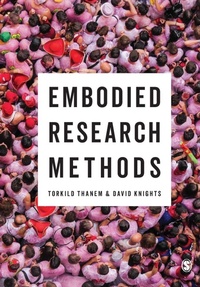
Embodied Research Methods
1st Edition
Published on 22. April 2019
Book
Paperback/Softback
184 pages
978-1-4739-0441-5 (ISBN)
Description
Disembodied research erects false dichotomies between flesh and reason, and between the corporeal and the social. By contrast, Torkild Thanem and David Knights engage with approaches and practices that exploit the body's capacity to generate knowledge, craft lively accounts, and create fleshy concepts. These approaches enrich our understanding of how people live, work, and interact with their bodies within the social world.
Thanem and Knights discuss methods, practices, and personal experiences which involve bodies in the research process - in generating and analysing empirical material, reflecting on the work they do as researchers, and turning research into written text.
Embodied Research Methods is an important and practical resource for undergraduate and postgraduate students across the social sciences, and a thought-provoking read for researchers in these areas.
Thanem and Knights discuss methods, practices, and personal experiences which involve bodies in the research process - in generating and analysing empirical material, reflecting on the work they do as researchers, and turning research into written text.
Embodied Research Methods is an important and practical resource for undergraduate and postgraduate students across the social sciences, and a thought-provoking read for researchers in these areas.
Reviews / Votes
This book will not only provoke its readers to think differently about embodiment.It will also get them to change the way they carry out their social investigations. -- Loic Wacquant This book is a pleasant experience for scientists who want to put feeling in their research [translated from dutch] -- Jillis Kors * Amsterdam University Press *
More details
Edition
First Edition
Language
English
Place of publication
London
United Kingdom
Target group
College/higher education
Dimensions
Height: 244 mm
Width: 170 mm
Thickness: 12 mm
Weight
359 gr
ISBN-13
978-1-4739-0441-5 (9781473904415)
Copyright in bibliographic data and cover images is held by Nielsen Book Services Limited or by the publishers or by their respective licensors: all rights reserved.
Schweitzer Classification
Other editions
Additional editions
Torkild Thanem | David Knights
Embodied Research Methods
Book
04/2019
1st Edition
SAGE Publications Ltd
€160.80
Shipment within 15-20 days
Torkild Thanem | David Knights
Embodied Research Methods
E-Book
04/2019
1st Edition
SAGE Publications Ltd
€78.49
Available for download
Persons
David Knights is Professor in the Department of Organization, Work and Technology at the Lancaster University Management School, UK. His recent empirical research has been on academics and veterinary surgeons and his theoretical interests are lie in the field of the body and ethics, gender and diversity, identity and power, and management and leadership. He recently co-edited a book: Mabey C and D. Knights, Leadership Matters?: Finding Voice, Connection and Meaning in the 21st Century, (New York: Routledge, 2017). He was a co-founder and co-editor of Gender, Work and Organization from 1994-2016.
Content
TABLE OF CONTENTS
Prelims
Introduction: The embodied turn in social science research
Chapter 1. Disembodied methodology
Chapter 2. Embodied methodology
Chapter 3. Initiating an embodied research process
Chapter 4. Embodied immersion and ethnographic fieldwork
Chapter 5. Embodying interviews and conversations
Chapter 6. Recording and documenting embodied lives
Chapter 7. Embodied analysis and interpretation
Chapter 8. Embodied writing and dissemination
Chapter 9. Truth and politics in embodied research
Conclusion: Embodied imagination in future research
Notes
References
Index
Prelims
Introduction: The embodied turn in social science research
Chapter 1. Disembodied methodology
Chapter 2. Embodied methodology
Chapter 3. Initiating an embodied research process
Chapter 4. Embodied immersion and ethnographic fieldwork
Chapter 5. Embodying interviews and conversations
Chapter 6. Recording and documenting embodied lives
Chapter 7. Embodied analysis and interpretation
Chapter 8. Embodied writing and dissemination
Chapter 9. Truth and politics in embodied research
Conclusion: Embodied imagination in future research
Notes
References
Index