

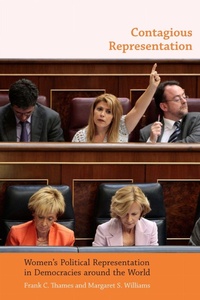
Contagious Representation
Women's Political Representation in Democracies Around the World
Published on 21. January 2013
Book
Hardback
208 pages
978-0-8147-8417-4 (ISBN)
Description
Women's participation in parliaments, high courts, and executive
offices worldwide has reached record high numbers, but this
global increase in women's representation masks significant variation
among different democratic political systems. For example, in
December of 2009, Rwanda's legislature contained 56% women,
while the U.S. Congress contained only about 17% and the Japanese
Diet had only 11%. Since 2000, only twenty-seven women
have achieved executive office worldwide. Contagious Representation
is a comprehensive look at women's participation in all aspects
of public life in the main democratic political institutions-the executive,
the judiciary, the legislature, and within political parties.
Moving beyond studies of single countries and institutions, Contagious
Representation presents original data from 159 democratic
countries spanning 50 years, providing a comprehensive understanding
of women in democracies worldwide. The first volume to
offer an analysis on all avenues for women's participation for such
a lengthy time period, Contagious Representation examines not
only the causes of women's representation in the main democratic
political institutions but also how women's representation in one
institution affects the others. Each chapter contains case studies
and examples of the change in women's participation over time
from around the world. Thames and Williams definitively explain
the rise, decline, or stagnant levels of women's political participation,
considering how representation is contagious across political
institutions and gaining a better understanding of what factors affect
women's political participation.
offices worldwide has reached record high numbers, but this
global increase in women's representation masks significant variation
among different democratic political systems. For example, in
December of 2009, Rwanda's legislature contained 56% women,
while the U.S. Congress contained only about 17% and the Japanese
Diet had only 11%. Since 2000, only twenty-seven women
have achieved executive office worldwide. Contagious Representation
is a comprehensive look at women's participation in all aspects
of public life in the main democratic political institutions-the executive,
the judiciary, the legislature, and within political parties.
Moving beyond studies of single countries and institutions, Contagious
Representation presents original data from 159 democratic
countries spanning 50 years, providing a comprehensive understanding
of women in democracies worldwide. The first volume to
offer an analysis on all avenues for women's participation for such
a lengthy time period, Contagious Representation examines not
only the causes of women's representation in the main democratic
political institutions but also how women's representation in one
institution affects the others. Each chapter contains case studies
and examples of the change in women's participation over time
from around the world. Thames and Williams definitively explain
the rise, decline, or stagnant levels of women's political participation,
considering how representation is contagious across political
institutions and gaining a better understanding of what factors affect
women's political participation.
Reviews / Votes
"Frank Thames and Margaret Williams concept of contagion and their careful analysis of how womens participation and gains in one institution affect their opportunities in other areas of government pushes the scholarship on women and politics forward.They draw on a broad array of empirical evidence including both large n statistical analysis and case studies drawn from around the world to support their argument. By advancing our understanding of how inter-institutional relationships affect opportunities for womens political participation, this book makes important contributions to the women and gender studies literature. Clearly written, the book is accessible to a wide audience." - Melinda Adams,Associate Professor of Political Science, James Madison University "This is a very accessible book that provides rigorous qualitative and quantitative research methods and a theory that can be tested in other areas such as business. Highly recommended for scholars of gender and political representation and a valuable text for women's studies, research methods, and political science students. Summing Up: Highly recommended." - I. Coronado (Choice) "Using the novel idea of contagion, this pathbreaking book is indispensable for those of us who struggle to account for the variations in womens representation in diverse political institutions, regions and across time. Its a must for women and politics courses." - Marianne Githens,Professor of Women, Gender, and Sexuality Studies, Goucher CollegeMore details
Language
English
Place of publication
New York
United States
Target group
Professional and scholarly
Product notice
With printed dust jacket
Dimensions
Height: 229 mm
Width: 152 mm
Thickness: 14 mm
Weight
435 gr
ISBN-13
978-0-8147-8417-4 (9780814784174)
Copyright in bibliographic data and cover images is held by Nielsen Book Services Limited or by the publishers or by their respective licensors: all rights reserved.
Schweitzer Classification
Other editions
Additional editions

Frank C. Thames | Margaret S. Williams
Contagious Representation
Women's Political Representation in Democracies Around the World
E-Book
01/2013
1st Edition
New York University Press
€142.99
Available for download
Persons
Frank C. Thames is Associate Professor in the Department of Political Science at Texas Tech University.
Margaret S. Williams is Senior Research Associate at the Federal Judicial Center in Washington, DC.
Margaret S. Williams is Senior Research Associate at the Federal Judicial Center in Washington, DC.
Content
1 Women's Political Participation and the Influence of Contagion2 Understanding Women's Legislative Representation3 Women and the Executive4 Gender and Cross-National Courts5 Contagion and the Adoption of Voluntary Party Quotas6 Contagion and the Adoption of National Quotas7 Conclusion: Why Contagion Matters