

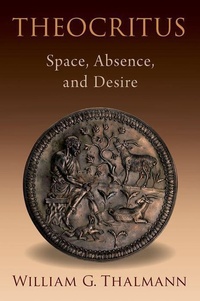
Theocritus
Space, Absence, and Desire
Published on 14. March 2023
Book
Hardback
256 pages
978-0-19-763655-8 (ISBN)
Description
Theocritus: Space, Absence, and Desire discusses many of Theocritus's Idylls with emphasis on how these poems construct space--its contours and borders, along with the people, animals, and objects that fill it--and the equally important role of absence. Drawing on spatial theory from anthropology and cultural geography, author William G. Thalmann studies each poem in itself and in its connections with other poems, so that a loose coherence emerges among them. Spatially, the Ptolemaic empire provides a setting and reference point for the various types of Idylls (bucolic, urban, mythological, and encomiastic poems), in ways that help legitimate it. In all the idylls, however, space is constructed selectively from particular perspectives, so that it reflects and shapes people's relations with each other and humans' relations with nature. The bucolic Idylls in particular raise questions about being in and out of place and relations between self and other that would have been important under the conditions of mobility and intercultural contact in the early Hellenistic period. Yet theirs is a fictional world, defined more by its margins than by its center, and visions of fullness and presence of nature are always distanced from the reader. Absence is constitutive of this world, just as absence of the beloved is the precondition for the desire of bucolic characters and prompts their singing. Their desire mirrors the desire of readers for the absent bucolic world that the poems arouse and that keeps them reading.
Reviews / Votes
Thalmann offers a brilliant reading of the Theocritean corpus through the lens of space and location. Treating both realistic subjects under Ptolemaic rule and imaginary characters dwelling in bucolic space, Thalmann focuses on the dynamic of absence and desire as Theocritus' overarching theme. A pleasure to read! * Kathryn Gutzwiller, University of Cincinnati * This is a nuanced discussion of Theocritean bucolic space: how it differs from urban, agricultural, marine, and mythological realms, and the ways in which boundary dynamics inform the texts of the received corpus. A fitting successor to his work on the Argonautica. * Susan Stephens, Stanford University * Altogether this book is a delight; Thalmann effectively uses the idea of imaginative spaces to illuminate Theocritus' creation of his bucolic world while keeping the focus on the poetry, not the theory. At the same time, he engages contemporary concerns in Hellenistic poetry: the poetry book, engagement with contemporary politics, particularly the Ptolemaic Empire and Alexandrian self-consciousness. * Classical Journal-Online * Both scholarly and accessible, the study fills a need for a current book-length treatment of Theocritus and contributes to important themes in Hellenistic poetry more broadly. * Choice * [Thalmann] has authored an elegant and sensitive study that repays close engagement. It is a necessary read for anyone seriously interested in the study of Theocritus. * Classical Review * This book surveys the vast majority of Theocritus' bucolic and erotic poems and will deservedly become the definitive work on the varieties of spaces depicted in Theocritus' poetry. * Bryn Mawr Classical Review * This book surveys the vast majority of Theocritus' bucolic and erotic poems and will deservedly become the definitive work on the varieties of spaces depicted in Theocritus' poetry, in particular the "space of absence" of the absent beloved. * Marco Fantuzzi, Bryn Mawr Classical Review * Can humans ever truly fit into nature? This is one of the central questions asked by William G. Thalmann in his book Theocritus: Space, Absence, and Desire. The book treats the Theocritean corpus as a multifaceted whole, covering a range of fictional spaces (from the bucolic to the urban, the mythological to the encomiastic), all coloured by the overarching contextual space of the Ptolemaic empire. But the bucolic Idylls take on particular importance as they raise the question of the relationship of human culture to nature. * Greece & Rome *More details
Language
English
Place of publication
New York
United States
Target group
Professional and scholarly
Product notice
sewn/stitched
Cloth over boards
Dimensions
Height: 237 mm
Width: 163 mm
Thickness: 21 mm
Weight
526 gr
ISBN-13
978-0-19-763655-8 (9780197636558)
Copyright in bibliographic data and cover images is held by Nielsen Book Services Limited or by the publishers or by their respective licensors: all rights reserved.
Schweitzer Classification
Other editions
Additional editions
E-Book
01/2023
OUP eBook
€38.49
Available for download
E-Book
01/2023
OUP eBook
€38.49
Available for download
Person
William G. Thalmann has taught at Yale University, Hobart and William Smith Colleges, and the University of Southern California, where he is now Professor Emeritus of Classics and Comparative Literature. He is the author of five previous books on Greek poetry and a number of articles on ancient literature and ancient slavery.
Content
Preface
Introduction
Note on Text and Transliteration
Chapter 1: Theocritean Spaces 1: The Bucolic and Urban Poems
Chapter 2: Theocritean Spaces 2: Mythological and Encomiastic Space
Chapter 3: The Poetics of Absence
Chapter 4: On the Margins of Bucolic
Chapter 5: Conclusion
References
Indexes
Introduction
Note on Text and Transliteration
Chapter 1: Theocritean Spaces 1: The Bucolic and Urban Poems
Chapter 2: Theocritean Spaces 2: Mythological and Encomiastic Space
Chapter 3: The Poetics of Absence
Chapter 4: On the Margins of Bucolic
Chapter 5: Conclusion
References
Indexes