

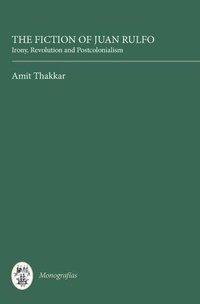
The Fiction of Juan Rulfo
Irony, Revolution and Postcolonialism
Published on 15. April 2012
Book
Hardback
190 pages
978-1-85566-238-4 (ISBN)
Description
This is the first extended, English-language study to focus exclusively on the fiction of Juan Rulfo in over twenty years, analyzing a selection of short stories from Rulfo's collection and also two of the main characters of hismasterpiece, Pedro Paramo.
This is the first extended, English-language study to focus exclusively on the fiction of Juan Rulfo in over twenty years. It contains innovative analyses of a selection of short stories from Rulfo's collection, El llano en llamas (1953). It also examines in great depth two of the main characters of Pedro Paramo (1955), Rulfo's masterpiece and only novel.
The book shows how Rulfo's works can be read as exercises in irony directed againstthe rhetoric of post-Revolutionary Mexican governments. It also demonstrates the relevance of certain legacies of colony in Rulfo's use of irony. Successive Mexican governments promoted a vision of post-Revolutionary society founded on specific notions of ethnicity, family, nation, education, religion and rural politics. The author combines examination of the speeches, images and newspaper articles which disseminated this vision with incisive literary analyses of Rulfo's work. These analyses are informed both by his original theory of irony, based on "internal" and "external" referents, and by existing postcolonial theories, particularly those of Homi K. Bhabha.
Amit Thakkar is a Lecturer in Hispanic Studies at Lancaster University.
This is the first extended, English-language study to focus exclusively on the fiction of Juan Rulfo in over twenty years. It contains innovative analyses of a selection of short stories from Rulfo's collection, El llano en llamas (1953). It also examines in great depth two of the main characters of Pedro Paramo (1955), Rulfo's masterpiece and only novel.
The book shows how Rulfo's works can be read as exercises in irony directed againstthe rhetoric of post-Revolutionary Mexican governments. It also demonstrates the relevance of certain legacies of colony in Rulfo's use of irony. Successive Mexican governments promoted a vision of post-Revolutionary society founded on specific notions of ethnicity, family, nation, education, religion and rural politics. The author combines examination of the speeches, images and newspaper articles which disseminated this vision with incisive literary analyses of Rulfo's work. These analyses are informed both by his original theory of irony, based on "internal" and "external" referents, and by existing postcolonial theories, particularly those of Homi K. Bhabha.
Amit Thakkar is a Lecturer in Hispanic Studies at Lancaster University.
Reviews / Votes
The reader is captivated by Thakkar's exercise of close reading and his penetrating analysis of Rulfo's work against the discourse of the post-Revolutionary state in speeches, newspaper articles, essays and murals. Read against this background, Rulfo's words acquire an additional weight ... Thakkar's remarkable insight and scholarship render this book essential reading for anyone interested in deepening their understanding of Rulfo's works. * MODERN LANGUAGE REVIEW * This book is a very welcome addition to the existing body of criticism on Rulfo and an important reminder that 'literary, symbolic, universal' and 'non-literary, regional, context specific' readings are not mutually exclusive. * BULLETIN OF SPANISH STUDIES *More details
Series
Language
English
Place of publication
Woodbridge
United Kingdom
Publishing group
Boydell & Brewer Ltd
Target group
College/higher education
Product notice
Cloth over boards
Dimensions
Height: 241 mm
Width: 160 mm
Thickness: 18 mm
Weight
522 gr
ISBN-13
978-1-85566-238-4 (9781855662384)
Copyright in bibliographic data and cover images is held by Nielsen Book Services Limited or by the publishers or by their respective licensors: all rights reserved.
Schweitzer Classification
Other editions
Additional editions
E-Book
04/2012
1st Edition
De Gruyter
€48.99
Available for download
Person
Amit Thakkar
Content
Acknowledgements
Introduction
Juan Rulfo and Fictional Irony
Centripetal Irony in 'Nos han dado la tierra' and 'El dia del derrumbe'
Centrifugal Irony and 'La Unidad Nacional'
Ambivalence and the Crisis of the Mimic Man: Irony and Context in 'Luvina'
The Priest of Pedro Paramo:Fetishistic Stereotyping and Positive Iconography
Pedro Paramo: Irony and Caciquismo
Conclusion
Bibliography
Introduction
Juan Rulfo and Fictional Irony
Centripetal Irony in 'Nos han dado la tierra' and 'El dia del derrumbe'
Centrifugal Irony and 'La Unidad Nacional'
Ambivalence and the Crisis of the Mimic Man: Irony and Context in 'Luvina'
The Priest of Pedro Paramo:Fetishistic Stereotyping and Positive Iconography
Pedro Paramo: Irony and Caciquismo
Conclusion
Bibliography