

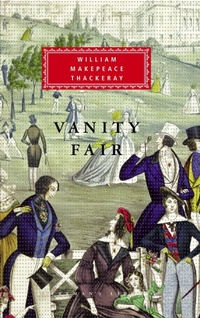
Vanity Fair
Description
A panoramic satire of English society during the Napoleonic Wars, Vanity Fair is William Makepeace Thackeray's masterpiece. At its center is one of the most unforgettable characters in nineteenth-century literature: the enthralling Becky Sharp, a charmingly ruthless social climber who is determined to leave behind her humble origins, no matter the cost. Her more gentle friend Amelia, by contrast, only cares for Captain George Osborne, despite his selfishness and her family's disapproval. As both women move within the flamboyant milieu of Regency England, the political turmoil of the era is matched by the scheming Becky's sensational rise-and its unforeseen aftermath.
Based in part upon Thackeray's own love for the wife of a friend, Vanity Fair portrays the hypocrisy and corruption of high society and the dangers of unrestrained ambition with epic brilliance and scathing wit. With an introduction by Catherine Peters.
More details
Other editions
Additional editions
Persons
Thackeray's earliest literary success, The Yellowplush Correspondence, a group of satiric sketches written in the guise of a cockney footman's memoirs, was serialized in Fraser's Magazine beginning in 1837. Catherine (serialized 1839-40; published 1869), his first novel, parodied the crime stories popular in Victorian England. Under the name Michael Angelo Titmarsh, the most famous of his many pseudonyms, Thackeray turned out The Paris Sketch Book (1840) and The Irish Sketch-Book (1843), two popular volumes of travel writing. The Luck of Barry Lyndon (1844), which chronicles the adventures of an Irish knave in eighteenth-century England, marked his first serious attack on social pretension. In The Book of Snobs (1848), a collection of satiric portraits originally published in Punch magazine (1846-47), he lampooned the avarice and snobbery occasioned by the Industrial Revolution.
Vanity Fair, Thackeray's resplendent social satire exposing the greed and corruption raging in England during the turmoil of the Napoleonic wars, brought him immediate acclaim when it appeared in Punch beginning in 1847. "The more I read Thackeray's works," wrote Charlotte Bronte, "the more certain I am that he stands alone-alone in his sagacity, alone in his truth, alone in his feeling (his feeling, though he makes no noise about it, is about the most genuine that ever lived on a printed page), alone in his power, alone in his simplicity, alone in his self-control. Thackeray is a Titan. . . . I regard him as the first of modern masters."