

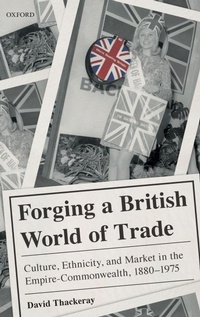
Forging a British World of Trade
Culture, Ethnicity, and Market in the Empire-Commonwealth, 1880-1975
Published on 18. February 2019
Book
Hardback
248 pages
978-0-19-881671-3 (ISBN)
Description
Brexit is likely to lead to the largest shift in Britain's economic orientation in living memory. Some have argued that leaving the EU will enable Britain to revive markets in Commonwealth countries with which it has long-standing historical ties. Their opponents maintain that such claims are based on forms of imperial nostalgia which ignore the often uncomfortable historical trade relations between Britain and these countries, as well as the UK's historical role as a global, rather than chiefly imperial, economy.
Forging a British World of Trade explores how efforts to promote a 'British World' system, centred on promoting trade between Britain and the Dominions, grew and declined in influence between the 1880s and 1970s. At the beginning of the twentieth century many people from London, to Sydney, Auckland, and Toronto considered themselves to belong to culturally British nations. British politicians and business leaders invested significant resources in promoting trade with Australia, Canada, New Zealand, and South Africa out of a perception that these were great markets of the future.
However, ideas about promoting trade between 'British' peoples were racially exclusive. From the 1920s onwards, colonized and decolonizing populations questioned and challenged the basis of British World networks, making use of alternative forms of international collaboration promoted firstly by the League of Nations, and then by the United Nations. Schemes for imperial collaboration amongst ethnically 'British' peoples were hollowed out by the actions of a variety of political and business leaders across Asia and Africa who reshaped the functions and identity of the Commonwealth.
Forging a British World of Trade explores how efforts to promote a 'British World' system, centred on promoting trade between Britain and the Dominions, grew and declined in influence between the 1880s and 1970s. At the beginning of the twentieth century many people from London, to Sydney, Auckland, and Toronto considered themselves to belong to culturally British nations. British politicians and business leaders invested significant resources in promoting trade with Australia, Canada, New Zealand, and South Africa out of a perception that these were great markets of the future.
However, ideas about promoting trade between 'British' peoples were racially exclusive. From the 1920s onwards, colonized and decolonizing populations questioned and challenged the basis of British World networks, making use of alternative forms of international collaboration promoted firstly by the League of Nations, and then by the United Nations. Schemes for imperial collaboration amongst ethnically 'British' peoples were hollowed out by the actions of a variety of political and business leaders across Asia and Africa who reshaped the functions and identity of the Commonwealth.
Reviews / Votes
David Thackeray has written an authoritative and compelling account of the emergence, growth, and decline of the "British World"; that is, the networks of trade and communication between the United Kingdom, Australia, Canada, New Zealand, and South Africa, between the late nineteenth century and the 1970s. * David M. Higgins, Journal of British Studies *More details
Language
English
Place of publication
Oxford
United Kingdom
Target group
Professional and scholarly
Illustrations
24 black and white figures/illustrations
Dimensions
Height: 240 mm
Width: 161 mm
Thickness: 18 mm
Weight
552 gr
ISBN-13
978-0-19-881671-3 (9780198816713)
Copyright in bibliographic data and cover images is held by Nielsen Book Services Limited or by the publishers or by their respective licensors: all rights reserved.
Schweitzer Classification
Other editions
Additional editions
David Thackeray
Forging a British World of Trade
Culture, Ethnicity, and Market in the Empire-Commonwealth, 1880-1975
E-Book
01/2019
1st Edition
OUP eBook
€62.99
Available for download
David Thackeray
Forging a British World of Trade
Culture, Ethnicity, and Market in the Empire-Commonwealth, 1880-1975
E-Book
01/2019
1st Edition
OUP eBook
€62.99
Available for download
Person
David Thackeray's work has explored the political culture of modern Britain and its involvement in trade networks. Having undertaken his PhD at Cambridge he is a Senior Lecturer at the University of Exeter. With Andrew Thompson and Richard Toye, he has edited Imagining Britain's Economic Future, c.1800-1975: Trade, Consumerism, and Global Markets (2018).
Content
Introduction- Locating the British World
1: The Importance of Being British: Networks and the Politics of Imperial Trade, c.1880-1914
2: Between Geneva and Ottawa: The Empire-Commonwealth and the Emerging International System, 1915-1939
3: Buying for Britain, China or India?: Forging Trade Communities During the Great Depression
4: 'What Are We Doing to Earn Dollars?': The Old and New Commonwealths in an Era of Internationalism and Decolonization, 1940-60
5: We're All Backing Britain?: Patriotic Trade and the Decline of the British World
6: Selling Washing Machines in Duesseldorf: The Disintegration of the British World of Trade, c.1961-1975
1: The Importance of Being British: Networks and the Politics of Imperial Trade, c.1880-1914
2: Between Geneva and Ottawa: The Empire-Commonwealth and the Emerging International System, 1915-1939
3: Buying for Britain, China or India?: Forging Trade Communities During the Great Depression
4: 'What Are We Doing to Earn Dollars?': The Old and New Commonwealths in an Era of Internationalism and Decolonization, 1940-60
5: We're All Backing Britain?: Patriotic Trade and the Decline of the British World
6: Selling Washing Machines in Duesseldorf: The Disintegration of the British World of Trade, c.1961-1975