

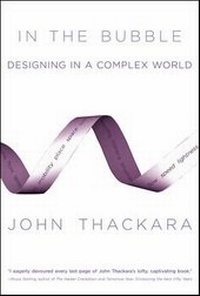
In the Bubble
Designing in a Complex World
Published on 25. March 2005
Book
Hardback
336 pages
978-0-262-20157-5 (ISBN)
Description
We're filling up the world with technology and devices, but we've lost
sight of an important question: What is this stuff for? What value does it add to
our lives? So asks author John Thackara in his new book, In the Bubble:
Designing for a Complex World. These are tough questions for the pushers
of technology to answer. Our economic system is centered on technology, so it would
be no small matter if "tech" ceased to be an end-in-itself in our daily lives.
Technology is not going to go away, but the time to discuss the end it will serve is
before we deploy it, not after. We need to ask what purpose will be served by the
broadband communications, smart materials, wearable computing, and connected
appliances that we're unleashing upon the world. We need to ask what impact all this
stuff will have on our daily lives. Who will look after it, and
how?
In the Bubble is about a world based less
on stuff and more on people. Thackara describes a transformation that is taking
place now -- not in a remote science fiction future; it's not about, as he puts it,
"the schlock of the new" but about radical innovation already emerging in daily
life. We are regaining respect for what people can do that technology can't.
In the Bubble describes services designed to help people carry
out daily activities in new ways. Many of these services involve technology --
ranging from body implants to wide-bodied jets. But objects and systems play a
supporting role in a people-centered world. The design focus is on services, not
things. And new principles -- above all, lightness -- inform the way these services
are designed and used. At the heart of In the Bubble is a belief,
informed by a wealth of real-world examples, that ethics and responsibility can
inform design decisions without impeding social and technical innovation.
sight of an important question: What is this stuff for? What value does it add to
our lives? So asks author John Thackara in his new book, In the Bubble:
Designing for a Complex World. These are tough questions for the pushers
of technology to answer. Our economic system is centered on technology, so it would
be no small matter if "tech" ceased to be an end-in-itself in our daily lives.
Technology is not going to go away, but the time to discuss the end it will serve is
before we deploy it, not after. We need to ask what purpose will be served by the
broadband communications, smart materials, wearable computing, and connected
appliances that we're unleashing upon the world. We need to ask what impact all this
stuff will have on our daily lives. Who will look after it, and
how?
In the Bubble is about a world based less
on stuff and more on people. Thackara describes a transformation that is taking
place now -- not in a remote science fiction future; it's not about, as he puts it,
"the schlock of the new" but about radical innovation already emerging in daily
life. We are regaining respect for what people can do that technology can't.
In the Bubble describes services designed to help people carry
out daily activities in new ways. Many of these services involve technology --
ranging from body implants to wide-bodied jets. But objects and systems play a
supporting role in a people-centered world. The design focus is on services, not
things. And new principles -- above all, lightness -- inform the way these services
are designed and used. At the heart of In the Bubble is a belief,
informed by a wealth of real-world examples, that ethics and responsibility can
inform design decisions without impeding social and technical innovation.
More details
Language
English
Place of publication
Cambridge, Mass.
United States
Publishing group
MIT Press Ltd
Target group
Professional and scholarly
Interest Age: From 18 years
Illustrations
Illustrations
Dimensions
Height: 229 mm
Width: 152 mm
Thickness: 0 mm
Weight
454 gr
ISBN-13
978-0-262-20157-5 (9780262201575)
Copyright in bibliographic data and cover images is held by Nielsen Book Services Limited or by the publishers or by their respective licensors: all rights reserved.
Schweitzer Classification
Other editions
Additional editions
E-Book
02/2006
MIT Press
€33.99
Available for download
Person
John Thackara, described as a "design guru, critic and business
provocateur" by Fast Company, is the Director of Doors of
Perception, a design futures network based in Amsterdam and Bangalore. He is the
author of Design after Modernism, Lost in Space: A
Traveler's Tale, Winners! How Successful Companies Innovate by
Design, and other books. Since 2002, he has authored the Doors of
Perception blog and newsletter (http://www.doorsofperception.com/).
provocateur" by Fast Company, is the Director of Doors of
Perception, a design futures network based in Amsterdam and Bangalore. He is the
author of Design after Modernism, Lost in Space: A
Traveler's Tale, Winners! How Successful Companies Innovate by
Design, and other books. Since 2002, he has authored the Doors of
Perception blog and newsletter (http://www.doorsofperception.com/).