

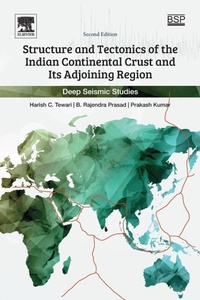
Structure and Tectonics of the Indian Continental Crust and Its Adjoining Region
Deep Seismic Studies
2nd Edition
Published on 10. February 2018
Book
Paperback/Softback
266 pages
978-0-12-813685-0 (ISBN)
Description
Structure and Tectonics of the Indian Continental Crust and Its Adjoining Region: Deep Seismic Studies, Second Edition, collates essential data from seismic studies of Earth's crust across India, offering an essential understanding of the tectonic development of the Indian subcontinent. Seismic studies have been carried out in various parts of India since 1972, recording crust-related seismic data for determination of velocity-depth configuration and determination of structural patterns. The book examines the details of these studies, including their synthesis and global applications. The book presents both background and applications in one cohesive volume for researchers and students of geophysics and geology.
More details
Edition
2nd edition
Language
English
Place of publication
United States
Target group
Professional and scholarly
Researchers and students in geophysics, seismology, tectonics, and geology
Product notice
Paperback (trade)
Dimensions
Height: 229 mm
Width: 152 mm
Thickness: 14 mm
Weight
362 gr
ISBN-13
978-0-12-813685-0 (9780128136850)
Copyright in bibliographic data and cover images is held by Nielsen Book Services Limited or by the publishers or by their respective licensors: all rights reserved.
Schweitzer Classification
Other editions
Additional editions
Harish C. Tewari | B. Rajendra Prasad | Prakash Kumar
Structure and Tectonics of the Indian Continental Crust and Its Adjoining Region
Deep Seismic Studies
E-Book
02/2018
2nd Edition
Elsevier
€128.00
Available for download
Persons
Dr. Harish C. Tewari did his M.Sc. in Physics from the Agra University and Ph.D. from the ISM, Dhanbad. He worked in the Oil & Natural Gas Corporation, India during 1965-72 and joined National Geophysical Research Institute, Hyderabad in 1973. His field of interest for the next 35 years has been crustal seismic studies in India. He retired from the NGRI in 2003 and continued as Emeritus Scientist till 2007. He then joined as Vice President, Seismic studies, with a Hydrocarbon exploration firm for an year in 2008. He was awarded National Mineral Award of Government of India for excellence in Geophysics in the year 1999 and L N Kailasam gold medal by the Indian Geophysical Union in the year 2011. He has published more than 65 research papers in various peer reviewed national and international scientific journals and presented several papers in seminars/symposiums, chairing several technical sessions. He was also a reviewer of the research papers for journals like Tectonophysics, geophysical J. Int., Jour. Of Geological Society, India and several others. He was a member of the Dept. of Science and Technology, Government of India committee on Monitoring and Evaluation of Deep Continental studies in India for 4 year period from 2000-2004. Several students received their Ph.D. under his guidance. He has visited USA and several countries in Europe and Asia under exchange programs and presentation of scientific papers. Dr. B.Rajendra Prasad did his M.Sc.(Tech) and Ph.D. in Geophysics from the Centre of Exploration Geophysics, Osmania University, Hyderabad, India. He joined the NGRI in 1974 continued to serve it till his superannuation in 2009. He specialized in deep seismic reflection, refraction data Acquisition, Processing and Interpretation. He has published over 60 research papers in national and international peer reviewed journals. He is currently working as an Emeritus Scientist at National Geophysical Research Institute, Hyderabad. He is a guest professor at Osmania University, University of Hyderabad and BARC-AMD training school, Hyderabad. He joined the NGRI in 1974 and served it for over three decades. His broad areas of research interest include Controlled Source Seismology, Deep Seismic Reflection Refraction /Wide Angle Reflection, Integrated Geotransect studies and Lithospheric studies. He also specialized using Integrated approach using seismic reflection refraction, MTS and gravity studies geophysical studies for hydrocarbon exploration. He visited United States, Canada, France, Italy, Singapore and other several other countries to present scientific papers or for participating in training programs. He is an elected fellow of AP Academy of Sciences-2003. He is an elected Fellow of Indian Geophysical Union and Life member of Association of Exploration Geophysicists, Society of Petroleum Geophysicists, Indian Geological Congress, and Indian Society of Earthquake Research. He is a member of Society of Exploration Geophysicists (USA) and Asia Oceanic Geoscientific Society, Singapore. He won the prestigious Decennial Award of IGU in 2007. He acted as reviewer for Journal of the Geological society of India and Current Science etc. He is a co-author of several chapters in many other books. Dr. Prakash Kumar is Principal Scientist in CSIR's Seismological Division. He did his M.Sc.(Tech) and Indian School of Mines, and received his Ph.D. in Geophysics from Osmania University. He has previously held positions as a Visiting Researcher at GFZ in Germany and the Earthquake Research Institute at the University of Tokyo. His research interests include theoretical and computational seismology, seismological tools to explore deep Earth, and earthquake source dynamics. He has been the recipient of the Krishnan Medal from the Indian Geophysical Union, the National Geoscience Award from the Ministry of Mines, and most recently the Anni Talwani Memorial Prize in 2016 from the Indian Geophysical Union.
Content
1. Earth's Structure2. Indian Peninsular Shield3. The Aravalli-Delhi Fold Belt4. East Coast Sedimentary Basins of India5. Deccan Volcanic Province near the West Coast6. Central Indian Region7. Northwest Himalayan, Tibet and Karakoram Regions8. Velocity Structure of the Indian CrustSynthesis and Global Applications