

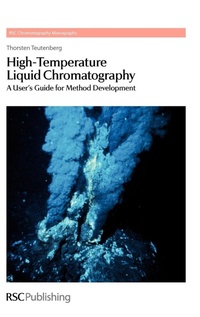
High-Temperature Liquid Chromatography
A User's Guide for Method Development
Published on 3. June 2010
Book
Hardback
220 pages
978-1-84973-013-6 (ISBN)
Description
High-temperature liquid chromatography has attracted much interest in recent years but has not yet recognized its full potential in the chromatographic community. There is a widespread reluctance in industry to use temperature to speed up the separation process, influence the selectivity of a separation or implement novel detection techniques. However, the technology has now matured and could revolutionize chromatography as we see it today. Better equipment, such as heating systems able to generate faster heating rates, is becoming more readily available. Also, columns based on silica gel, which can withstand higher temperatures for an extended period, are now being introduced. Nevertheless, further technological and methodical efforts are needed to establish the method in a regulated environment like the pharmaceutical industry. This is the only text to cover all the practical aspects, as well as the underlying theoretical principles, of setting up an HPLC system for high temperature operation. It is not intended solely for academics but will also benefit the researcher interested in more practical considerations. The author is a recognized expert and has conducted several studies with partners from industry to validate the method. Many real examples from these studies have been included in the book. The aim is to support practitioners in the creation of their own protocols without the need to rely solely on trial and error. The book starts with a brief definition of high temperature liquid chromatography before going on to cover: system set up; the heating system; mobile phase considerations; suitable stationary phases; method development using temperature programming; analyte stability, and special hyphenation techniques using superheated water as a mobile phase. In each chapter, experimental data is used to illustrate the main statements and the advantages over conventional HPLC are evaluated. The book concludes with a critical outlook on further developments and applications underlining the necessary advances needed to make high temperature HPLC more robust.
Reviews / Votes
High-temperature liquid chromatography has attracted much interest in recent years but has not yet recognized its full potential in the chromatographic community. There is a widespread reluctance in industry to use temperature to speed up the separation process, influence the selectivity of a separation or implement novel detection techniques. However, the technology has now matured and could revolutionize chromatography as we see it today. Better equipment, such as heating systems able to generate faster heating rates, is becoming more readily available. Also, columns based on silica gel, which can withstand higher temperatures for an extended period, are now being introduced. Nevertheless, further technological and methodical efforts are needed to establish the method in a regulated environment like the pharmaceutical industry. This is the only text to cover all the practical aspects, as well as the underlying theoretical principles, of setting up an HPLC system for high-temperature operation. It is not intended solely for academics but will also benefit the researcher interested in more practical considerations. The author is a recognized expert and has conducted several studies with partners from industry to validate the method. Many real examples from these studies have been included in the book. The aim is to support practitioners in the creation of their own protocols without the need to rely solely on trial and error. The book starts with a brief definition of high-temperature liquid chromatography before going on to cover: system set up; the heating system; mobile phase considerations; suitable stationary phases; method development using temperature programming; analyte stability, and special hyphenation techniques using superheated water as a mobile phase. In each chapter, experimental data is used to illustrate the main statements and the advantages over conventional HPLC are evaluated. The book concludes with a critical outlook on further developments and applications underlining the necessary advances needed to make high-temperature HPLC more robust.More details
Series
Language
English
Place of publication
Cambridge
United Kingdom
Target group
Professional and scholarly
Product notice
Unsewn / adhesive bound
Dimensions
Height: 242 mm
Width: 164 mm
Thickness: 19 mm
Weight
484 gr
ISBN-13
978-1-84973-013-6 (9781849730136)
Copyright in bibliographic data and cover images is held by Nielsen Book Services Limited or by the publishers or by their respective licensors: all rights reserved.
Schweitzer Classification
Other editions
Additional editions
E-Book
06/2010
1st Edition
Royal Society of Chemistry
€168.99
Available for download
Person
Thorsten Teutenberg obtained his doctorate from the University of Bochum in 2004. His thesis was on the development of a specially designed heating system for high-temperature liquid chromatography. He subsequently joined the Institut f (3)r Energie- und Umwelttechnik e. V. in Duisburg where he became responsible for a small working group within the Department of Research Analysis focused on method development strategies for high temperature liquid chromatography. Currently, he heads a number of joint research projects, with partners from university and industry, aimed at implementing high temperature liquid chromatography as a routine method. His special interest is the understanding of the temperature dependence of physicochemical solvent properties of binary liquid mixtures used for reversed phase HPLC. Future research interests include multidimensional liquid chromatography, capillary and nano HPLC as well as systematic optimization strategies for an efficient method development.
Content
A brief definition of high-temperature liquid chromatography;
System set up for high temperature liquid chromatography;
The heating system;
Mobile phase considerations;
Suitable stationary phases;
Method development using temperature programming Analyte stability;
Special hyphenation techniques using superheated water as a mobile phase;
A critical outlook
System set up for high temperature liquid chromatography;
The heating system;
Mobile phase considerations;
Suitable stationary phases;
Method development using temperature programming Analyte stability;
Special hyphenation techniques using superheated water as a mobile phase;
A critical outlook