

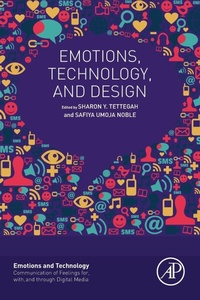
Emotions, Technology, and Design
Published on 6. January 2016
Book
Paperback/Softback
268 pages
978-0-12-801872-9 (ISBN)
Description
Emotional design explicitly addresses the emotional relationship between the objects and the subjects of design-in this book, the objects are technologies, and the subjects are technology users. The first section delves into the philosophy and theory of emotional design to provide a foundation for the rest of the book, which goes on to discuss emotional design principles, the design and use of emoticons, and then intelligent agents in a variety of settings. A conclusion chapter covers future research and directions. Emotions, Technology, and Design provides a thorough look at how technology design affects emotions and how to use that understanding to in practical applications.
More details
Series
Language
English
Place of publication
San Diego
United States
Publishing group
Elsevier Science Publishing Co Inc
Target group
Professional and scholarly
Product notice
Paperback (trade)
Dimensions
Height: 229 mm
Width: 152 mm
Thickness: 15 mm
Weight
398 gr
ISBN-13
978-0-12-801872-9 (9780128018729)
Copyright in bibliographic data and cover images is held by Nielsen Book Services Limited or by the publishers or by their respective licensors: all rights reserved.
Schweitzer Classification
Other editions
Additional editions
Sharon Tettegah | Safiya Noble
Emotions, Technology, and Design
E-Book
12/2015
Academic Press
€58.95
Available for download
Persons
Sharon Tettegah is a Professor in the Department of Teaching and Learning at the University of Nevada, Las Vegas and Former Program Chair of Digital Environments for Learning, Teaching and Agency in the College of Education, at the University of Illinois, at Urbana Champaign. She has an appointment in the Cognitive Neuroscience in Bio-Intelligence at the Beckman Institute for Advanced Science and Technology. In addition, she is a Research Scientist and affiliate at the National Center for Supercomputing Applications (NCSA). Her research centers on the intersection of STEM learning, Emotions, Equity and Social justice. She was also a Program Director in 2010-2012 at the National Science Foundation where she managed five programs in the Directorates of Education and Human Resources, Computer and Information Science and Engineering and including a NSF cross-cutting program on Science, Engineering, Education for Sustainability (SEES). She is also the Series Editor for Emotions and Technology with Elsevier, Academic Psychology Division. Safiya Umoja Noble is an Assistant Professor in the Department of Information Studies in the Graduate School of Education and Information Studies at UCLA where she conducts research in socio-cultural informatics; including feminist, historical and political-economic perspectives on computing platforms and software in the public interest. Her research is at the intersection of culture and technology in the design and use of applications on the Internet.
Editor
College of Education, University of Nevada, Las Vegas, Beckman Institute for Advanced Science and Technology, National Center for Supercomputing Applications affiliate, University of Illinois, IL, USA
Department of Information Studies, Graduate School of Education and Information Studies, UCLA, CA, USA
Content
I. Experiments and Theories in Emotions, Technology and Design
1. Emotional screen. Color and moving images in digital media
2. Safe and Sound: Using Audio to Communicate Comfort, Safety, and Familiarity in Digital Media?
3. Emoticons in business communication: is the :) worth it?
4. Empathetic technology
5. Spoken dialogue agent applications using emotional expressions
6. Engaging Learners through Rational Design of Multisensory Effects
7. Designing interaction strategies for companions interacting with children
II. Critical Theoretical Engagements with Emotions, Technology and Design
8. The Emulation of Emotions in Artificial Intelligence: Another Step into Anthropomorphism
9. Through Google Colored Glass(es): Design, Emotion, Class and Wearables as Commodity and Control
10. Designing Emotions: Deliver the Nets, Eradicate Malaria in Africa, and Feel Good?
11. Police Body Cameras: Emotional Mediation and the Economies of Visuality
1. Emotional screen. Color and moving images in digital media
2. Safe and Sound: Using Audio to Communicate Comfort, Safety, and Familiarity in Digital Media?
3. Emoticons in business communication: is the :) worth it?
4. Empathetic technology
5. Spoken dialogue agent applications using emotional expressions
6. Engaging Learners through Rational Design of Multisensory Effects
7. Designing interaction strategies for companions interacting with children
II. Critical Theoretical Engagements with Emotions, Technology and Design
8. The Emulation of Emotions in Artificial Intelligence: Another Step into Anthropomorphism
9. Through Google Colored Glass(es): Design, Emotion, Class and Wearables as Commodity and Control
10. Designing Emotions: Deliver the Nets, Eradicate Malaria in Africa, and Feel Good?
11. Police Body Cameras: Emotional Mediation and the Economies of Visuality