

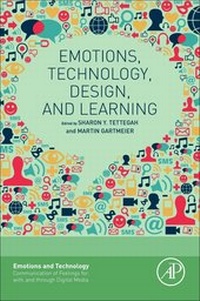
Emotions, Technology, Design, and Learning
Published on 15. October 2015
Book
Paperback/Softback
332 pages
978-0-12-801856-9 (ISBN)
Description
Emotions, Technology, Design, and Learning provides an update to the topic of emotional responses and how technology can alter what is being learned and how the content is learned.
The design of that technology is inherently linked to those emotional responses. This text addresses emotional design and pedagogical agents, and the emotions they generate. Topics include design features such as emoticons, speech recognition, virtual avatars, robotics, and adaptive computer technologies, all as relating to the emotional responses from virtual learning.
The design of that technology is inherently linked to those emotional responses. This text addresses emotional design and pedagogical agents, and the emotions they generate. Topics include design features such as emoticons, speech recognition, virtual avatars, robotics, and adaptive computer technologies, all as relating to the emotional responses from virtual learning.
More details
Series
Language
English
Place of publication
San Diego
United States
Publishing group
Elsevier Science Publishing Co Inc
Target group
Professional and scholarly
Dimensions
Height: 229 mm
Width: 152 mm
Weight
520 gr
ISBN-13
978-0-12-801856-9 (9780128018569)
Copyright in bibliographic data and cover images is held by Nielsen Book Services Limited or by the publishers or by their respective licensors: all rights reserved.
Schweitzer Classification
Other editions
Additional editions
Sharon Y. Tettegah | Martin Gartmeier
Emotions, Technology, Design, and Learning
E-Book
10/2015
Academic Press
€71.95
Available for download
Persons
Sharon Tettegah is a faculty member and Program Chair of Digital Environments for Learning, Teaching and Agency in the College of Education, at the University of Illinois, at Urbana Champaign. She also has an appointment in the Cognitive Neuroscience in Bio-Intelligence and Human Computer Interaction at the Beckman Institute for Advanced Science and Technology. In addition, she is a Research Scientist and affiliate at the National Center for Supercomputing Applications (NCSA). Her research centers on the intersection of STEM learning, Emotions, Equity and Social justice. She was also a Program Director in 2010-2012 at the National Science Foundation where she managed five programs in the Directorates of Education and Human Resources, Computer and Information Science and Engineering and including a NSF cross-cutting program on Science, Engineering, Education for Sustainability (SEES). Postdoctoral Research Fellow at the TUM School of Education, Department of Empirical Educational Research (Since 10/2012). Research interests: Communication between teachers and parents, communication training of (becoming) teachers, use and development of video cases in teacher education, negative knowledge and learning from errors at work, competence development in work processes.
Content
Series Introduction
Volume Introduction
1: Emoticons and Online Learning: A Review of the Literature
2: Emotional Design in Digital Media for Learning
3: Measuring Emotions: A Survey of Cutting-Edge Methodologies Used in Advanced Agent-Based Learning Environment Research
4: A Real-Time Speech Emotion Recognition System and Its Application in Online Learning
5: Animated Pedagogical Agents and Emotion
6: Virtual Avatars as Emotional Facilitators in Online Learning Environments
7: Promoting Engaged Learning with Pedagogical Agents
8: Emotional Pedagogical Agents with Temperament
9: Emotions in Adaptive Computer Technologies to Promote Deeper Learning
10: Robots, Emotions, and Learning
11: Future Research in Emotion, Design, Learning, and Technology
Volume Introduction
1: Emoticons and Online Learning: A Review of the Literature
2: Emotional Design in Digital Media for Learning
3: Measuring Emotions: A Survey of Cutting-Edge Methodologies Used in Advanced Agent-Based Learning Environment Research
4: A Real-Time Speech Emotion Recognition System and Its Application in Online Learning
5: Animated Pedagogical Agents and Emotion
6: Virtual Avatars as Emotional Facilitators in Online Learning Environments
7: Promoting Engaged Learning with Pedagogical Agents
8: Emotional Pedagogical Agents with Temperament
9: Emotions in Adaptive Computer Technologies to Promote Deeper Learning
10: Robots, Emotions, and Learning
11: Future Research in Emotion, Design, Learning, and Technology