

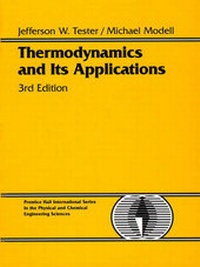
Thermodynamics and Its Applications
3rd Edition
Published on 27. September 1996
Book
Paperback/Softback
960 pages
978-0-13-915356-3 (ISBN)
Description
Based on the authors' graduate courses at MIT, this text and reference provides a unified understanding of both the critical concepts of chemical thermodynamics and their applications.KEY TOPICS:Part I of this book provides the theoretical basis of classical thermodynamics, including the 1st and 2nd laws, the Fundamental Equation, Legendre transformations, and general equilibrium criteria. Part II contains an extensive description of how thermodynamic properties are correlated, modeled, manipulated and estimated. Both macroscopic, empirically-based and molecular-level approaches are discussed in-depth, for pure components and mixtures. New, detailed coverage shows how traditional macroscopic models are connected to their roots at the molecular level. Part III presents applications of classical thermodynamics in detail. The book connects theory with applications at every opportunity, using extensive examples, classroom problems and homework exercises.MARKET:Chemical engineering and physical chemistry graduate courses in thermodynamics.
More details
Edition
3rd edition
Language
English
Place of publication
Upper Saddle River
United States
Publishing group
Pearson Education (US)
Target group
College/higher education
Dimensions
Height: 241 mm
Width: 184 mm
Thickness: 38 mm
Weight
1532 gr
ISBN-13
978-0-13-915356-3 (9780139153563)
Schweitzer Classification
Other editions
Previous edition

Michael Modell | Robert C. Reid
Thermodynamics and Its Applications
Book
01/1983
2nd Edition
Prentice Hall PTR
€131.17
Article exhausted; check for reprint
Content
I. FUNDAMENTALS PRINCIPLES.
1. The Scope of Classical Thermodynamics.
2. Basic Concepts and Definitions.
3. Energy and the First Law.
4. Reversibility and the Second Law.
5. The Calculus of Thermodynamics.
6. Equilibrium Criteria.
7. Stability Criteria.
II. THERMODYNAMIC PROPERTIES.
8. Properties of Pure Materials.
9. Property Relationships for Mixtures.
10. Statistical Mechanical Approach for Property Models.
11. Models for Non-Ideal, Non-Electrolyte Solutions.
12. Models for Electrolyte Solutions.
13. Estimating Physical Properties.
III. APPLICATIONS.
14. Practical heat Engines and Power Cycles.
15. Phase Equilibrium and Stability.
16. Chemical Equilibria.
17. Generalized Treatment of Phase and Chemical Equilibria.
18. Systems under Stress, in Electromagnetic or Potential Fields.
19. Thermodynamics of Surfaces.
APPENDICES.
A. Summary of the Postulates.
B. Mathematical relations of Functions of States.
C. Derivation of Euler's Theorem.
D. Mathematical Formulae for Stability and Equilibria.
E. Numerical Methods.
F. General Mixture Relationships for Extensive and Intensive Properties.
G. Pure Component Property Data.
H. Conversion Factors and Gas Constant Values.
1. The Scope of Classical Thermodynamics.
2. Basic Concepts and Definitions.
3. Energy and the First Law.
4. Reversibility and the Second Law.
5. The Calculus of Thermodynamics.
6. Equilibrium Criteria.
7. Stability Criteria.
II. THERMODYNAMIC PROPERTIES.
8. Properties of Pure Materials.
9. Property Relationships for Mixtures.
10. Statistical Mechanical Approach for Property Models.
11. Models for Non-Ideal, Non-Electrolyte Solutions.
12. Models for Electrolyte Solutions.
13. Estimating Physical Properties.
III. APPLICATIONS.
14. Practical heat Engines and Power Cycles.
15. Phase Equilibrium and Stability.
16. Chemical Equilibria.
17. Generalized Treatment of Phase and Chemical Equilibria.
18. Systems under Stress, in Electromagnetic or Potential Fields.
19. Thermodynamics of Surfaces.
APPENDICES.
A. Summary of the Postulates.
B. Mathematical relations of Functions of States.
C. Derivation of Euler's Theorem.
D. Mathematical Formulae for Stability and Equilibria.
E. Numerical Methods.
F. General Mixture Relationships for Extensive and Intensive Properties.
G. Pure Component Property Data.
H. Conversion Factors and Gas Constant Values.