

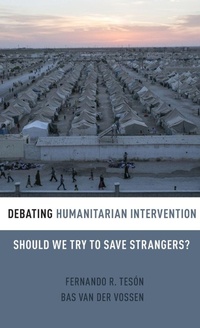
Debating Humanitarian Intervention
Should We Try to Save Strangers?
Published on 16. November 2017
Book
Hardback
290 pages
978-0-19-020290-3 (ISBN)
Description
When foreign powers attack civilians, other countries face an impossible dilemma. Two courses of action emerge: either to retaliate against an abusive government on behalf of its victims, or to remain spectators. Either course offers its own perils: the former, lost lives and resources without certainty of restoring peace or preventing worse problems from proliferating; the latter, cold spectatorship that leaves a country at the mercy of corrupt rulers or to revolution.
Philosophers Fernando Teson and Bas van der Vossen offer contrasting views of humanitarian intervention, defining it as either war aimed at ending tyranny, or as violence. The authors employ the tools of impartial modern analytic philosophy, particularly just war theory, to substantiate their claims. According to Teson, a humanitarian intervention has the same just cause as a justified revolution: ending tyranny. He analyzes the different kinds of just cause and whether or not an intervener may pursue other justified causes. For Teson, the permissibility of humanitarian intervention is almost exclusively determined by the rules of proportionality. Bas van der Vossen, by contrast, holds that military intervention is morally impermissible in almost all cases. Justified interventions, Van der Vossen argues, must have high ex ante chance of success. Analyzing the history and prospects of intervention shows that they almost never do.
Teson and van der Vossen refer to concrete cases, and weigh the consequences of continued or future intervention in Syria, Somalia, Rwanda, Bosnia, Iraq, Lybia and Egypt. By placing two philosophers in dialogue, Debating Humanitarian Intervention is not constrained by a single, unifying solution to the exclusion of all others. Rather, it considers many conceivable actions as judged by analytic philosophy, leaving the reader equipped to make her own, informed judgments.
Philosophers Fernando Teson and Bas van der Vossen offer contrasting views of humanitarian intervention, defining it as either war aimed at ending tyranny, or as violence. The authors employ the tools of impartial modern analytic philosophy, particularly just war theory, to substantiate their claims. According to Teson, a humanitarian intervention has the same just cause as a justified revolution: ending tyranny. He analyzes the different kinds of just cause and whether or not an intervener may pursue other justified causes. For Teson, the permissibility of humanitarian intervention is almost exclusively determined by the rules of proportionality. Bas van der Vossen, by contrast, holds that military intervention is morally impermissible in almost all cases. Justified interventions, Van der Vossen argues, must have high ex ante chance of success. Analyzing the history and prospects of intervention shows that they almost never do.
Teson and van der Vossen refer to concrete cases, and weigh the consequences of continued or future intervention in Syria, Somalia, Rwanda, Bosnia, Iraq, Lybia and Egypt. By placing two philosophers in dialogue, Debating Humanitarian Intervention is not constrained by a single, unifying solution to the exclusion of all others. Rather, it considers many conceivable actions as judged by analytic philosophy, leaving the reader equipped to make her own, informed judgments.
Reviews / Votes
the book is an excellent contribution in terms of bringing together different arguments on intervention, the moral dilemma involved and the implicit political logic...the book...presents a much more condensed and balanced overview. It would be of great help to students and researchers working on issues pertaining to sovereignty, international justice, intervention and non-intervention to find multiple sources in a single book. * Abhishek Choudhary, Jawaharlal Nehru University, Human Rights Review * this book provides an important overview of the humanitarian intervention debate and forces the reader to rethink both the conditions under which humanitarian intervention can be justified, as well as the limitations of military responses in addressing humanitarian need. As a result, this book will be of interest to both academics and students wishing to challenge their own underlying assumptions about humanitarian intervention, on either side of this long-running debate. * Garrett Wallace Brown and Samuel Jarvis, E-International Relations *More details
Series
Language
English
Place of publication
New York
United States
Target group
College/higher education
Dimensions
Height: 222 mm
Width: 145 mm
Thickness: 19 mm
Weight
499 gr
ISBN-13
978-0-19-020290-3 (9780190202903)
Copyright in bibliographic data and cover images is held by Nielsen Book Services Limited or by the publishers or by their respective licensors: all rights reserved.
Schweitzer Classification
Other editions
Additional editions
Fernando Teson | Bas van der Vossen
Debating Humanitarian Intervention
Should We Try to Save Strangers?
Book
11/2017
Oxford University Press Inc
€31.50
Shipment within 15-20 days
Fernando R. Tesón | Bas van der Vossen
Debating Humanitarian Intervention
Should We Try to Save Strangers?
E-Book
10/2017
1st Edition
OUP eBook
€11.99
Available for download
Fernando R. Tesón | Bas van der Vossen
Debating Humanitarian Intervention
Should We Try to Save Strangers?
E-Book
10/2017
1st Edition
OUP eBook
€11.99
Available for download
Persons
Fernando R. Teson is the Tobias Simon Eminent Scholar at Florida State University College of Law. He is the author, inter alia, of Justice at a Distance: Extending Freedom Globally (Cambridge University Press, 2015) [with Loren Lomasky] and Humanitarian Intervention: An Inquiry into Law and Morality , 3rd ed. (Transnational Publishers 2005), and dozens of articles in specialized journals.
Bas van der Vossen is Associate Professor of Philosophy in the Smith Institute of Political Economy and Philosophy and the Philosophy Department at Chapman University. His research focuses on questions in political philosophy, and he is an Associate Editor of the journal Social Philosophy and Policy.
Bas van der Vossen is Associate Professor of Philosophy in the Smith Institute of Political Economy and Philosophy and the Philosophy Department at Chapman University. His research focuses on questions in political philosophy, and he is an Associate Editor of the journal Social Philosophy and Policy.
Content
Introduction
Fernando Teson and Bas van der Vossen
Part I: A defense of humanitarian intervention Fernando Teson
1. Humanitarian intervention as defense of persons
2. Just cause in humanitarian intervention
3. Intervention and revolution: the equivalence thesis
4. Proportionality in humanitarian intervention
5. Further issues in humanitarian intervention
APPENDIX: The Iraq war
Part II: Humanitarian non-intervention Bas van der Vossen
6. A presumption against intervention
7. Between internal and external threats
8. Why sovereignty (still) matters
9. The success condition
10. Justice ex post or ex ante?
11. Three structural problems
12. Looking for exceptions
13. Humanitarian non-intervention
Fernando Teson and Bas van der Vossen
Part I: A defense of humanitarian intervention Fernando Teson
1. Humanitarian intervention as defense of persons
2. Just cause in humanitarian intervention
3. Intervention and revolution: the equivalence thesis
4. Proportionality in humanitarian intervention
5. Further issues in humanitarian intervention
APPENDIX: The Iraq war
Part II: Humanitarian non-intervention Bas van der Vossen
6. A presumption against intervention
7. Between internal and external threats
8. Why sovereignty (still) matters
9. The success condition
10. Justice ex post or ex ante?
11. Three structural problems
12. Looking for exceptions
13. Humanitarian non-intervention