

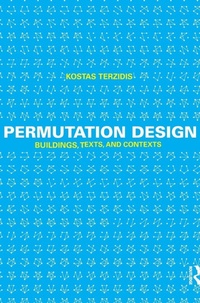
Permutation Design
Buildings, Texts, and Contexts
1st Edition
Published on 4. September 2014
Book
Hardback
170 pages
978-0-415-64449-5 (ISBN)
Description
In design, the problems that designers are called upon to solve can be regarded as a problem of permutations. A permutation is an ordered arrangement of elements in a set. In our case, the set is design and the elements are design components, such as lines, shapes, forms, or spaces.
Traditionally, such arrangements are done by human designers who base their decision-making process either on intuition or on random sampling until a valid solution is found. However, in both cases the solution found may be an acceptable one but cannot be labeled as "the best possible solution" due to the subjective or arbitrary nature of the selection process. In contrast, by harnessing the potential of computational design, these elements can be arranged in all possible ways and then the best ones are chosen based on specific criteria. By presenting a complete list of permutation-based arrangements the "best solution" will eventually reveal itself by excluding all other possible solutions.
This book comprehensively addresses theories, techniques, and examples of permutation design in order to fully demonstrate to the reader the full range of possibilities this method represents. The significance of such an approach to design is enormous, paradigmatic, and far-reaching. It provides an alternative method for design analysis, synthesis, and evaluation that is based on computational force rather than pure human intelligence alone. In contrast to human-based random sampling or intuition, permutation-based design offers the assurance of an optimum design since any possible alternative design can be eliminated. From a practical point of view, this methodology offers a paradigmatic shift away from the current state of design practice where arbitrariness, repetition, and redundancy often exist. From a theoretical viewpoint, this new paradigm will offer alternative insights into the value of human creativity, intuition, and intelligence.
Traditionally, such arrangements are done by human designers who base their decision-making process either on intuition or on random sampling until a valid solution is found. However, in both cases the solution found may be an acceptable one but cannot be labeled as "the best possible solution" due to the subjective or arbitrary nature of the selection process. In contrast, by harnessing the potential of computational design, these elements can be arranged in all possible ways and then the best ones are chosen based on specific criteria. By presenting a complete list of permutation-based arrangements the "best solution" will eventually reveal itself by excluding all other possible solutions.
This book comprehensively addresses theories, techniques, and examples of permutation design in order to fully demonstrate to the reader the full range of possibilities this method represents. The significance of such an approach to design is enormous, paradigmatic, and far-reaching. It provides an alternative method for design analysis, synthesis, and evaluation that is based on computational force rather than pure human intelligence alone. In contrast to human-based random sampling or intuition, permutation-based design offers the assurance of an optimum design since any possible alternative design can be eliminated. From a practical point of view, this methodology offers a paradigmatic shift away from the current state of design practice where arbitrariness, repetition, and redundancy often exist. From a theoretical viewpoint, this new paradigm will offer alternative insights into the value of human creativity, intuition, and intelligence.
More details
Language
English
Place of publication
London
United Kingdom
Publishing group
Taylor & Francis Ltd
Target group
College/higher education
Professional and scholarly
Postgraduate, Professional, and Professional Practice & Development
Illustrations
80 s/w Abbildungen
80 Illustrations, black and white
Dimensions
Height: 250 mm
Width: 175 mm
Thickness: 14 mm
Weight
484 gr
ISBN-13
978-0-415-64449-5 (9780415644495)
Copyright in bibliographic data and cover images is held by Nielsen Book Services Limited or by the publishers or by their respective licensors: all rights reserved.
Schweitzer Classification
Other editions
Additional editions
Book
09/2014
1st Edition
Routledge
€81.00
Shipment within 15-20 days
E-Book
09/2014
1st Edition
Routledge
€78.99
Available for download
E-Book
09/2014
1st Edition
Routledge
€78.99
Available for download
Person
Kostas Terzidis was an Associate Professor at Harvard University Graduate School of Design from 2003 until 2012. He taught courses in Algorithmic Architecture, Kinetic Architecture, Digital Media, and Design Research Methods. He holds a PhD in Architecture from the University of Michigan (1994), an M.Arch from OS (1989), and a Diploma of Engineering from the Aristotle University in Thessaloniki, Greece (1986). He is now the CEO and co-founder of Organic Parking, a company developing smart city parking space optimization using mobile social networks.
Content
Introduction 1. The Myth of the Genius 2. Parasights 3. Digital Culture: A Critical View 4. Combinations, Permutations, and other Predicaments 5. Studies 6. Epi(dia)logue Index