

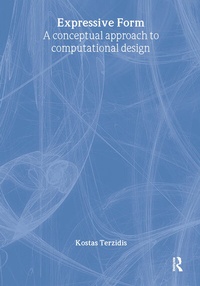
Expressive Form
A Conceptual Approach to Computational Design
1st Edition
Will be published approx. on 25. September 2003
Book
Hardback
102 pages
978-0-415-31743-6 (ISBN)
Description
With the increased use of computers, architecture has found itself in the midst of a plethora of possible uses. This book combines theoretical enquiry with practical implementation offering a unique perspective on the use of computers related to architectureal form and design. Notions of exaggeration, hybrid, kinetic, algorithmic, fold and warp are examined from different points of view: historical, mathematical, philosophical or critical. Generously illustrated, this book is a source of inspiration for students and professionals.
More details
Language
English
Place of publication
London
United Kingdom
Publishing group
Taylor & Francis Ltd
Target group
College/higher education
Professional and scholarly
Illustrations
30 s/w Abbildungen
30 Illustrations, black and white
Dimensions
Height: 246 mm
Width: 174 mm
Weight
436 gr
ISBN-13
978-0-415-31743-6 (9780415317436)
Copyright in bibliographic data and cover images is held by Nielsen Book Services Limited or by the publishers or by their respective licensors: all rights reserved.
Schweitzer Classification
Other editions
Additional editions
E-Book
03/2004
Routledge
€69.99
Available for download
E-Book
03/2004
Routledge
€69.99
Available for download
Book
09/2003
1st Edition
Routledge
€75.40
Shipment within 15-20 days
Person
Kostas Terzidis is an Assistant Professor in UCLA's Department of Architecture. His work focuses on creative experimentation within the threshold between arts, architecture, music, and computer science. He has studied extensively the implications of virtual reality for the representation of space and spatiality in art and architecture. He is the author of many computer applications on form-making, morphing, filtering, and network mapping. His most recent work is the development of a visualization system in Java, called zhapes and a 3D-morphing system called morphZhapes. He has presented papers and lectured widely on both virtual reality and algorithmic design systems at conferences ranging from design methods to engineering applications.
Content
1. Caricature Form 2. Hybrid Form 3. Kinetic Form 4. (Un)Folding Form 5. Warped Eye 6. Algorithmic Form. Epi(dia)logue