

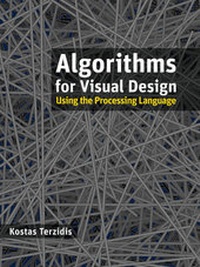
Algorithms for Visual Design Using the Processing Language
Published on 8. May 2009
Book
Hardback
384 pages
978-0-470-37548-8 (ISBN)
Description
As the first book to share the necessary algorithms for creating code to experiment with design problems in the processing language, this book offers a series of generic procedures that can function as building blocks and encourages you to then use those building blocks to experiment, explore, and channel your thoughts, ideas, and principles into potential solutions. The book covers such topics as structured shapes, solid geometry, networking and databases, physical computing, image processing, graphic user interfaces, and more.
More details
Other editions
Additional editions
Kostas Terzidis
Algorithms for Visual Design Using the Processing Language
E-Book
04/2009
Wiley
€53.99
Available for download
Person
Kostas Terzidis is an associate professor at Harvard University's Graduate School of Design. He is an educator, designer, theorist, architect, and computer scientist. His professional work includes software development for Java media framework and Linux as a software engineer for AOL. Terzidis is also the author of three previous books.
Content
Introduction.
1. Elements of the Language.
2. Points, Lines, and Shapes.
3. Structured Shapes.
4. Basics of Graphical User Interfaces.
5. Image Processing.
6. Motion.
7. Advanced Algorithms.
8. 3-D Space.
9. Solid Modeling.
10. File Processing.
11. Physical Computing.
Appendix A: Equations of Lines and Planes.
Appendix B: Answers to Exercises.
Appendix C: Further Reading.
1. Elements of the Language.
2. Points, Lines, and Shapes.
3. Structured Shapes.
4. Basics of Graphical User Interfaces.
5. Image Processing.
6. Motion.
7. Advanced Algorithms.
8. 3-D Space.
9. Solid Modeling.
10. File Processing.
11. Physical Computing.
Appendix A: Equations of Lines and Planes.
Appendix B: Answers to Exercises.
Appendix C: Further Reading.