

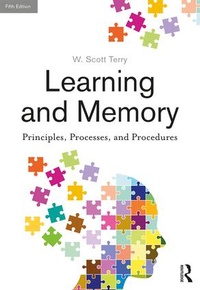
Learning and Memory
Basic Principles, Processes, and Procedures, Fifth Edition
5th Edition
Published on 16. October 2017
Book
Hardback
428 pages
978-1-138-64591-2 (ISBN)
Description
This thoroughly updated edition provides a balanced review of the core methods and the latest research on animal learning and human memory. The relevance of basic principles is highlighted throughout via everyday examples to ignite student interest, along with more traditional examples from human and animal laboratory studies. Individual differences in age, gender, learning style, cultural background, or special abilities (such as the math gifted) are highlighted within each chapter to help students see how the principles may be generalized to other subject populations.
The basic processes of learning - such as classical and instrumental conditioning and encoding and storage in long-term memory in addition to implicit memory, spatial learning, and remembering in the world outside the laboratory - are reviewed. The general rules of learning are described along with the exceptions, limitations, and best applications of these rules. The relationship between the fields of neuropsychology and learning and memory is stressed throughout.
The relevance of this research to other disciplines is reflected in the tone of the writing and is demonstrated through a variety of examples from education, neuropsychology, rehabilitation, psychiatry, nursing and medicine, I/O and consumer psychology, and animal behavior.
Each chapter begins with an outline and concludes with a detailed summary. A website for instructors and students accompanies the book.
Updated throughout with new research findings and examples the new edition features:
A streamlined presentation for today's busy students. As in the past, the author supports each concept with a research example and real-life application, but the duplicate example or application now appears on the website so instructors can use the additional material to illustrate the concepts in class.
Expanded coverage of neuroscience that reflects the current research of the field including aversive conditioning (Ch. 5) and animal working memory (Ch. 8).
More examples of research on student learning that use the same variables discussed in the chapter, but applies them in a classroom or student's study environment. This includes research that applies encoding techniques to student learning, for example: studying: recommendations from experts (Ch. 1); the benefits of testing (Ch. 9); and Joshua Foer's Moonwalking with Einstein, on his quest to become a memory expert (Ch. 6).
More coverage of unconscious learning and knowledge (Ch. 11).
Increased coverage of reinforcement and addiction (Ch. 4), causal and language learning (Ch. 6), working memory (WM) and the effects of training on WM, and the comparative evolution of WM in different species (Ch. 8), and genetics and learning (Ch. 12).
The basic processes of learning - such as classical and instrumental conditioning and encoding and storage in long-term memory in addition to implicit memory, spatial learning, and remembering in the world outside the laboratory - are reviewed. The general rules of learning are described along with the exceptions, limitations, and best applications of these rules. The relationship between the fields of neuropsychology and learning and memory is stressed throughout.
The relevance of this research to other disciplines is reflected in the tone of the writing and is demonstrated through a variety of examples from education, neuropsychology, rehabilitation, psychiatry, nursing and medicine, I/O and consumer psychology, and animal behavior.
Each chapter begins with an outline and concludes with a detailed summary. A website for instructors and students accompanies the book.
Updated throughout with new research findings and examples the new edition features:
A streamlined presentation for today's busy students. As in the past, the author supports each concept with a research example and real-life application, but the duplicate example or application now appears on the website so instructors can use the additional material to illustrate the concepts in class.
Expanded coverage of neuroscience that reflects the current research of the field including aversive conditioning (Ch. 5) and animal working memory (Ch. 8).
More examples of research on student learning that use the same variables discussed in the chapter, but applies them in a classroom or student's study environment. This includes research that applies encoding techniques to student learning, for example: studying: recommendations from experts (Ch. 1); the benefits of testing (Ch. 9); and Joshua Foer's Moonwalking with Einstein, on his quest to become a memory expert (Ch. 6).
More coverage of unconscious learning and knowledge (Ch. 11).
Increased coverage of reinforcement and addiction (Ch. 4), causal and language learning (Ch. 6), working memory (WM) and the effects of training on WM, and the comparative evolution of WM in different species (Ch. 8), and genetics and learning (Ch. 12).
Reviews / Votes
'The book remains a solid presentation of basic principles of learning and memory, offered in a student-centered style with engaging examples of their applications to the real-world situations and problems that readers are likely to encounter. Whether considering how to study, how to make decisions or how much practice is necessary to become an expert, Terry offers clear summaries of what is consistent with research findings.' -J.W.(Bill) Whitlow, Rutgers UniversityMore details
Edition
5th edition
Language
English
Place of publication
London
United Kingdom
Publishing group
Taylor & Francis Ltd
Target group
College/higher education
Illustrations
28 s/w Tabellen
28 Tables, black and white
Dimensions
Height: 254 mm
Width: 178 mm
Weight
907 gr
ISBN-13
978-1-138-64591-2 (9781138645912)
Copyright in bibliographic data and cover images is held by Nielsen Book Services Limited or by the publishers or by their respective licensors: all rights reserved.
Schweitzer Classification
Other editions
New editions
Book
05/2023
6th Edition
Routledge
€264.20
Shipment within 10-20 days
Additional editions

Book
04/2017
5th Edition
Routledge
€133.69
The article will not be published
Previous edition
Book
10/2008
4th Edition
Psychology Press
€132.63
Article exhausted; check for reprint
Person
W. Scott Terry is Professor of Psychology at the University of North Carolina at Charlotte where he teaches psychology of learning to undergraduate & graduate students in I/O, clinical psych, & education.
Content
1. Introduction 2. Habituation and Other Forms of Stimulus Learning 3. Classical Conditioning 4. Instrumental Conditioning: Reward 5. Instrumental Conditioning: Nonreward, Punishment, and Avoidance 6. Verbal Learning 7. Human Memory: Conceptual Approaches 8. Short-Term Memory 9. Encoding 10. Storage and Retrieval 11. Spatial, Motor-Skill, and Implicit Learning 12. Individual Differences in Learning and Memory