

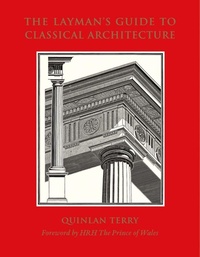
The Layman's guide to classical architecture
Will be published approx. on 10. February 2022
Book
Hardback
238 pages
978-91-89069-81-7 (ISBN)
Description
How do you draw a column? What distinguishes the different orders of columns, and is it really possible for anyone at all to learn how to interpret classical architecture? Quinlan Terry, one of the world's most noted classical architects, has designed cathedrals, castles, villas and university buildings in traditional style. All of his knowledge has now been gathered in The Layman's Guide to Classical Architecture, a complete guide to the rudiments of classical architecture.
Using his own drawings and sketches, Quinlan Terry shows step-by-step the structure of the different orders of columns, the relevance of proportions and the importance of the right materials and construction. The book is a contemporary version of the many pattern books in history that previously taught the same knowledge to architects, artisans and clients.
Today a wider group of people can benefit greatly from learning about classical architecture, both as historical background and as inspiration for today. The foreword is written by King Charles III, who has worked in partnership with Quinlan Terry for many years.
Using his own drawings and sketches, Quinlan Terry shows step-by-step the structure of the different orders of columns, the relevance of proportions and the importance of the right materials and construction. The book is a contemporary version of the many pattern books in history that previously taught the same knowledge to architects, artisans and clients.
Today a wider group of people can benefit greatly from learning about classical architecture, both as historical background and as inspiration for today. The foreword is written by King Charles III, who has worked in partnership with Quinlan Terry for many years.
More details
Language
English
Place of publication
Sweden
Product notice
Laminated cover
Dimensions
Height: 280 mm
Width: 223 mm
Thickness: 26 mm
Weight
1202 gr
ISBN-13
978-91-89069-81-7 (9789189069817)
Copyright in bibliographic data and cover images is held by Nielsen Book Services Limited or by the publishers or by their respective licensors: all rights reserved.
Schweitzer Classification
Persons
Quinlan Terry is a British architect and a well-known representative of New Classical architecture. He has received several awards for his work. Charles III, King of the United Kingdom and other Commonwealth realms. Besides his official royal duties, he is involved in many charities and has a keen interest in, and dedication to, architecture and art.
Content
1. i. Foreword by prince Charles
ii. Introduction
1. The parts and proportions of the Doric Order
2. The parts and proportions of the Tuscan Order
3. The parts and proportions of the Ionic Order
4. The parts and proportions of the Corinthian and Composite Orders
5. Superimposed Orders and the use of different Orders used together
6. The origin of the three Orders
7. Romanesque, Gothic, Indian and later architectural revivals
8. The characteristics of the Baroque
9. Appropriate materials for buildings that will last for centuries
10. Guidance on how a layman should sketch the Orders
11. Classical architecture which has no recognisable Order
12. Classical architecture as the hallmark of its time and place
ii. Introduction
1. The parts and proportions of the Doric Order
2. The parts and proportions of the Tuscan Order
3. The parts and proportions of the Ionic Order
4. The parts and proportions of the Corinthian and Composite Orders
5. Superimposed Orders and the use of different Orders used together
6. The origin of the three Orders
7. Romanesque, Gothic, Indian and later architectural revivals
8. The characteristics of the Baroque
9. Appropriate materials for buildings that will last for centuries
10. Guidance on how a layman should sketch the Orders
11. Classical architecture which has no recognisable Order
12. Classical architecture as the hallmark of its time and place