

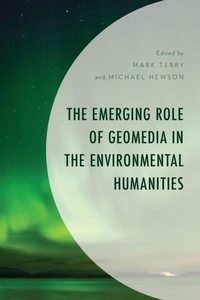
The Emerging Role of Geomedia in the Environmental Humanities
Published on 1. April 2024
Book
Paperback/Softback
208 pages
978-1-6669-1344-6 (ISBN)
Description
The Emerging Role of Geomedia in the Environmental Humanities, edited by Mark Terry and Michael Hewson, provides the latest scholarship on the various methods and approaches being used by environmental humanists to incorporate geomedia into their research and analyses. Chapters in the book examine such applications as geographic information systems, global positioning systems, geo-doc filmmaking, and related geo-locative systems all being used as new technologies of research and analysis in investigations in the environmental humanities. The contributors also explore how these new methodologies impact the production of knowledge in this field of study as well as promote the impact of First Nation people perspectives.
Reviews / Votes
"This intriguing book transcends academic disciplines to invite new provocations about maps, stories, images, and places in the digital age. It is a unique contribution to environmental studies that reads like a comet, leaving notable traces and teachings for ecological storytelling including those shared by young people, ecofeminists, Indigenous communities, and geographers." -- Kate Tilleczek, York University A fascinating look at the various theoretical frameworks, technologies, methods, and approaches to new and emerging applications of geomedia as a communications and pedagogical tool for understanding global issues. The scholars in this book share compelling research and case studies that demonstrate the historical, temporal, and spatial affordances of geo-locative applications that combine to provide additional context to complex global issues currently being studied. This book serves as a resource to using geomedia in these new and productive ways. -- Charles Hopkins, UNESCO Chair in Reorienting Education towards Sustainability This wide-ranging, interdisciplinary anthology brings together original and timely ecocritical work that explores the power of GIS and geomedia to address important questions of environmental justice. Committed to a critical pedagogy firmly rooted in an environmental humanities framework, the chapters in this collection provide valuable resources for researchers, teachers, and policy makers to understand climate shift from a humanities perspective. -- Markus Reisenleitner, York University "Shaping a just and sustainable future requires bold ideas and bold actions. As the editors of this volume argue, mapping is a powerful form of storytelling that can educate, engage, and enable critical reflections on the dire ecological emergency and environmental injustices of our time. The volume chapters span important meta-themes linked to Indigenous scholars' geographical information methods, integration of cultural with biophysical datasets, and classroom-based engagements. The Emerging Role of Geomedia in the Environmental Humanities is a must read for those wanting to extend possibilities for how we 'evolve stories that shift' society in a more just and sustainable direction." -- Alice J. Hovorka It is ever more essential to understand human phenomena in the context of space, place, and our interrelationships with natural systems if we are to have a chance of dealing with a range of complex problems, from indigenous land claims to the global climate crisis. In The Emerging Role of Geomedia in the Environmental Humanities, Terry and Hewson have curated an outstanding set of examples that mobilize the analytic and communicative power of geographic information systems to do this: supporting local voices in participatory processes, representing indigenous culture and lands, exposing gender dynamics in water management, and more. This book is already influencing my own work! -- Martin J. Bunch, York UniversityMore details
Series
Language
English
Place of publication
United States
Publishing group
Bloomsbury Publishing Plc
Target group
Professional and scholarly
Illustrations
12 b/w illustrations; 2 tables;
Dimensions
Height: 229 mm
Width: 152 mm
Thickness: 12 mm
Weight
346 gr
ISBN-13
978-1-6669-1344-6 (9781666913446)
Copyright in bibliographic data and cover images is held by Nielsen Book Services Limited or by the publishers or by their respective licensors: all rights reserved.
Schweitzer Classification
Other editions
Additional editions
E-Book
10/2022
1st Edition
Lexington Books
€33.49
Available for download
Persons
Mark Terry is contract faculty professor in the Faculty of Environmental and Urban Change at York University.
Michael Hewson is senior lecturer in geography at Central Queensland University.
Michael Hewson is senior lecturer in geography at Central Queensland University.
Content
Chapter 1: GIS and the Environmental Humanities: How Citizen Scientists, Civil Servants, and Researchers Are Teaming Up to Study and Solve Environmental Issues
Mark Terry
Chapter 2: Wadawurrung Dja: The Ethnography and Biogeography of Pre-Colonisation Wadawurrung Country in a Digital Realm
Susan Ryan, David S. Jones, Murray Herron, and Phillip Rooes
Chapter 3: Tech for TEK: The Value of GIS Systems in Sustainable Community Planning and Indigenous Land Protection Initiatives
Shahreen Shehwar
Chapter 4: The Use of GIS by Indigenous Peoples in Charting Culture, Claims, and Country
Jigme Lhamo Tsering
Chapter 5: Ecofeminist Visualization: Reading GIS as a Bridge to Gendered Water Management in India
Pamela Carralero
Chapter 6: Ecologies of the Digital Map: GIS and the Geography of Autopoietic Worlding
Erik Tate
Chapter 7: In the Retelling: Exploring Spatial Data as Narratives of Place
Michael Hewson
Chapter 8: Geomedia as a Pedagogical Tool: Toward Sustainability Competence
Michael John Long
Chapt
Mark Terry
Chapter 2: Wadawurrung Dja: The Ethnography and Biogeography of Pre-Colonisation Wadawurrung Country in a Digital Realm
Susan Ryan, David S. Jones, Murray Herron, and Phillip Rooes
Chapter 3: Tech for TEK: The Value of GIS Systems in Sustainable Community Planning and Indigenous Land Protection Initiatives
Shahreen Shehwar
Chapter 4: The Use of GIS by Indigenous Peoples in Charting Culture, Claims, and Country
Jigme Lhamo Tsering
Chapter 5: Ecofeminist Visualization: Reading GIS as a Bridge to Gendered Water Management in India
Pamela Carralero
Chapter 6: Ecologies of the Digital Map: GIS and the Geography of Autopoietic Worlding
Erik Tate
Chapter 7: In the Retelling: Exploring Spatial Data as Narratives of Place
Michael Hewson
Chapter 8: Geomedia as a Pedagogical Tool: Toward Sustainability Competence
Michael John Long
Chapt