

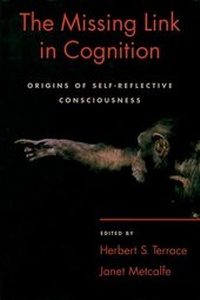
The Missing Link in Cognition
Origins of self-reflective consciousness
Published on 10. February 2005
Book
Hardback
392 pages
978-0-19-516156-4 (ISBN)
Description
How do we develop self-awareness, or a sense of self? One of the most popular theories is that language plays a major role: language and the narrative form allow us to develop a sense of self because this sense is dependent upon representational thought and the psychological manipulation of representations. Some scholars argue against this theory, claiming that more than language and representational thought is needed. Comparing human and animal cognition is a particularly powerful way of examining this disagreement; if animals possess self-awareness without having the representational linguistic capabilities of humans, then the comparison will provide significant evidence for the argument that language and narrative form do not play the only role, and that researchers may have overlooked a cognitive link. Terrace and Metcalfe propose to facilitate this work of some participants, such as Endel Tulving, Janet Metcalfe, and Daniel Povinelli, shows that self-awareness, metacognitions, and representational thought are unique to humans, while that of precursors to self-aware thought processes exist in non-human primates, the debate is likely to be lively and informative. This volume will be of great interest to researchers in cognitive, developmental, and social psychology.
Reviews / Votes
"After a century in the wilderness of questions considered unanswerable by science, the study of animal consciousness has undergone a revival in the last few decades. Research on consiousness in nonhumans has spawned several experimental paradigms, all of which are represented in this edited volume. The Missing Link in Cognition (the missing link being, as its subtitle suggests, the origin of self-reflective consiousness)stands as an excellent resource for advanced students and researchers interested in the state of the art in this rapidly growing field... greatly expands our understanding of the things nonhumans can and cannot do." --TRENDS in
Cognitive Sciences
"remarkable collection of essays by some of the most renowned scientists in the fields of cognitive psychology, development, animal learning, and primatology. No doubt because of the conference origins of the text, each chapter is written with full awareness of and integration with the topics in the other chapters. This is a very welcome if somewhat rare feature in edited volumes . . . This text would be an excellent addition to any psychologist's library. Only
those with no interest in cognition, development, the conscious mind, animal behavior, evolutionary theory, or philosophy of science would fail to thoroughly enjoy this text. It is likely only
accessible to graduate students and professionals, but it should be fascinating to all of them." --Salavador Macias, in Psyccritiques
"...essential reading for anyone interested in the nature of self-awareness."--Alan M. Leslie, Rutgers University
"We usually think that we are the only conscious beings, but after reading this collection of empirical and philosophical papers, this position becomes hard to maintain. There is plenty of common ground."--Frans B. M. de Waal, Living Links Center
"...Particularly important and surprising are its reports of recent ingenious research showing something like metacognitive competencies in primates."--John H. Flavell, Stanford University
"Just when you thought it was safe to proclaim our intellectual uniqueness and domination of the animal kingdom, along comes The Missing Link in Cognition, the latest challenge to our status as the paragon of animals."--Marc Hauser, Harvard University
"After a century in the wilderness of questions considered unanswerable by science, the study of animal consciousness has undergone a revival in the last few decades. Research on consiousness in nonhumans has spawned several experimental paradigms, all of which are represented in this edited volume. The Missing Link in Cognition (the missing link being, as its subtitle suggests, the origin of self-reflective consiousness)
stands as an excellent resource for advanced students and researchers interested in the state of the art in this rapidly growing field... greatly expands our understanding of the things nonhumans can and cannot do." --TRENDS in
Cognitive Sciences
"remarkable collection of essays by some of the most renowned scientists in the fields of cognitive psychology, development, animal learning, and primatology. No doubt because of the conference origins of the text, each chapter is written with full awareness of and integration with the topics in the other chapters. This is a very welcome if somewhat rare feature in edited volumes . . . This text would be an excellent addition to any psychologist's library. Only
those with no interest in cognition, development, the conscious mind, animal behavior, evolutionary theory, or philosophy of science would fail to thoroughly enjoy this text. It is likely only
accessible to graduate students and professionals, but it should be fascinating to all of them." --Salavador Macias, in Psyccritiques
"...essential reading for anyone interested in the nature of self-awareness."--Alan M. Leslie, Rutgers University
"We usually think that we are the only conscious beings, but after reading this collection of empirical and philosophical papers, this position becomes hard to maintain. There is plenty of common ground."--Frans B. M. de Waal, Living Links Center
"...Particularly important and surprising are its reports of recent ingenious research showing something like metacognitive competencies in primates."--John H. Flavell, Stanford University
"Just when you thought it was safe to proclaim our intellectual uniqueness and domination of the animal kingdom, along comes The Missing Link in Cognition, the latest challenge to our status as the paragon of animals."--Marc Hauser, Harvard University
"...admirably explores the cognitive dimensions of self-reflective consciousness...the individuals chapters are all of high quality...a useful volume for readers interested in a broad-ranging examination of this topic."--The Quarterly Review of Biology
More details
Language
English
Place of publication
New York
United States
Target group
Professional and scholarly
Illustrations
numerous halftones, colour plates, graphs and line drawings
Dimensions
Height: 163 mm
Width: 236 mm
Thickness: 25 mm
Weight
700 gr
ISBN-13
978-0-19-516156-4 (9780195161564)
Copyright in bibliographic data and cover images is held by Nielsen Book Services Limited or by the publishers or by their respective licensors: all rights reserved.
Schweitzer Classification
Other editions
Additional editions
Herbert S. Terrace | Janet Metcalfe
The Missing Link in Cognition
Origins of Self-Reflective Consciousness
E-Book
01/2005
1st Edition
OUP eBook
€80.49
Available for download
Herbert S. Terrace | Janet Metcalfe
The Missing Link in Cognition
Origins of Self-Reflective Consciousness
E-Book
01/2005
1st Edition
OUP eBook
€80.49
Available for download
Persons
Herbert S. Terrace obtained his Ph.D at Harvard University, where he was a student of B.F. Skinner. Partly as a result of Project Nim (an attempt to teach sign language to the chimpanzee Nim Chimpsky), his interests changed from behaviourism to animal cognition. Currently, he is investigating the ability of monkeys to remember arbitrary sequences and has provided extensive evidence that they can think about those sequences without language.
Janet Metcalfe received her doctorate from the University of Toronto. Although she started her career as a computational modeler of human memory, having developed a composite holographic associative recall model (CHARM), she has, for many years, studied human metacognition. She has published extensively on the mechanisms underlying human metacognitive abilities, and the repercussions of these abilities. She has been an editor of several special issues on human metacognition including the popular volume Metacognition: Knowing about Knowing.
Janet Metcalfe received her doctorate from the University of Toronto. Although she started her career as a computational modeler of human memory, having developed a composite holographic associative recall model (CHARM), she has, for many years, studied human metacognition. She has published extensively on the mechanisms underlying human metacognitive abilities, and the repercussions of these abilities. She has been an editor of several special issues on human metacognition including the popular volume Metacognition: Knowing about Knowing.
Content
1. Episodic memory and autonoesis: Uniquely human? ; 2. Self-reflective consciousness and the projectable self ; 3. Metacognition and the evolution of language ; 4. Emerging levels of consciousness in early human development ; 5. A continuum of self-consciousness that emerges in phylogeny and ontogeny ; 6. Humans as applied motivation scientists: Self-consciousness from "Shared Reality" and "Becoming" ; 7. Two normative roles for self-consciousness ; 8. Progress in the study of chimpanzee recall and episodic memory ; 9. Do non-human primates have episodic memory ; 10. Studies of uncertainty monitoring and metacognition in animals and humans ; 11. Can Rhesus monkeys discriminate between remembering and forgetting? ; 12. Meta-confidence judgements in Rhesus Macaques: Explicit versus implicit mechanisms ; 13. The self and other: A missing link in comparative social cognition