

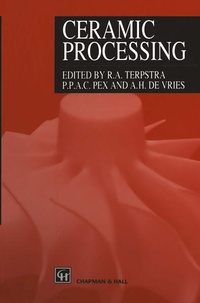
Ceramic Processing
Published on 21. October 2012
Book
Paperback/Softback
XIV, 217 pages
978-94-010-4236-9 (ISBN)
Description
Ceramic Processing is the first comprehensive, stand alone, multi-authored book on advanced ceramic processing. It provides an overview of the important processing steps involved in the fabrication of advanced ceramics for structural and functional applications.
Reviews / Votes
...it is a valuable contribution and worth a read - Materials WorldMore details
Edition
Softcover reprint of the original 1st ed. 1995
Language
English
Place of publication
Dordrecht
Netherlands
Target group
Professional and scholarly
Research
Illustrations
XIV, 217 p.
Dimensions
Height: 235 mm
Width: 155 mm
Thickness: 13 mm
Weight
365 gr
ISBN-13
978-94-010-4236-9 (9789401042369)
DOI
10.1007/978-94-011-0531-6
Schweitzer Classification
Other editions
Additional editions
R.A. Terpstra | Paul Pex | Andre de Vries
Ceramic Processing
E-Book
12/2012
Springer
€149.79
Available for download
R.A. Terpstra | Paul Pex | Andre de Vries
Ceramic Processing
Book
07/1995
Chapman and Hall
€160.49
Shipment within 10-20 days
Content
1 Special ceramics for modern applications: which? why? how?.- 1.1 Introduction.- 1.2 Predictions arising from simple considerations of strength.- 1.3 Materials predictions based on equation (1.16).- 1.4 Some predictions based on fracture toughness.- 1.5 The size and shape of materials needed for processing.- 1.6 Prediction of limiting particle size arising from mechanical grinding.- 1.7 Combination of ultrafine ceramic powders and fibres: ceramic-ceramic composites.- 1.8 Relative costs.- 1.9 Self-propagating high-temperature synthesis (SHS).- References.- 2 Laser vapour phase synthesis of ceramic powders.- 2.1 Introduction.- 2.2 Experimental aspects.- 2.3 Results.- 2.4 Discussion.- 2.5 Conclusions.- References.- 3 Particle interactions in suspensions.- 3.1 Introduction.- 3.2 Surface forces.- 3.3 Behaviour of suspensions.- 3.4 Controlling interparticle forces.- 3.5 Some examples.- References.- 4 Dry pressing of ceramic powders.- 4.1 Introduction.- 4.2 Industrial problems.- 4.3 Macroscopic behaviour: the classical approach.- 4.4 Macroscopic behaviour: the mechanical approach.- 4.5 Microscopic behaviour.- 4.6 Conclusions.- Appendix: Tensor notation for stress.- References.- 5 The principles of tape casting and tape casting applications.- 5.1 Introduction.- 5.2 The doctor blade tape process.- 5.3 Subsequent processing of unfired tapes.- References.- 6 Plastic forming of ceramics: extrusion and injection moulding.- 6.1 Introduction to extrusion.- 6.2 Formulation principles.- 6.3 Mixing.- 6.4 Soil mechanics.- 6.5 The extrusion process.- 6.6 Additional topics.- 6.7 Introduction to injection moulding.- 6.8 Detailed discussion of the process.- 6.9 New approaches to forming complex shapes.- References.