

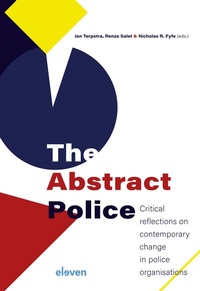
The Abstract Police
Critical reflections on contemporary change in police organisations
Published on 10. February 2022
Book
Hardback
250 pages
978-94-6236-264-2 (ISBN)
Description
Over the past ten to fifteen years the police in many Western European countries have undergone a series of profound organisational changes. The police now appear to operate at a greater distance from citizens, they are more impersonal and decontextualized and have become more dependent on digitalised data systems.
These changes are captured through the concept of the 'abstract police' and in this international collection of essays, leading policing scholars use this concept to make sense of contemporary changes to police organisations.
Drawing on empirical evidence from a wide range of policing contexts, the individual chapters address major questions about current developments in policing:
- How are police organisations being shaped by the social, cultural, technological and political contexts in which they operate?
- How does the concept of the abstract police help understanding of the complex interplay between change and continuity in policing?
- Is the emergence of an abstract police the unintended outcome of processes of rationalization or a deliberate response to the new complexities of late modernity?
These changes are captured through the concept of the 'abstract police' and in this international collection of essays, leading policing scholars use this concept to make sense of contemporary changes to police organisations.
Drawing on empirical evidence from a wide range of policing contexts, the individual chapters address major questions about current developments in policing:
- How are police organisations being shaped by the social, cultural, technological and political contexts in which they operate?
- How does the concept of the abstract police help understanding of the complex interplay between change and continuity in policing?
- Is the emergence of an abstract police the unintended outcome of processes of rationalization or a deliberate response to the new complexities of late modernity?
More details
Language
English
Place of publication
Utrecht
Netherlands
Target group
Professional and scholarly
Dimensions
Height: 240 mm
Width: 165 mm
ISBN-13
978-94-6236-264-2 (9789462362642)
Copyright in bibliographic data and cover images is held by Nielsen Book Services Limited or by the publishers or by their respective licensors: all rights reserved.
Schweitzer Classification
Persons
Jan Terpstra is professor emeritus at the Radboud University of Nijmegen, the Netherlands, and fellow at the Free University of Brussels (Research Group Crime & Society), Belgium. His main topics of research are the police (in practice and in policy), plural policing, criminal justice, and issues of public and private security.
Renze Salet is assistant professor criminology at the department of Criminal Law & Criminology of the Radboud University, Nijmegen (the Netherlands). She conducts research on the empirical functioning of the police and other agencies in the domain of public safety.
Nicholas R. Fyfe is Professor and Vice Principal for Research at Robert Gordon University, Aberdeen. He was the founding Director of the Scottish Institute for Policing Research and his recent works has focused on issues of police reform, the use of research evidence to inform police practice, and the policing of missing persons.
Renze Salet is assistant professor criminology at the department of Criminal Law & Criminology of the Radboud University, Nijmegen (the Netherlands). She conducts research on the empirical functioning of the police and other agencies in the domain of public safety.
Nicholas R. Fyfe is Professor and Vice Principal for Research at Robert Gordon University, Aberdeen. He was the founding Director of the Scottish Institute for Policing Research and his recent works has focused on issues of police reform, the use of research evidence to inform police practice, and the policing of missing persons.
Content
1 Introduction: Abstract Police, the Concept and Some Main Questions, Jan Terpstra, Nicholas R. Fyfe & Renze Salet; 2 The Abstract Police and Occupational Culture, Michael Rowe, Liam Ralph, Andrew Millie & Matthew Jones; 3 Abstract Police and Police 'Professionalism': Contemporary Contradictions in British Policing Tom Cockcroft & Jacques de Maillard; 4 Reform and Emergent Police Practice in Scotland: In Search of Situated Policing Alistair, Henry & Nicholas R. Fyfe; 5 Community Policing in the Age of Abstract Police Jan Terpstra & Renze Salet; 6 Investigating at a Distance: Abstractness in Detective Work, Helene O.I. Gundhus, Niri Talberg & Christin Thea Wathne; 7 Risks of Abstractness in Policing Honour-Based Violence, Janine Janssen; 8 An Assessment of Police Technology and the 'Iron Cage' of the Abstract Police in the United States, James J. Willis, Christopher S. Koper & Cynthia Lum; 9 Good Policing in Times of Abstract Police, Kai Seidensticker & Felix Bode; 10 Canadian Reflections on 'the Abstract Police', James Sheptycki; 11 'Virtual Policing', Trust and Legitimacy, Ben Bradford, Elizabeth Aston, Megan O'Neill & Helen Wells; Contributors