


Think Twice
Sociology Looks at Current Social Issues
Published on 10. August 1998
Book
Paperback/Softback
319 pages
978-0-13-242322-9 (ISBN)
Description
For use as a supplemental reader in the Introductory Sociology, Global Issues, and Culture & Society courses. This text lets students realize for themselves that a "sociological imagination" can help them understand the burning questions of today's society, and that this kind of thinking is within their grasp. It illustrates how understanding society means engaging with its issues. The book consists of a series of debates in which multiple sides of today's hottest topics are examined-Is the environment improving? Is religion dead? Do poor people create their own poverty? Should marijuana be legalized? Is ethnic nationalism destructive? Revealing how much sociology has to contribute to our understanding of these topics, it encourages readers to Think Twice...then think again.
More details
Language
English
Place of publication
United States
Publishing group
Pearson Education (US)
Target group
Professional and scholarly
Dimensions
Height: 236 mm
Width: 180 mm
Thickness: 16 mm
Weight
499 gr
ISBN-13
978-0-13-242322-9 (9780132423229)
Copyright in bibliographic data is held by Nielsen Book Services Limited or its licensors: all rights reserved.
Schweitzer Classification
Other editions
New editions
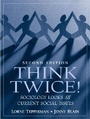
Lorne Tepperman | Jenny Blain
Think Twice! Sociology Looks at Current Social Issues
Book
08/2005
2nd Edition
Pearson
€75.63
Article is exhausted; no reprint
Content
1. Culture.
2. Socialization.
3. Deviance and Control.
4. Class and Stratification.
5. Race and Ethnic Relations.
6. Gender Relations.
7. Family.
8. Work and the Economy.
9. Education.
10. Politics and the State.
11. Health.
12. Population.
13. Religion.
14. Global Inequality.
15. Social Change.
2. Socialization.
3. Deviance and Control.
4. Class and Stratification.
5. Race and Ethnic Relations.
6. Gender Relations.
7. Family.
8. Work and the Economy.
9. Education.
10. Politics and the State.
11. Health.
12. Population.
13. Religion.
14. Global Inequality.
15. Social Change.