

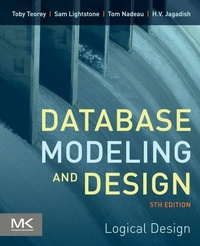
Database Modeling and Design
Logical Design
5th Edition
Published on 28. March 2011
Book
Paperback/Softback
352 pages
978-0-12-382020-4 (ISBN)
Description
Database Modeling and Design, Fifth Edition, focuses on techniques for database design in relational database systems.
This extensively revised fifth edition features clear explanations, lots of terrific examples and an illustrative case, and practical advice, with design rules that are applicable to any SQL-based system. The common examples are based on real-life experiences and have been thoroughly class-tested.
This book is immediately useful to anyone tasked with the creation of data models for the integration of large-scale enterprise data. It is ideal for a stand-alone data management course focused on logical database design, or a supplement to an introductory text for introductory database management.
This extensively revised fifth edition features clear explanations, lots of terrific examples and an illustrative case, and practical advice, with design rules that are applicable to any SQL-based system. The common examples are based on real-life experiences and have been thoroughly class-tested.
This book is immediately useful to anyone tasked with the creation of data models for the integration of large-scale enterprise data. It is ideal for a stand-alone data management course focused on logical database design, or a supplement to an introductory text for introductory database management.
Reviews / Votes
"Database Modeling and Design is one of the best books that I have seen for explaining how to build database applications. The book is informative, well-written, and concise." --Michael Blaha, DSc., Consultant, Modelsoft Consulting Corp"This book book is by far the best book available on classic database design. Topics like normalization and many-to-many and n-ary association semantics are without peer in teaching you how to model real-world complexities. This latest edition extends the classic material with extensive discussion of modern tools and other aspects of logical database design. Every database architect should have this book at hand." --Bob Muller, Data Analyst, Poesys Associates"The book is not only good for beginners, but it also provides greater insight for experienced learners. Perhaps this is why it has evolved into its fifth edition. The book is generally well organized. It starts with the first step in the database life cycle, and progresses in a chronological order to more advanced concepts such as object relational design, Extensible Markup Language (XML), and Web databases. The writing style of the book is simple and straightforward, and the use of database terminology is very concise...In my opinion, the book could be used as a course text, with some help from other sources to cover SQL query-related concepts. However, I would have liked a chapter on SQL that covered simple and complex query design, as well as optimization." --Computing ReviewsMore details
Series
Edition
5th edition
Language
English
Place of publication
San Francisco
United States
Publishing group
Elsevier Science & Technology
Target group
Professional and scholarly
Data management professionals with job titles/functions that include data analyst, data modeler, data architect, database designer, database application developer, application architect, database programmer, programmer/analyst, and database administrator.
Product notice
Paperback (trade)
Illustrations
Approx. 130 illustrations
Dimensions
Height: 234 mm
Width: 192 mm
Thickness: 27 mm
Weight
727 gr
ISBN-13
978-0-12-382020-4 (9780123820204)
Copyright in bibliographic data and cover images is held by Nielsen Book Services Limited or by the publishers or by their respective licensors: all rights reserved.
Schweitzer Classification
Other editions
Additional editions
E-Book
02/2011
5th Edition
Morgan Kaufmann
€49.95
Available for download
Previous edition
Book
10/2005
4th Edition
Morgan Kaufmann
€59.41
Article exhausted; check for reprint
Persons
Toby J. Teorey is a professor in the Electrical Engineering and Computer Science Department at the University of Michigan, Ann Arbor. He received his B.S. and M.S. degrees in electrical engineering from the University of Arizona, Tucson, and a Ph.D. in computer sciences from the University of Wisconsin, Madison. He was general chair of the 1981 ACM SIGMOD Conference and program chair for the 1991 Entity-Relationship Conference. Professor Teorey's current research focuses on database design and data warehousing, OLAP, advanced database systems, and performance of computer networks. He is a member of the ACM and the IEEE Computer Society. Sam Lightstone is a Senior Technical Staff Member and Development Manager with IBM's DB2 product development team. His work includes numerous topics in autonomic computing and relational database management systems. He is cofounder and leader of DB2's autonomic computing R&D effort. He is Chair of the IEEE Data Engineering Workgroup on Self Managing Database Systems and a member of the IEEE Computer Society Task Force on Autonomous and Autonomic Computing. In 2003 he was elected to the Canadian Technical Excellence Council, the Canadian affiliate of the IBM Academy of Technology.
He is an IBM Master Inventor with over 25 patents and patents pending; he has published widely on autonomic computing for relational database systems. He has been with IBM since 1991. Tom Nadeau is the founder of Aladdin Software (aladdinsoftware.com) and works in the area of data and text mining. He received his B.S. degree in computer science and M.S. and Ph.D. degrees in electrical engineering and computer science from the University of Michigan, Ann Arbor. His technical interests include data warehousing, OLAP, data mining and machine learning. He won the best paper award at the 2001 IBM CASCON Conference. H.V. Jagadish is a professor in EE and CS at the University of Michigan, Ann Arbor, where he is part of the database group affiliated with the bioinformatics program and the Center for Computational Medicine and Bioinformatics. Prior to joining the Michigan faculty, he spent over a decade at AT&T Bell Laboratories as a research scientist where he became head of the Database division.
He is an IBM Master Inventor with over 25 patents and patents pending; he has published widely on autonomic computing for relational database systems. He has been with IBM since 1991. Tom Nadeau is the founder of Aladdin Software (aladdinsoftware.com) and works in the area of data and text mining. He received his B.S. degree in computer science and M.S. and Ph.D. degrees in electrical engineering and computer science from the University of Michigan, Ann Arbor. His technical interests include data warehousing, OLAP, data mining and machine learning. He won the best paper award at the 2001 IBM CASCON Conference. H.V. Jagadish is a professor in EE and CS at the University of Michigan, Ann Arbor, where he is part of the database group affiliated with the bioinformatics program and the Center for Computational Medicine and Bioinformatics. Prior to joining the Michigan faculty, he spent over a decade at AT&T Bell Laboratories as a research scientist where he became head of the Database division.
Content
1. Introduction2. The Entity-Relationship Model3. Unified Modeling Language (UML)4. Requirements Analysis and Conceptual Modeling5. Transforming the Conceptual Data Model to SQL6. Normalization7. An Example of Logical Database Design8. Object Relational Design9. XML and Web Databases10. Business Intelligence11. CASE ToolsAppendix: The Basics of SQL