

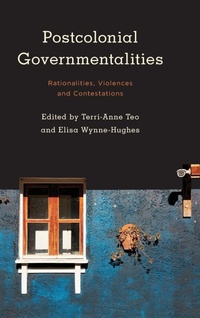
Postcolonial Governmentalities
Rationalities, Violences and Contestations
Published on 19. February 2020
Book
Hardback
280 pages
978-1-78660-682-2 (ISBN)
Description
This edited volume asks how governmentality and postcolonial approaches can be brought together to help us better understand specific sites and practices of contemporary postcolonial governance. The framework/approach was inspired by the recent use of governmentality approaches that emphasize how governance functions not solely through states but through multiple tactics and means that regulate the conduct of individuals and institutions through both freedom and constraint.
A postcolonial approach to governance exposes the role of postcolonial sites and practices in shaping governance and the inequalities embedded within it, insofar as standards of conduct determine which subjects are privileged and excluded.Postcolonial perspectives show how governance can be both productive and repressive, functioning to impose a fixed code of conduct that objectifies (gendered, racialized, sexualized) 'others' as part of its project of improvement. In discussing governance, we must also consider how power is negotiated and challenged through forms of resistance and counter-conduct.
This volume argues that we need to incorporate postcolonial theories and carefully examine postcolonial practices and sites, to understand how contemporary governance shapes various transnational inequalities and social divisions. The authors in this edited volume illustrate the value of postcolonial governance as a conceptual framework through empirical examples from Asia, Australia, Africa, and Europe. These cases unpack practices of governance operating within complex political landscapes.
A postcolonial approach to governance exposes the role of postcolonial sites and practices in shaping governance and the inequalities embedded within it, insofar as standards of conduct determine which subjects are privileged and excluded.Postcolonial perspectives show how governance can be both productive and repressive, functioning to impose a fixed code of conduct that objectifies (gendered, racialized, sexualized) 'others' as part of its project of improvement. In discussing governance, we must also consider how power is negotiated and challenged through forms of resistance and counter-conduct.
This volume argues that we need to incorporate postcolonial theories and carefully examine postcolonial practices and sites, to understand how contemporary governance shapes various transnational inequalities and social divisions. The authors in this edited volume illustrate the value of postcolonial governance as a conceptual framework through empirical examples from Asia, Australia, Africa, and Europe. These cases unpack practices of governance operating within complex political landscapes.
Reviews / Votes
Governmental power works through freedom, but is always racialised, gendered, classed and sexualised. This cutting-edge volume explores these dynamics in contexts beyond the West, and brilliantly shows the flashes of inspiration and illumination that a postcolonial governmentality approach can yield. -- Carl Death, Senior Lecturer in Politics, University of Manchester, UKMore details
Series
Language
English
Place of publication
United Kingdom
Publishing group
Bloomsbury Publishing PLC
Target group
Professional and scholarly
US School Grade: From College Junior to College Graduate Student
Illustrations
2 b/w photos; 1 tables;
Dimensions
Height: 235 mm
Width: 157 mm
Thickness: 21 mm
Weight
609 gr
ISBN-13
978-1-78660-682-2 (9781786606822)
Copyright in bibliographic data and cover images is held by Nielsen Book Services Limited or by the publishers or by their respective licensors: all rights reserved.
Schweitzer Classification
Other editions
Additional editions
Terri-Anne Teo | Elisa Wynne-Hughes
Postcolonial Governmentalities
Rationalities, Violences and Contestations
E-Book
02/2020
1st Edition
Rowman & Littlefield Publishers
€42.49
Available for download
Terri-Anne Teo | Elisa Wynne-Hughes
Postcolonial Governmentalities
Rationalities, Violences and Contestations
E-Book
02/2020
1st Edition
Rowman & Littlefield Publishers
€42.49
Available for download
Person
Elisa Wynne-Hughes is a Lecturer in International Relations at Cardiff University's School of Law and Politics.
Terri-Anne Teo is a Research Fellow at the Centre of Excellence for National Security (CENS), S. Rajaratnam School of International Studies (RSIS), Nanyang Technological University (NTU).
Terri-Anne Teo is a Research Fellow at the Centre of Excellence for National Security (CENS), S. Rajaratnam School of International Studies (RSIS), Nanyang Technological University (NTU).
Content
1. Introduction: Postcolonial Governmentalities, Terri-Anne Teo and Elisa Wynne-Hughes
Part I: Rationalities of Postcolonial Governance
2. Hierarchies, Erasures and Appropriations of Knowledge: Colonial Governmentality in the Global Governance of 'Traditional Knowledge', Karen Tucker
3.Governmentality, Postcolonialism and Hybrid Subjectivities: Stories from International Schools, Elisa Wynne-Hughes and Chiziwiso Pswarayi
4. "Governing Without the Politics": Postcolonial Governmentality and the Indian Middle Classes, Ipshita Basu
Part II: Violent Governmentalities
5. Affect and Postcolonial Governmentality: Consuming Colonial Heritage at London's Maritime Greenwich, Audrey Reeves
6. Governing West Papua: The Limits of Authoritarian Governmentality, Simon Philpott
7. Governmental Logics of an Assassin State, Grace A Musila
Part III: Practices of Contestation and Resistance
8. Temporalising Postcolonial Governmentality for Studies in Forced Migration, Paul Hodge and Faith Curtis
Part I: Rationalities of Postcolonial Governance
2. Hierarchies, Erasures and Appropriations of Knowledge: Colonial Governmentality in the Global Governance of 'Traditional Knowledge', Karen Tucker
3.Governmentality, Postcolonialism and Hybrid Subjectivities: Stories from International Schools, Elisa Wynne-Hughes and Chiziwiso Pswarayi
4. "Governing Without the Politics": Postcolonial Governmentality and the Indian Middle Classes, Ipshita Basu
Part II: Violent Governmentalities
5. Affect and Postcolonial Governmentality: Consuming Colonial Heritage at London's Maritime Greenwich, Audrey Reeves
6. Governing West Papua: The Limits of Authoritarian Governmentality, Simon Philpott
7. Governmental Logics of an Assassin State, Grace A Musila
Part III: Practices of Contestation and Resistance
8. Temporalising Postcolonial Governmentality for Studies in Forced Migration, Paul Hodge and Faith Curtis