

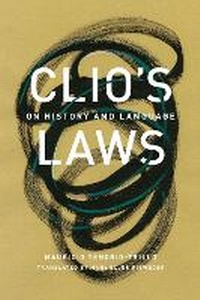
Clio's Laws
On History and Language
Published on 16. December 2019
Book
Hardback
272 pages
978-1-4773-1926-0 (ISBN)
Description
Offering a unique perspective on the very notions and practices of storytelling, history, memory, and language, Clio's Laws collects ten essays (some new and some previously published in Spanish) by a revered voice in global history. Taking its title from the Greek muse of history, this opus considers issues related to the historian's craft, including nationalism and identity, and draws on Tenorio-Trillo's own lifetime of experiences as a historian with deep roots in both Mexico and the United States. By turns deeply ironic, provocative, and experimental, and covering topics both lowbrow and highbrow, the essays form a dialogue with Clio about idiosyncratic yet profound matters.
Tenorio-Trillo presents his own version of an ars historica (what history is, why we write it, and how we abuse it) alongside a very personal essay on the relationship between poetry and history. Other selections include an exploration of the effects of a historian's autobiography, a critique of history's celebratory obsession, and a guide to reading history in an era of internet searches and too many books. A self-described exile, Tenorio-Trillo has produced a singular tour of the historical imagination and its universal traits.
Tenorio-Trillo presents his own version of an ars historica (what history is, why we write it, and how we abuse it) alongside a very personal essay on the relationship between poetry and history. Other selections include an exploration of the effects of a historian's autobiography, a critique of history's celebratory obsession, and a guide to reading history in an era of internet searches and too many books. A self-described exile, Tenorio-Trillo has produced a singular tour of the historical imagination and its universal traits.
Reviews / Votes
Clio's Laws constitutes a fresh depiction of the way history is now conceived and written, far removed from the rigid canons established by its historicist founders...A whole gallery of historical figures, professional historians and literary authors file past over the course of the book, hugely enriching what could have been reduced to a general survey of the most important ideas on the relationship between history and language....Clio's Laws is undoubtedly a valuable and original contribution to the field of historiography and historical-literary criticism, as well as to Latin American studies. (Journal of the Philosophy of History) An eccentric assortment of writings that play, mostly in an ironic and irreverent mode, with the transnational topoi of Latin Americanist historiography as the author has lived and performed them over his notable career trajectory from Mexico to Barcelona and Chicago...the torsions of living, translating, and publishing between one or another manner of Spanish and English...animates the entire collection and may be taken to be its primary insight. (Hispanic American Historical Review) Tenorio-Trillo's book will delight any so-called history buff...Clio's Laws includes so many references across Europe and the Americas that it can be both enticing and dizzying for the reader...Tenorio-Trillo shows a respect for the tradition of historiography but has the mindfulness to discuss its current transformations. Readers convinced by Tenorio-Trillo's playful attitude toward historical imagination will enjoy this book in two ways: they will learn a lot about historiography and history writing, and they will see imaginative history writing being practiced. The pleasure of reading Tenorio-Trillo is worth the price of the book. (Chiricu Journal) Expansive and provocative...Clio's Laws provokes deep thoughts about history: not just the standard reflections on objectivity and knowledge, but rather takes the reader through a range of often idiosyncratic topics spanning from the laws of history to personal narratives, historical imagination, memory, and language...Clio's Laws both reminded me of-and exposed me again to-the love of being a historian, reveling in imagination and the very human stories we share and contemplate...This is a book that deserves wide readership, both among graduate students as well as practicing historians needing a reconnection with what makes our calling unique...This is an excellent book. (American Historical Review)More details
Language
English
Place of publication
Austin, TX
United States
Target group
Professional and scholarly
Dimensions
Height: 229 mm
Width: 152 mm
Thickness: 28 mm
Weight
567 gr
ISBN-13
978-1-4773-1926-0 (9781477319260)
Copyright in bibliographic data and cover images is held by Nielsen Book Services Limited or by the publishers or by their respective licensors: all rights reserved.
Schweitzer Classification
Other editions
Additional editions

E-Book
12/2019
1st Edition
University of Texas Press
€114.99
Available for download
Persons
Mauricio Tenorio-Trillo is the Samuel N. Harper Professor of History, Romance Languages, and Literatures at the University of Chicago and an associate professor at the Centro de lnvestigaciOn y Docencia EconOmicas (CIDE) in Mexico City. He is the author of several previous books, including La Paz: 1876 and I Speak of the City: Mexico City at the Turn of the Century, which won the Spiro Kostof Book Award from the Society of Architectural Historians.
Content
Preamble
I. On History
Chapter 1. The Laws of History
Chapter 2. Poetry and History
Chapter 3. The Historical Imagination
Chapter 4. Reading History Today
Chapter 5. Celebrating History: Between Ser and Estar
Chapter 6. Self-History and Autobiography
Chapter 7. Six Life Stories by Heart
II. On Language
Chapter 8. Polyglotism and Monolingualism
Chapter 9. Amar queriendo como en otro tiempo: Language, Memory, and Boleros
Chapter 10. Wicked Tongue (Extracts)
Notes
Bibliography
I. On History
Chapter 1. The Laws of History
Chapter 2. Poetry and History
Chapter 3. The Historical Imagination
Chapter 4. Reading History Today
Chapter 5. Celebrating History: Between Ser and Estar
Chapter 6. Self-History and Autobiography
Chapter 7. Six Life Stories by Heart
II. On Language
Chapter 8. Polyglotism and Monolingualism
Chapter 9. Amar queriendo como en otro tiempo: Language, Memory, and Boleros
Chapter 10. Wicked Tongue (Extracts)
Notes
Bibliography