

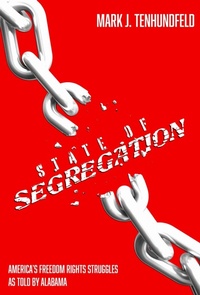
State of Segregation
Description
A revealing legal journey through Alabama's civil rights battles, exposing systemic discrimination and the enduring fight for justice via landmark Supreme Court cases
State of Segregation: America's Freedom Rights Struggles, as Told by Alabama by Mark J. Tenhundfeld offers a compelling exploration of Alabama's civil rights and civil liberties history through the lens of thirty-two pivotal US Supreme Court cases. Each case, rooted in Alabama's social and legal conflicts, reveals the persistent struggle to fulfill the Constitution's promises of equal protection and due process. From early twentieth-century challenges to the Alabama Constitution of 1901 to contemporary battles over gerrymandering, Tenhundfeld traces how discrimination was embedded in the state's institutions—and how it was contested.
State of Segregation uniquely blends legal analysis, historical narrative, and social commentary to expose the deep-rooted systems of racial, gender, and class-based discrimination in Alabama. Tenhundfeld argues that while discrimination is the most defining feature of Alabama's past, it remains the most difficult to confront. By illuminating the legal strategies used to uphold and dismantle injustice, State of Segregation contributes to the broader understanding of how historical inequities continue to shape modern society.
Accessible to general readers and scholars alike, this work stands apart by combining Alabama history, civil rights struggles, and Supreme Court jurisprudence into a single, powerful narrative. It offers both cautionary tales about the fragility of freedom and enduring lessons for today's social justice advocates.
More details
Person
Content
Preface
Introduction
Part I: Voting Rights
Chapter 1: And You Thought Plessy Was Bad—Giles v. Harris (1903)
Chapter 2: What Has Twenty-Eight Sides and Cheats?—Gomillion v. Lightfoot (1960)
Chapter 3: Trees, People . . . Whatever—Reynolds v. Sims (1964)
Chapter 4: A Smoking Gun to the Rescue—City of Mobile v. Bolden (1980)
Chapter 5: An Effective Voting Rights Act—Allen v. Milligan (2023)
Chapter 6: Throw Away That Umbrella—Shelby County v. Holder (2013)
Chapter 7: A Vexing Vestige—Hunter v. Underwood (1985)
Part II: Public Accommodations
Chapter 8: Standing Up for a Seat—Browder v. Gayle (1956)
Chapter 9: And How'd You Spend Your Christmas Vacation?—Boynton v. Virginia (1960)
Chapter 10: The Ribs That Ate the South—Katzenbach v. McClung (1964)
Chapter 11: No Fun to Stay at the YMCA—Gilmore v. City of Montgomery (1974)
Part III: Public Education
Chapter 12: Who Knew Things Were So Good?—Shuttlesworth v. Birmingham Board of Education (1958)
Chapter 13: The Battle Is Joined—Lee v. Macon County Board of Education (1967)
Chapter 14: Frank Johnson, Rock Star—Carr v. Montgomery Board of Education (1974)
Chapter 15: A Bus to Nowhere—Davis v. Board of School Commissioners of Mobile County (1971)
Part IV: Employment
Chapter 16: No Railroading of Black Employees, Please—Steele v. Louisville & N. R. Co. (1944)
Chapter 17: A Trouper for Trying—United States v. Paradise (1987)
Chapter 18: A Presumptuous Congress—Frontiero v. Richardson (1973)
Chapter 19: Checks and Balances—Ledbetter v. Goodyear Tire and Rubber Company (2007)
Part V: First Amendment
Chapter 20: If You Can't Beat 'Em, Enjoin 'Em—NAACP v. Alabama (1958)
Chapter 21: Heed Their Rising (If Slightly Distorted) Voices—New York Times v. Sullivan (1964)
Chapter 22: A Corrupt Corrupt Practices Act—Mills v. Alabama (1966)
Chapter 23: When Is a Law Not a Law?—Shuttlesworth v. Birmingham (1969)
Chapter 24: Rich Folks Must Have a Lot to Say—McCutcheon v. Federal Election Commission (2014)
Chapter 25: The Judge That Didn't Have a Prayer—Wallace v. Jaffree (1985)
Part VI: Criminal Justice
Chapter 26: Fallen Women and Fall Guys—Powell v. Alabama (1932)
Chapter 27: Experts for Sale—Hinton v. Alabama (2014)
Chapter 28: A Jury Not of Your Peers—Norris v. Alabama (1935)
Chapter 29: The Least of My Brothers—Miller v. Alabama (2012)
Chapter 30: "The Law Is a Ass"—McMillian v. Alabama (1997)
Part VII: Slavery
Chapter 31: A Backward Advance—Bailey v. Alabama (1911)
Chapter 32: Petit Larceny of Freedom—United States v. Reynolds (1914)
Epilogue
Notes
Works Cited
Index