

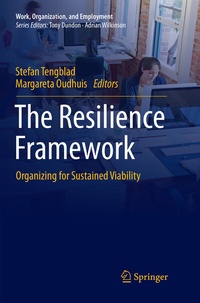
The Resilience Framework
Organizing for Sustained Viability
Published on 12. January 2019
Book
Paperback/Softback
XXI, 264 pages
978-981-13-5363-5 (ISBN)
Description
This book puts forward a carefully crafted theoretical framework that makes a substantial contribution to the field of organizational resilience. It is a framework that goes far beyond the traditional crisis management perspective (accidents, scandals, etc) to an investigation of the characteristics and factors that make organizations viable over time. The book creates a much-needed link between human resource management and organizational development on the one hand, and the literature about risk and crises management and resilience engineering on the other.
The book assembles several robust social science theories such as evolutionary theory, complexity theory, and institutional theory, as well as concepts from management theory such as followership, organizational trust, open innovation, and serendipity management into a coherent framework. It also integrates important models from the field of resilience engineering that have not previously been included in the research on organizational resilience. Several new models are used to present the theoretical framework, models that have relevance for researchers as well as practitioners. In addition to the theoretical framework, all chapters are set in various practical environments that both illustrate the use of resilience resources and align with the framework itself.
The book assembles several robust social science theories such as evolutionary theory, complexity theory, and institutional theory, as well as concepts from management theory such as followership, organizational trust, open innovation, and serendipity management into a coherent framework. It also integrates important models from the field of resilience engineering that have not previously been included in the research on organizational resilience. Several new models are used to present the theoretical framework, models that have relevance for researchers as well as practitioners. In addition to the theoretical framework, all chapters are set in various practical environments that both illustrate the use of resilience resources and align with the framework itself.
More details
Series
Edition
Softcover reprint of the original 1st ed. 2018
Language
English
Place of publication
Singapore
Singapore
Target group
Professional and scholarly
Illustrations
13 s/w Abbildungen, 6 farbige Abbildungen
XXI, 264 p. 19 illus., 6 illus. in color.
Dimensions
Height: 235 mm
Width: 155 mm
Thickness: 15 mm
Weight
501 gr
ISBN-13
978-981-13-5363-5 (9789811353635)
DOI
10.1007/978-981-10-5314-6
Schweitzer Classification
Other editions
Additional editions
Book
09/2017
Springer
€192.59
Shipment within 15-20 days
Persons
Stefan Tengblad
is Professor of Business Administration at the University of Skövde, Sweden. He has written and edited various books and articles on managerial work, leadership, and followership. Among his edited books are
The Work of Managers
and
The Art of Science
. He is the leader of the research specialisation centre Enterprises for the Future at the University of Skövde.
Margareta Oudhuis is Professor in Work Science at the University of Borås, Sweden. As a researcher in organization, she has written books and articles on management models, leadership and work organization as well as on culture and the characteristics of enterprises in the Borås region of Sweden. She is a member of the research collaboration Enterprises for the Future between the University of Skövde and the University of Borås.
Margareta Oudhuis is Professor in Work Science at the University of Borås, Sweden. As a researcher in organization, she has written books and articles on management models, leadership and work organization as well as on culture and the characteristics of enterprises in the Borås region of Sweden. She is a member of the research collaboration Enterprises for the Future between the University of Skövde and the University of Borås.
Content
Chapter 1: Organization resilience: What makes companies and organizations sustainable?.- Chapter 2: Organizational resilience: Theoretical framework.- Chapter 3: A resource-based model of organizational resilience.- Chapter 4: The champion company that disappeared: A resilience resources analysis of Circuit City.- Chapter 5: BP and Deepwater Horizon: A catastrophe from a resilience perspective.- Chapter 6: Resilient leadership: Lessons from three legendary business leaders.- Chapter 7: Financial resilience: The role of financial balance, profitability, and ownership.- Chapter 8: Resilience in the product-delivery supply chain.- Chapter 9: Followership: An important social resource for organizational resilience.- Chapter 10: Followership for organizational resilience in healthcare.- Chapter 11: Organizational resilience and stagnation at a fashion company.- Chapter 12: Business clusters and organizational resilience.- Chapter 13: Regional resilience.- Chapter 14: Conclusions: The resilience framework summarised.