

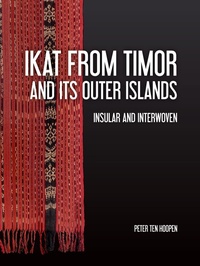
Ikat from Timor and its outer Islands
Insular and Interwoven
1st Edition
Published on 28. September 2022
Book
Hardback
320 pages
978-94-6428-013-5 (ISBN)
Description
This is the first study to focus on ikat of the Timor region from a technical perspective, including microscopy and design analysis of asymmetry, an understudied subject. Paradoxically this technical perspective highlights the human factor. Focused on the last century of the colonial period, we see the weaver's decisions in close-up, as if we are sitting next to her. This yields rich insights, not just in materiality, but also in the weavers' creativity.
Asymmetry is widely distributed in the region, yet has largely been ignored. This is curious, because asymmetry is highly interesting: it goes against ikat's technical diktat (which prescribes the production of two identical panels in parallel), hence requires extra work. Seven distinct ways to achieve asym-metry are differentiated, including visual tricks and illusions, flagrant displays of virtuosity and intellectual superiority. On Sumba, women of the nobility made thrilling and amusing efforts to hide their virtuosity, dyeing into their men's cloths tiny visual devices, secret keys, which revealed that their work was not just good, but luar biasa, out of the ordinary. Ironically, because these late 19th- and early 20th-century dyers were such great masters at hiding their virtuosity, it remained overlooked by generations of researchers.
Taking up Marie Jeanne Adams's 1969 call, so far unheeded, to deepen the study of Indonesian ikat textiles by means of microscopy, the author shot thousands of micro-photographs, allowing a study of yarn development over time, as well as the differentiation of 21 distinct weave types, a number far exceeding expectation, and their distribution across 41 ikat weaving regions in the Indonesian archipelago.
In the final chapter the author analyses what may have spurred the weavers of the region to create their most intricate, most time consuming, feats of artistry, and develops a view of these women as far more inventive and intelligent than they have been credited with before - and more assertive, using ikat's prestige to spin their men into a web of taboos and prescriptions.
Asymmetry is widely distributed in the region, yet has largely been ignored. This is curious, because asymmetry is highly interesting: it goes against ikat's technical diktat (which prescribes the production of two identical panels in parallel), hence requires extra work. Seven distinct ways to achieve asym-metry are differentiated, including visual tricks and illusions, flagrant displays of virtuosity and intellectual superiority. On Sumba, women of the nobility made thrilling and amusing efforts to hide their virtuosity, dyeing into their men's cloths tiny visual devices, secret keys, which revealed that their work was not just good, but luar biasa, out of the ordinary. Ironically, because these late 19th- and early 20th-century dyers were such great masters at hiding their virtuosity, it remained overlooked by generations of researchers.
Taking up Marie Jeanne Adams's 1969 call, so far unheeded, to deepen the study of Indonesian ikat textiles by means of microscopy, the author shot thousands of micro-photographs, allowing a study of yarn development over time, as well as the differentiation of 21 distinct weave types, a number far exceeding expectation, and their distribution across 41 ikat weaving regions in the Indonesian archipelago.
In the final chapter the author analyses what may have spurred the weavers of the region to create their most intricate, most time consuming, feats of artistry, and develops a view of these women as far more inventive and intelligent than they have been credited with before - and more assertive, using ikat's prestige to spin their men into a web of taboos and prescriptions.
More details
Thesis
Doctoral thesis
Edition
1. Auflage
Language
English
Place of publication
Leiden
Netherlands
Target group
Professional and scholarly
Illustrations
350fc/5bw
Dimensions
Height: 286 mm
Width: 215 mm
Thickness: 25 mm
Weight
1410 gr
ISBN-13
978-94-6428-013-5 (9789464280135)
Copyright in bibliographic data and cover images is held by Nielsen Book Services Limited or by the publishers or by their respective licensors: all rights reserved.
Schweitzer Classification
Person
Dr. Peter ten Hoopen was born in the Netherlands in 1944. After completing his Gymnasium ss education he started out as a journalist and translator. From 1968 to 1971 he lived in and travelled through the Middle East and South Asia, conducting journalistic research and recording ethnic music in Afghanistan, now curated by the Smithsonian Institution (Washington, DC). During his extensive travels in 65 countries in subsequent years he witnessed the ongoing decline of numerous indigenous traditions. This experience affected him deeply and in 1976 led to his initiative to assemble a reference collection of particularly imperilled Indonesian ikat textiles - meticulously documented on a level not previously attempted.
Recognition for his literary work led to an appointment as writer in residence at the University of Michigan during the academic year 1984-1985, teaching creative writing. Throughout the remainder of the 20th century, he kept writing in three fields: journalism, belles-lettres and advertising. From 2000 to 2010, building on his international background, he worked world-wide as a consultant and coach, teaching managers and companies to improve their cross-cultural effectiveness. In the process he developed new research software and wrote as well as co-authored several handbooks on coaching and leadership. Two of the latter were based on fine-grained ethnographic research of corporate cultures.
Since his retirement in 2010 Peter ten Hoopen has been focussing on documenting of the above-mentioned, by then extensive reference collection of Indonesian ikat textiles. This has led to major exhibitions at the Museu do Oriente in Lisbon (2014-2015 and 2019-2020) and at the Museum and Art Gallery, the University of Hong Kong (2017-2018), for which he authored or edited the catalogues. His collecting and documenting since the mid-1970s culminated in the publication of his Ikat Textiles of the Indonesian Archipelago (2018) and the research reported in the present PhD thesis.
Recognition for his literary work led to an appointment as writer in residence at the University of Michigan during the academic year 1984-1985, teaching creative writing. Throughout the remainder of the 20th century, he kept writing in three fields: journalism, belles-lettres and advertising. From 2000 to 2010, building on his international background, he worked world-wide as a consultant and coach, teaching managers and companies to improve their cross-cultural effectiveness. In the process he developed new research software and wrote as well as co-authored several handbooks on coaching and leadership. Two of the latter were based on fine-grained ethnographic research of corporate cultures.
Since his retirement in 2010 Peter ten Hoopen has been focussing on documenting of the above-mentioned, by then extensive reference collection of Indonesian ikat textiles. This has led to major exhibitions at the Museu do Oriente in Lisbon (2014-2015 and 2019-2020) and at the Museum and Art Gallery, the University of Hong Kong (2017-2018), for which he authored or edited the catalogues. His collecting and documenting since the mid-1970s culminated in the publication of his Ikat Textiles of the Indonesian Archipelago (2018) and the research reported in the present PhD thesis.
Content
Preface
1. Angles of investigation
1.1 Status quaestionis
1.2 The Austronesian ikat tradition
1.3 The field of study
1.4 Focus on older specimens
1.5 The Reference Set
2. Yarn and weave types
2.1 Fibres under the microscope
2.2 Varieties of plying
2.3 Introduction of machine-made thread
2.4 Weave varieties per region
2.5 Irregular weaves pose questions about motivation
3. Distribution of shared motifs
3.1 Emblems of identity and connection
3.2 Motives for adopting 'foreign' motifs
3.3 Whose pattern is it anyway?
3.4 Motifs shared across the region under study
3.4.1 Linked hexagons
3.4.2 The Pictorial Strip, Rimanu
3.4.3 The Human figure, stand-alone
3.4.4 The Double-headed eagle
3.4.5 The Triangle-with-projections
3.4.6 The Eight-pointed star
3.4.7 The 'Breast beam' motif
3.4.8 The Keu motif
4. Asymmetry - in defiance of ikat's technical diktat
4.1 Techniques to achieve asymmetry
4.2 Sought complexity: asymmetry as proof of mastery
4.3 Incidental asymmetry - intentional or accidental
5. Ikat in its social context
6. Conclusion: technical research highlights female talents
Abstract
Appendix
Bibliography
Acknowledgements
Pronunciation Guide
Colophon
Index
1. Angles of investigation
1.1 Status quaestionis
1.2 The Austronesian ikat tradition
1.3 The field of study
1.4 Focus on older specimens
1.5 The Reference Set
2. Yarn and weave types
2.1 Fibres under the microscope
2.2 Varieties of plying
2.3 Introduction of machine-made thread
2.4 Weave varieties per region
2.5 Irregular weaves pose questions about motivation
3. Distribution of shared motifs
3.1 Emblems of identity and connection
3.2 Motives for adopting 'foreign' motifs
3.3 Whose pattern is it anyway?
3.4 Motifs shared across the region under study
3.4.1 Linked hexagons
3.4.2 The Pictorial Strip, Rimanu
3.4.3 The Human figure, stand-alone
3.4.4 The Double-headed eagle
3.4.5 The Triangle-with-projections
3.4.6 The Eight-pointed star
3.4.7 The 'Breast beam' motif
3.4.8 The Keu motif
4. Asymmetry - in defiance of ikat's technical diktat
4.1 Techniques to achieve asymmetry
4.2 Sought complexity: asymmetry as proof of mastery
4.3 Incidental asymmetry - intentional or accidental
5. Ikat in its social context
6. Conclusion: technical research highlights female talents
Abstract
Appendix
Bibliography
Acknowledgements
Pronunciation Guide
Colophon
Index