

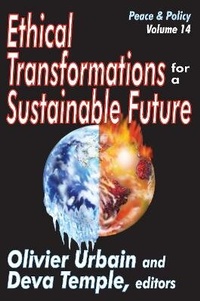
Ethical Transformations for a Sustainable Future
Peace and Policy
1st Edition
Published on 15. January 2011
Book
Paperback/Softback
166 pages
978-1-4128-1445-4 (ISBN)
Description
It has become increasingly apparent that humanity's complex social, political, and economic systems are incompatible with the finite capacity of the Earth to replenish resources and absorb wastes. If the planet is to continue to be habitable for the myriad web of other creatures that make life possible, humans must transform their systems so that they are aligned with natural systems. One thing is sure-it will not be Nature's laws, the delicate interdependence that characterizes Earth's ecosystems, that change. The change must begin within each person, and from there permeate throughout our social, political, and economic structures.
The contributors to this volume believe that such transformations are urgently needed and possible, and they offer specific examples. They suggest solutions that call for new perspectives in our ethics, beliefs, traditions, economy, business, gender relations, education, and technology. They show that human beings have the power to implement changes in all natural and social environments.
The chapters in this book have been organized around three keywords: Reconnecting, Reframing, and Rethinking. The contributors argue that we need to reconnect with the Earth and nature, as well as with each other and parts of ourselves that we have ignored for too long. We need to reframe the way in which people prioritize choices in the economy, the way we do business and pursue development; and we need to rethink the mission of education and the roles of technology.
The contributors to this volume believe that such transformations are urgently needed and possible, and they offer specific examples. They suggest solutions that call for new perspectives in our ethics, beliefs, traditions, economy, business, gender relations, education, and technology. They show that human beings have the power to implement changes in all natural and social environments.
The chapters in this book have been organized around three keywords: Reconnecting, Reframing, and Rethinking. The contributors argue that we need to reconnect with the Earth and nature, as well as with each other and parts of ourselves that we have ignored for too long. We need to reframe the way in which people prioritize choices in the economy, the way we do business and pursue development; and we need to rethink the mission of education and the roles of technology.
More details
Series
Language
English
Place of publication
New York
United States
Publishing group
Taylor & Francis Inc
Target group
College/higher education
Dimensions
Height: 229 mm
Width: 152 mm
Weight
310 gr
ISBN-13
978-1-4128-1445-4 (9781412814454)
Copyright in bibliographic data and cover images is held by Nielsen Book Services Limited or by the publishers or by their respective licensors: all rights reserved.
Schweitzer Classification
Other editions
Additional editions
E-Book
09/2017
Routledge
€31.49
Available for download
E-Book
09/2017
Routledge
€31.49
Available for download
Book
09/2017
1st Edition
Routledge
€215.77
Shipment within 10-20 days
Person
Temple, Deva
Content
Introduction, 1 Reconnecting with the Earth and Humanity: Storytelling and Wonder: On the Rejuvenation of Oral Culture as an Ecological Imperative; The Ecology of Equality: From Dominance to Shared Sacredness; Exploring Ethical and Religious Attitudes to Sustainability 2 Reframing Economy and Development: Against So Much Money and Power, Can the Sustainability Movement Succeed? Economic Genesis: The Evolution of a Sustainable; Economy through Values-Based Social Architecture; From Social Engineering to Community Transformation: mul, Grameen Bank, and Mondragon as Exemplar Organizations 3 Rethinking Education and Technology: Sustainable Globalization and Limits to Sustainability; Renewal of Ecological Ethics: Educational; Aspects from a Multicultural Approach to Human[1]Nature Interactivity; The Ethical Implications of Geospatial Technologies and New Perspectives for Community Involvement in the Face of Global Change: The Case of Malaria in Sucre, Venezuela