

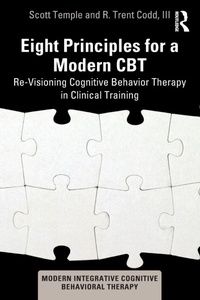
Eight Principles for a Modern CBT
Re-Visioning Cognitive Behavior Therapy in Clinical Training
1st Edition
Will be published approx. on 26. November 2025
Book
Paperback/Softback
246 pages
978-1-032-81829-0 (ISBN)
Description
Eight Principles for a Modern CBT is a training guide for both new and experienced clinicians who want to understand and apply the newest developments in cognitive behavioral therapy. It's a hands-on manual that helps readers sort through competing models for addressing cognitive change, emotion processing, and behavior change. When is acceptance indicated, and how does one "do" acceptance in therapy? How can mindfulness be incorporated in ways that are brief, simple to teach, and effective? How should therapists use clients' values and hopes as guides for setting a course in therapy, rather than focusing exclusively on medicalized diagnoses? How does one tailor treatment for varying levels of severity of impairment? In these pages, readers will find answers to and insights on these questions and much more, including perspectives on evolutionary psychology and newer, process-based models that put human suffering in a less medicalized and stigmatizing frame.
Reviews / Votes
"Eight Principles for a Modern CBT provides clinicians with a humane, sophisticated, realistic, flexible, and practical guide to using a wide range of CBT approaches. Written in a user-friendly style, the years of clinical wisdom gained by treating patients and training therapists comes through in every chapter. Specific case examples illustrate the real room of therapy without a rigid fidelity to a therapeutic model. What I loved about this book was the openness to other approaches, the appreciation and validation of human suffering as an inevitable part of the human condition, and the practical insights and metaphors that the authors provide throughout."Robert L. Leahy, PhD, director, American Institute for Cognitive Therapy and clinical professor, Weill Cornell Medical College
"Temple and Codd address a persistent challenge for training clinicians in cognitive-behavior therapy, namely, how do we give them the most effective tools in the most efficient timeframe? Eight Principles for a Modern CBT isolates the central concepts that form the foundation for clinicians to maximize the efficacy of this complex treatment model. The rich case illustrations provide readers with details on the full gamut of CBT applications with adults. The book should be seriously considered for any professional training clinicians in this approach. It is also an excellent resource for seasoned experts who need a quick reference for problems that might not be a routine part of their everyday practice."
Dean McKay, PhD, ABPP, professor of psychology, Fordham University, past president, Association for Behavioral and Cognitive Therapies, and past president, Society for a Science of Clinical Psychology
"This is a book that aspires to be the 'big tent' under which all the diverse forms of cognitive and behavioral therapies are described and integrated. And it succeeds. Although some may want a deeper dive into each-and ample references are provided for those readers-most will find the clinical integration of these approaches extremely useful. For teachers, this book provides the next step for students who struggle to make sense of how to navigate so many forms and waves of CBT without rigidly adhering to a specific school of thought. For clinicians, the book validates the need to do what works in complex clinical situations. I will use it with my PG4s."
Donna M. Sudak, MD, past president, AADPRT, professor of psychiatry and vice chair for education, Drexel University, and general psychiatry residency program director, Phoenixville Hospital - Tower Health
More details
Series
Language
English
Place of publication
London
United Kingdom
Publishing group
Taylor & Francis Ltd
Target group
Professional and scholarly
Professional Practice & Development
Illustrations
11 s/w Abbildungen, 11 s/w Zeichnungen
11 Line drawings, black and white; 11 Illustrations, black and white
Dimensions
Height: 229 mm
Width: 152 mm
Thickness: 14 mm
Weight
379 gr
ISBN-13
978-1-032-81829-0 (9781032818290)
Copyright in bibliographic data and cover images is held by Nielsen Book Services Limited or by the publishers or by their respective licensors: all rights reserved.
Schweitzer Classification
Other editions
Additional editions
Scott Temple | R. Trent Codd III
Eight Principles for a Modern CBT
Re-Visioning Cognitive Behavior Therapy in Clinical Training
E-Book
11/2025
Routledge
€39.49
Available for download
Scott Temple | R. Trent Codd III
Eight Principles for a Modern CBT
Re-Visioning Cognitive Behavior Therapy in Clinical Training
E-Book
11/2025
Routledge
€39.49
Available for download
Scott Temple | R. Trent Codd III
Eight Principles for a Modern CBT
Re-Visioning Cognitive Behavior Therapy in Clinical Training
Book
approx. 11/2025
1st Edition
Routledge
€233.30
Not yet published
Persons
Scott Temple, PhD, is a clinical psychologist and emeritus professor of psychiatry at the University of Iowa. He is a founding fellow and a certified trainer/consultant in the Academy of Cognitive and Behavioral Therapies. He is the author of two previous books.
R. Trent Codd, III, EdS, is a private practitioner and author. He is a fellow and certified trainer and consultant for the Academy of Cognitive and Behavioral Therapies. He is author or co-author of six books.
R. Trent Codd, III, EdS, is a private practitioner and author. He is a fellow and certified trainer and consultant for the Academy of Cognitive and Behavioral Therapies. He is author or co-author of six books.
Content
Part 1: Eight Organizing Principles for CBT 1. Introduction 2. Principle #1: Normalizing Human Suffering 3. Principle #2: Transdiagnostic Processes 4. Principle #3: A Focus on Client Strengths and Values 5. Principle #4: The Use of Guided Discovery and Validation Strategies in Fostering the Treatment Relationship 6. Principle #5: Balancing Acceptance, Mindfulness, and Change Processes 7. Principle #6: Balancing Cognitive and Experiential Interventions in CBT 8. Principle #7: Self Processes 9. Principle #8: A Contextual Account of Human Functioning Part 2: Case Applications 10. Introduction and Format of Presentations 11. Case #1: A Desperate Mother 12. Case #2: The Lone Ranger 13. Case #3: A Case of Coke 14. Case #4: Parents of a Self-Injuring Teen 15. Case #5: The Case of Efran-Finding Meaning