

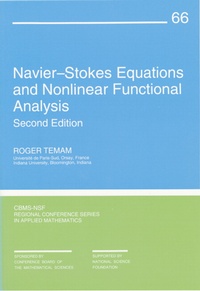
Navier-Stokes Equations and Nonlinear Function Analysis
2nd Edition
Will be published approx. on 31. December 1996
Book
Paperback/Softback
165 pages
978-0-89871-340-4 (ISBN)
Description
This second edition, like the first, attempts to arrive as simply as possible at some central problems in the Navier Stokes equations in the following areas: existence, uniqueness, and regularity of solutions in space dimensions two and three; large time behaviour of solutions and attractors; and numerical analysis of the Navier Stokes equations. Since publication of the first edition of these lectures in 1983, there has been extensive research in the area of inertial manifolds for Navier Stokes equations. These developments are addressed in a new section devoted entirely to inertial manifolds.
Inertial manifolds were first introduced under this name in 1985 and, since then, have been systematically studied for partial differential equations of the Navier Stokes type. Inertial manifolds are a global version of central manifolds. When they exist they encompass the complete dynamics of a system, reducing the dynamics of an infinite system to that of a smooth, finite dimensional one called the inertial system. Although the theory of inertial manifolds for Navier Stokes equations is not complete at this time, there is already a very interesting and significant set of results which deserves to be known, in the hope that it will stimulate further research in this area. These results are reported in this edition.
Part I presents the Navier Stokes equations of viscous incompressible fluids and the main boundary value problems usually associated with these equations. The case of the flow in a bounded domain with periodic or zero boundary conditions is studied and the functional setting of the equation as well as various results on existence, uniqueness, and regularity of time dependent solutions are given. Part II studies the behavior of solutions of the Navier Stokes equation when t approaches infinity and attempts to explain turbulence. Part III treats questions related to numerical approximation. In the Appendix, which is new to the second edition, concepts of inertial manifolds are described, definitions and some typical results are recalled, and the existence of inertial systems for two dimensional Navier Stokes equations is shown.
Inertial manifolds were first introduced under this name in 1985 and, since then, have been systematically studied for partial differential equations of the Navier Stokes type. Inertial manifolds are a global version of central manifolds. When they exist they encompass the complete dynamics of a system, reducing the dynamics of an infinite system to that of a smooth, finite dimensional one called the inertial system. Although the theory of inertial manifolds for Navier Stokes equations is not complete at this time, there is already a very interesting and significant set of results which deserves to be known, in the hope that it will stimulate further research in this area. These results are reported in this edition.
Part I presents the Navier Stokes equations of viscous incompressible fluids and the main boundary value problems usually associated with these equations. The case of the flow in a bounded domain with periodic or zero boundary conditions is studied and the functional setting of the equation as well as various results on existence, uniqueness, and regularity of time dependent solutions are given. Part II studies the behavior of solutions of the Navier Stokes equation when t approaches infinity and attempts to explain turbulence. Part III treats questions related to numerical approximation. In the Appendix, which is new to the second edition, concepts of inertial manifolds are described, definitions and some typical results are recalled, and the existence of inertial systems for two dimensional Navier Stokes equations is shown.
More details
Series
Edition
Second Edition
Language
English
Place of publication
New York
United States
Target group
Professional and scholarly
Edition type
New edition
Product notice
Paperback (trade)
Dimensions
Height: 252 mm
Width: 173 mm
Thickness: 10 mm
Weight
278 gr
ISBN-13
978-0-89871-340-4 (9780898713404)
Copyright in bibliographic data and cover images is held by Nielsen Book Services Limited or by the publishers or by their respective licensors: all rights reserved.
Schweitzer Classification
Content
Preface to the Second Edition
Introduction
Part I: Questions Related to the Existence, Uniqueness and Regularity of Solutions
Chapter 1: Representation of a Flow. The Navier-Stokes Equations
Chapter 2: Functional Setting of the Equations
Chapter 3: Existence and Uniqueness Theorems (Mostly Classical Results)
Chapter 4: New a priori Estimates and Applications
Chapter 5: Regularity and Fractional Dimension
Chapter 6: Successive Regularity and Compatibility Conditions at t=0 (Bounded Case)
Chapter 7: Analyticity in Time
Chapter 8: Lagrangian Representation of the Flow
Part II: Questions Related to Stationary Solutions and Functional Invariant Sets (Attractors)
Chapter 9: The Couette-Taylor Experiment
Chapter 10: Stationary Solutions of the Navier-Stokes Equations
Chapter 11: The Squeezing Property
Chapter 12: Hausdorff Dimension of an Attractor
Part III: Questions Related to the Numerical Approximation
Chapter 13: Finite Time Approximation
Chapter 14: Long Time Approximation of the Navier-Stokes Equations
Appendix: Inertial Manifolds and Navier-Stokes Equations
Comments and Bibliography
Comments and Bibliography: Update for the Second Edition
References.
Introduction
Part I: Questions Related to the Existence, Uniqueness and Regularity of Solutions
Chapter 1: Representation of a Flow. The Navier-Stokes Equations
Chapter 2: Functional Setting of the Equations
Chapter 3: Existence and Uniqueness Theorems (Mostly Classical Results)
Chapter 4: New a priori Estimates and Applications
Chapter 5: Regularity and Fractional Dimension
Chapter 6: Successive Regularity and Compatibility Conditions at t=0 (Bounded Case)
Chapter 7: Analyticity in Time
Chapter 8: Lagrangian Representation of the Flow
Part II: Questions Related to Stationary Solutions and Functional Invariant Sets (Attractors)
Chapter 9: The Couette-Taylor Experiment
Chapter 10: Stationary Solutions of the Navier-Stokes Equations
Chapter 11: The Squeezing Property
Chapter 12: Hausdorff Dimension of an Attractor
Part III: Questions Related to the Numerical Approximation
Chapter 13: Finite Time Approximation
Chapter 14: Long Time Approximation of the Navier-Stokes Equations
Appendix: Inertial Manifolds and Navier-Stokes Equations
Comments and Bibliography
Comments and Bibliography: Update for the Second Edition
References.