

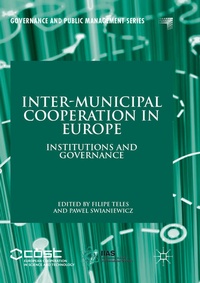
Inter-Municipal Cooperation in Europe
Institutions and Governance
Published on 5. September 2018
Book
Paperback/Softback
XIV, 354 pages
978-3-319-87404-3 (ISBN)
Description
This book sheds light on the central complexities of municipal cooperation and examines the dynamics, experiences and drivers of inter-municipal cooperation (IMC) in Europe. Particular attention is given to the features of governance arrangements and institutions created to generate and maintain collaborative settings between different local governments in a particular territory.
The thematically grouped case studies presented here address the dearth of comprehensive and comparative analyses in recent scholarship. The authors provide fresh insights into the rise of inter-municipal cooperation and its evolution during a period of financial crisis and European Union enlargement. This includes critical examinations of the impact of austerity policies, the behavior and perceptions of key actors; and under-explored new member states. Crucially, this work goes beyond the comparison of institutional forms of IMC to address why the phenomenon so widespread and questions whether it is successful, manageable and democratic.
This work which presents the most recent and innovative research on inter-local collaborative arrangements will appeal to practitioners as well as scholars of local government, public economy, public administration and policy.
The thematically grouped case studies presented here address the dearth of comprehensive and comparative analyses in recent scholarship. The authors provide fresh insights into the rise of inter-municipal cooperation and its evolution during a period of financial crisis and European Union enlargement. This includes critical examinations of the impact of austerity policies, the behavior and perceptions of key actors; and under-explored new member states. Crucially, this work goes beyond the comparison of institutional forms of IMC to address why the phenomenon so widespread and questions whether it is successful, manageable and democratic.
This work which presents the most recent and innovative research on inter-local collaborative arrangements will appeal to practitioners as well as scholars of local government, public economy, public administration and policy.
Reviews / Votes
"This book makes a value contribution in helping us to understand a classic governance manoeuvre in the context of constrained resources: inter-municipal cooperation. It explores using comparative material the dynamics, pitfalls and achievements of trying to get more for less by working with partners. The understanding that is gained provides lessons beyond local government for public administration in general." (Gerry Stoker, Professor of Governance, University of Southampton, UK )"By assembling expert analyses on 20 European countries and by focusing on the recent phase of fiscal austerity policies, this excellent edited book on "inter-municipal cooperation in Europe" covers more European countries and is more up-to-date than any other available publication. Thus it is "must" reading for students, academics and practitioners interested in in this crucial issue of local/subnational reorganization and governance." (Hellmut Wollmann, Professor Emeritus, Humboldt-Universität Berlin,Germany)
More details
Series
Edition
Softcover reprint of the original 1st ed. 2018
Language
English
Place of publication
Cham
Switzerland
Publishing group
Springer International Publishing
Target group
Professional and scholarly
Illustrations
4 s/w Abbildungen, 15 farbige Abbildungen
XIV, 354 p. 19 illus., 15 illus. in color.
Dimensions
Height: 210 mm
Width: 148 mm
Thickness: 20 mm
Weight
476 gr
ISBN-13
978-3-319-87404-3 (9783319874043)
DOI
10.1007/978-3-319-62819-6
Schweitzer Classification
Other editions
Additional editions
Book
11/2017
Palgrave Macmillan
€149.79
Shipment within 10-15 days
Persons
Filipe Teles is Assistant Professor at the University of Aveiro, Portugal, where he teaches courses in the fields of Public Policy and Political Science, and member of the Research Unit on Governance, Competitiveness and Public Policy. He has developed research work on local governance, public administration, territorial reforms and political leadership.
Pawel Swianiewicz is Professor of Economics and head of the Department of Local Development and Policy at the Faculty of Geography and Regional Studies at the University of Warsaw. His research focuses on local politics, local government finance, territorial and decentralization reforms with a special focus on countries of Central and Eastern Europe.
Pawel Swianiewicz is Professor of Economics and head of the Department of Local Development and Policy at the Faculty of Geography and Regional Studies at the University of Warsaw. His research focuses on local politics, local government finance, territorial and decentralization reforms with a special focus on countries of Central and Eastern Europe.
Content
1: Introduction: motives for revisiting inter-municipal cooperation; Filipe Teles and Pawel Swianiewicz.- Section One - Drivers, Democracy and Delivery.- 2: Inter-municipal cooperation and austerity policies: obstacles or opportunities?; Ringa Raudla and António Tavares.- 3: Actors in inter-municipal cooperation; Pawel Swianiewicz.- 4:A borrowed mandate? Democratic legitimacy of inter-municipal entities - a comparative analysis; Adam Gendzwill and Marta Lackowska.- 5: Striving for local governance capacity in Portugal and Spain; Patrícia Silva and Esther Pano.- 6: Reasons for inter-municipal cooperation: A comparative analysis of Finland, Iceland and Norway; Grétar Thór Eythórsson, Pekka Kettunen, and Jan Erling Klausen.- Section Two - Cooperation in Europe.- 7: Inter-municipal cooperation in France: a continuous reform, new trends; Robert Hertzog.- 8: Inter-municipal cooperation in the Netherlands; Pieter-Jan Klok, Marcel Boogers, Bas Denters, Maurits Sanders.- 9: Inter-municipal cooperation in Switzerland; Reto Steiner and Claire Kaiser.- 10: Traditions, problems and challenges of inter-municipal cooperation in the German federal state of Brandenburg; Jochen Franzke.- 11: Bigger and stronger together: How Icelandic municipalities solve their lack of capacity and scale economy; Grétar Thór Eythórsson.- 12: Inter-local financial transfers as a measure of cooperation in Poland; Julita Lukomska and Katarzyna Szmigiel-Rawska.- 13: Inter-municipal cooperation in Slovenia: an intermediate step towards regionalization; Irena Baclija-Brajnik.- 14: Layer upon layer: the position of inter-municipal cooperation in the Spanish quasi-federal system - the case of Catalonia; Esther Pano Puey, Lluis Medir Tejado, Carla Puiggròs Mussons and Jaume Magre Ferran.- Section Three - Success and failure: case-studies.- 15: The rise and fall of the union: a case in Poland; Pawel Swianiewicz and Adam Gendzwill.- 16: The architecture of a complex system: the Oradea Metropolitan Area in Romania; Cristina Stanu?.- 17: Korça Waste Management and the territorial reform in Albania; Alba Dakoli Wilson .- 18: Mapping the success: inter-municipal cooperation in two Czech Micro-regions; Jakub Lysek and Pavel Saradín.- 19: Can tiny municipalities survive through extensive IMC arrangements? The case of Iceland; Eva Marín Hlynsdóttir.- 20: Conclusion: Inter-municipal cooperation diversity, evolution and future research agenda; Pawel Swianiewicz and Filipe Teles.