

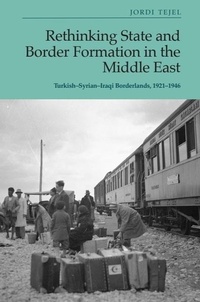
Rethinking State and Border Formation in the Middle East
Turkish-Syrian-Iraqi Borderlands, 1921-46
Published on 18. May 2023
Book
Hardback
376 pages
978-1-3995-0365-5 (ISBN)
Description
While the wars in Iraq, Syria, Libya and Yemen, alongside the establishment of the so-called "Islamic Caliphate" have brought the debate about the crisis of the territorial nation-state in the Middle East once again to the fore, this issue cannot be simply understood as the logical consequence of either an imported political construction or the purported artificiality of Middle Eastern borders. Instead, the process of state formation in the region has been a complicated course that involved different institutional traditions, managing societies marked by varying degrees of political loyalty to central power, and dealing with colonial interference. Rethinking State and Border Formation in the Middle East seeks to disentangle some of these complexities by proposing both a decentred and dialectic approach. Taking its cue from the bourgeoning field of borderland studies and a variety of historical sub-disciplines, this monograph pays attention to the circulation of people, goods, diseases and ideas as well as to the everyday encounters between a wide range of state and non-state actors in the borderlands laying between Turkey, Syria and Iraq. The goal is to provide a much more holistic yet finely-grained understanding of the formation of the territorial state in the interwar Middle East.
Reviews / Votes
Rethinking State and Border Formation in the Middle East studies borders and bordering as dialectic processes, in which policy and the reality of border were mutually constitutive. Empirically rich and meticulously researched, the book masterfully weaves together the macro-level of international relations, with the micro-level of borderlanders' lives. Inhabiting the pages of the book are nomads, rebels, smugglers, refugees, trains, cattle, locust and germs, whose mobility were affected by and helped shape the reality of the tri-border zone laying between Turkey, Syria, and Iraq. -- Liat Kozma, The Hebrew University of Jerusalem Theoretically astute and empirically meticulous, Jordi Tejel's Rethinking State and Border Formation in the Middle East deftly navigates between high diplomacy and everyday issues on the border. Tejel exposes a region long left out of conventional histories by centering the dynamism of borderlanders themselves, including border-crossing Sufi healers, silk-stocking smugglers and polyglot merchants who used Ottoman currency even after the empire's demise. -- Samuel Dolbee, Vanderbilt University Jordi Tejel's Rethinking State and Border Formation in the Middle East offers a fresh perspective on the region's state and boundary formation process during that critical juncture of the first two decades after the fall of the Ottoman Empire. -- Anuradha Jangra, Jawaharlal Nehru University * Kurdish Studies Journal * There is little doubt that Rethinking State and Border Formation in the Middle East is a major scholarly achievement. Supported by extensive original research conducted in British, French, German, and Turkish archives, Tejel presents a vivid account of the Turkish-Syrian-Iraqi borderlands at a critical historical juncture. -- Djene Rhys Bajalan, Missouri State University * Bustan: The Middle East Book Review *More details
Language
English
Place of publication
Edinburgh
United Kingdom
Product notice
sewn/stitched
Cloth over boards
Illustrations
4 black and white illustrations, 4 black and white maps
Dimensions
Height: 234 mm
Width: 156 mm
Thickness: 22 mm
Weight
721 gr
ISBN-13
978-1-3995-0365-5 (9781399503655)
Copyright in bibliographic data and cover images is held by Nielsen Book Services Limited or by the publishers or by their respective licensors: all rights reserved.
Schweitzer Classification
Person
Jordi Tejel is Research Professor in Contemporary History at the University of Neuchatel. Between 2017-2022, he has led a European Research Council (ERC, Consolidator Grant) research project on the borderlands of the interwar Middle East. He has notably authored La question kurde: Passe et present (2014), Syria's Kurds: History, Politics and Society(2009), and co-edited with Ramazan Hakki OEztan Regimes of Mobility: Borders and State Formation in the Middle East, 1918-1946 (Edinburgh University Press, 2022), and with Peter Sluglett, Hamit Bozarslan and Riccardo Bocco Writing the History of Iraq: Historiographical and Political Challenges (2012). He has also published in journals such as British Journal of Middle East Studies, Ethnic and Racial Studies, European Journal of Turkish Studies, Iranian Studies, Journal of Borderlands Studies, Journal of Migration History, Middle East Studies, and 20&21. Revue d'histoire.
Content
List of Figures Acknowledgements Introduction
1 Networks of Violence in the Shatter-zones of the Post-Ottoman Middle East 2 Refugees, Borders and Identity Boundaries 3 Cross-Border Infringements: Smugglers, Criminals and Fugitives 4 Interstate Cooperation against Diseases and Plagues and its Limits 5 Railroads, Uneven Mobilities and Frail States 6 Irredentism in a Context of Global Uncertainty 7 De-bordering and Re-bordering Middle Eastern States
Conclusion Bibliography Index
1 Networks of Violence in the Shatter-zones of the Post-Ottoman Middle East 2 Refugees, Borders and Identity Boundaries 3 Cross-Border Infringements: Smugglers, Criminals and Fugitives 4 Interstate Cooperation against Diseases and Plagues and its Limits 5 Railroads, Uneven Mobilities and Frail States 6 Irredentism in a Context of Global Uncertainty 7 De-bordering and Re-bordering Middle Eastern States
Conclusion Bibliography Index