

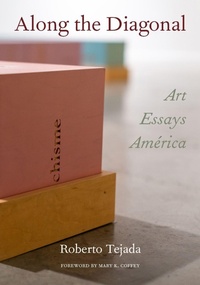
Along the Diagonal
Art/Essays/America
Will be published approx. on 4. August 2026
Book
Paperback/Softback
320 pages
978-1-5315-1329-0 (ISBN)
Description
The first book to offer an expansive view of both major figures and emerging voices in Latin American and US Latinx art
With a poet's eye and a critic's insight, Guggenheim Fellow and celebrated scholar Roberto Tejada brings together a dynamic collection drawn from decades of lectures, articles, cultural criticism, and catalog essays that reframe our understanding of Latin American and US Latinx art throughout the diaspora.
A landmark work from one of today's most vital minds in art criticism and cultural thought, Along the Diagonal moves fluidly between close readings of memoir, visual analysis, and political history to offer an expansive and deeply personal journey. Rather than defining Latinx or Latin American art as fixed categories, Tejada explores them as overlapping and diverging trajectories shaped by migration, colonization, media culture, and institutional visibility. He pushes against nar-row conceptions of Latinx identity as well as isolated histories of Civil Rights movements to situate artists, works of art, and images in sociopolitical contexts and within a web of identity, memory, and often-contested meanings.
Opening with Celia Alvarez Munoz's participatory installation, A Brand New Ball Game, Tejada sets the tone for his diagonal approach: one that favors slantwise perception, speculative connection, and aesthetic risk. From there, the book spans the street-level murals of Chicano Los Angeles, the photobooks of contemporary Brazil, and the multimedia installations of Puerto Rican duo Allora & Calzadilla. Tejada draws on his personal experiences in Mexico City in the 1990s, the theory of Roger Caillois and Vilem Flusser, and the activism of queer and Latinx artists to stage a rich and restless conversation about art as both a record and agent of historical change. Tejada offers sharp insights into the work of influential precursors such as Mexican muralist Jose Clemente Orozco and contemporary artists Miguel Angel Rios, Francis Alys, and Allora & Calzadilla, while also amplify-ing emerging and lesser-known voices, including Jenni(f)fer Tamayo and Jesus Macarena-Avila.
A vital contribution to the evolving conversation about Latinx and Latin American art, Along the Diagonal opens new paths for thinking about how art lives in, and helps shape, the social and political worlds we inhabit.
With a poet's eye and a critic's insight, Guggenheim Fellow and celebrated scholar Roberto Tejada brings together a dynamic collection drawn from decades of lectures, articles, cultural criticism, and catalog essays that reframe our understanding of Latin American and US Latinx art throughout the diaspora.
A landmark work from one of today's most vital minds in art criticism and cultural thought, Along the Diagonal moves fluidly between close readings of memoir, visual analysis, and political history to offer an expansive and deeply personal journey. Rather than defining Latinx or Latin American art as fixed categories, Tejada explores them as overlapping and diverging trajectories shaped by migration, colonization, media culture, and institutional visibility. He pushes against nar-row conceptions of Latinx identity as well as isolated histories of Civil Rights movements to situate artists, works of art, and images in sociopolitical contexts and within a web of identity, memory, and often-contested meanings.
Opening with Celia Alvarez Munoz's participatory installation, A Brand New Ball Game, Tejada sets the tone for his diagonal approach: one that favors slantwise perception, speculative connection, and aesthetic risk. From there, the book spans the street-level murals of Chicano Los Angeles, the photobooks of contemporary Brazil, and the multimedia installations of Puerto Rican duo Allora & Calzadilla. Tejada draws on his personal experiences in Mexico City in the 1990s, the theory of Roger Caillois and Vilem Flusser, and the activism of queer and Latinx artists to stage a rich and restless conversation about art as both a record and agent of historical change. Tejada offers sharp insights into the work of influential precursors such as Mexican muralist Jose Clemente Orozco and contemporary artists Miguel Angel Rios, Francis Alys, and Allora & Calzadilla, while also amplify-ing emerging and lesser-known voices, including Jenni(f)fer Tamayo and Jesus Macarena-Avila.
A vital contribution to the evolving conversation about Latinx and Latin American art, Along the Diagonal opens new paths for thinking about how art lives in, and helps shape, the social and political worlds we inhabit.
Reviews / Votes
"You do not know American art history until you have read Along the Diagonal: Art / Essays / America. Roberto Tejada traces a diagonal across the hemisphere, bringing Latino and Latin American artists into view - not as an addendum to U.S. art history, but as a site of open-ended contemplation on the larger, often silenced histories and asymmetrical entanglements that shape the region. Bridging disciplines, this book is indispensable for art history, cultural theory, hemispheric studies, and gender, sexuality, ethnic, and Indigenous studies." - Chon Noriega, Distinguished Professor, UCLA". . .collects the poet and critic's essays and lectures on Latinx and Latin American art." - Publishers Weekly
"Tejada's life work might adequately be abbreviated as the lifeline - the bridge - between us and the language arts and image worlds of Latin America. His precise portraits of the critical creative ecosystems that have animated the narrative arcs of cityscapes and public spheres in Los Angeles, Houston, and Mexico City are nothing short of thrilling. His importance in the landscape of Latinx letters cannot be overstated. Tejada is a compass for many of us navigating the choppy seas of Latinx cultural commentary and production. This essential compendium is a joy to the senses with its angular lyricism and muscular, exacting prose. Roberto Tejada proffers and deliberates on the world-making intersections of contemporary art, literature, cultural history, critical theory, performance, self-making, and memoir in a stunning sui generis style category all of his own. He is my bard of punk rock eleganza. The genealogist de las americas. A disciple of deep listening. He is your favorite interlocutor's favorite interlocutor. I am beyond exhilarated at the long awaited arrival of Along the Diagonal!" - Raquel Gutierrez, author of Brown Neon
More details
Language
English
Place of publication
New York
United States
Target group
College/higher education
Product notice
Paperback (trade)
Illustrations
32 color and 80 b/w illustrations
Dimensions
Height: 254 mm
Width: 178 mm
ISBN-13
978-1-5315-1329-0 (9781531513290)
Copyright in bibliographic data and cover images is held by Nielsen Book Services Limited or by the publishers or by their respective licensors: all rights reserved.
Schweitzer Classification
Persons
Roberto Tejada (Author)
Roberto Tejada is the author of poetry collections Carbonate of Copper (Fordham University Press, 2025), Why the Assembly Disbanded (Fordham University Press, 2022), Todo en el ahora (2015), Full Foreground (2012), Exposition Park (2010), and Mirrors for Gold (2006); as well as art and media histories that include Still Nowhere in an Empty Vastness (2019), National Camera: Photography and Mexico's Image Environment (2009), and Celia Alvarez Munoz (2009). The recipient of a John Simon Guggenheim Memorial Foundation Fellowship (2021), he is the Hugh Roy and Lillie Cranz Cullen Distinguished Professor in Creative Writing and Art History at the University of Houston.
Mary Coffey (Foreword By)
Mary K. Coffey is Professor Art History at Dartmouth College. She is the author of Orozco's American Epic: Myth, History, and the Melancholy of Race.
Roberto Tejada is the author of poetry collections Carbonate of Copper (Fordham University Press, 2025), Why the Assembly Disbanded (Fordham University Press, 2022), Todo en el ahora (2015), Full Foreground (2012), Exposition Park (2010), and Mirrors for Gold (2006); as well as art and media histories that include Still Nowhere in an Empty Vastness (2019), National Camera: Photography and Mexico's Image Environment (2009), and Celia Alvarez Munoz (2009). The recipient of a John Simon Guggenheim Memorial Foundation Fellowship (2021), he is the Hugh Roy and Lillie Cranz Cullen Distinguished Professor in Creative Writing and Art History at the University of Houston.
Mary Coffey (Foreword By)
Mary K. Coffey is Professor Art History at Dartmouth College. She is the author of Orozco's American Epic: Myth, History, and the Melancholy of Race.
Content
Foreword by Mary K. Coffey vii
Introduction: Diagonally Speaking 1
1. Diagonal and Self-Possessed: Group Portrait with Liminal Figures 9
2. "Everything I See Needs Rearranging": Los Angeles Snapshots 22
3. Mexico City: Art Stories with Roberto Bolano 53
4. Family Resemblance in 1990s Mexico: Francis Alys, The Fabiola Project 64
5. Diaspora Assemblage: "Held Together by Stardust" 78
6. Frameworks of Intelligibility: Latin American/Latinx Art 83
7. The Latin American Photobook in Context 93
8. Tropics of Broadband: Camera Culture and Experience in Sao Paulo 116
9. Printed Matters and Pop Art in America 128
10. Center of Gravity: Jose Clemente Orozco 138
11. White Stone, Bramble, Gravity, Chance: Miguel Angel Rios 142
12. The Capture of Cuauhtemoc: David Alfaro Siqueiros, Leo Matiz, Javier de la Garza 149
13. Celia Alvarez Munoz: "Ideas Are the Drivers" 153
14. Allora & Calzadilla: Wonderstruck on the Edge of Decline 164
15. Luis Gispert: Radical Feedback 177
16. Geographies of Language and Light: Laura Aguilar, Raquel Gutierrez 184
17. Latinx Art in the Future Imperfect: Axis Mundo, Jennif(f)er Tamayo 192
18. Jesus Macarena-Avila: The Essential Work 203
19. Christina Fernandez: Something Lost, Missing, or Unattainable 208
Acknowledgments 221
Notes 225
Index 259
Plates follow page 152
Introduction: Diagonally Speaking 1
1. Diagonal and Self-Possessed: Group Portrait with Liminal Figures 9
2. "Everything I See Needs Rearranging": Los Angeles Snapshots 22
3. Mexico City: Art Stories with Roberto Bolano 53
4. Family Resemblance in 1990s Mexico: Francis Alys, The Fabiola Project 64
5. Diaspora Assemblage: "Held Together by Stardust" 78
6. Frameworks of Intelligibility: Latin American/Latinx Art 83
7. The Latin American Photobook in Context 93
8. Tropics of Broadband: Camera Culture and Experience in Sao Paulo 116
9. Printed Matters and Pop Art in America 128
10. Center of Gravity: Jose Clemente Orozco 138
11. White Stone, Bramble, Gravity, Chance: Miguel Angel Rios 142
12. The Capture of Cuauhtemoc: David Alfaro Siqueiros, Leo Matiz, Javier de la Garza 149
13. Celia Alvarez Munoz: "Ideas Are the Drivers" 153
14. Allora & Calzadilla: Wonderstruck on the Edge of Decline 164
15. Luis Gispert: Radical Feedback 177
16. Geographies of Language and Light: Laura Aguilar, Raquel Gutierrez 184
17. Latinx Art in the Future Imperfect: Axis Mundo, Jennif(f)er Tamayo 192
18. Jesus Macarena-Avila: The Essential Work 203
19. Christina Fernandez: Something Lost, Missing, or Unattainable 208
Acknowledgments 221
Notes 225
Index 259
Plates follow page 152