

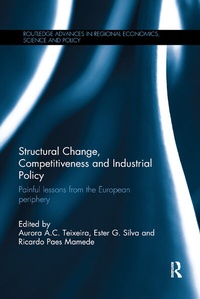
Structural Change, Competitiveness and Industrial Policy
Painful Lessons from the European Periphery
1st Edition
Published on 12. December 2019
Book
Paperback/Softback
346 pages
978-0-367-86875-8 (ISBN)
Description
The onset of the global crisis has emphasised the persistence of substantial differences in development and social progress within the euro area. The specific case of countries located in the southern periphery region has come to the centre stage, due to the harsh economic conditions that all these countries have experienced in the recent past.
In the aftermath of the American subprime credit bubble, these countries' high indebtedness raised doubts as to their ability to sustain public finances, with the financial crisis developing and gaining momentum due to the fragilities presented in the economy. To varying degrees of severity, all of these economies have since been forced to introduce strong fiscal tightening programmes in order to achieve fiscal consolidation, which have translated into recession and rising unemployment.
This book undertakes a comprehensive analysis of the causes of the crisis in southern European countries, showing that the 'Achilles heel' of these economies is rooted in the dismal evolution of productivity and in a specialisation pattern excessively based on the so-called 'traditional', low, and low-medium tech industries, which yield low margins, declining export shares and, ultimately, withering international competitiveness. Such evidence suggests that the southern European periphery industrial growth model has reached its limits, demanding a multidimensional policy approach capable of overcoming the magnitude and complexity of the present crisis.
Without denying the need to adjust public and private balance sheets, it is argued that finding a sustainable path out of the present problems requires addressing the challenges of productivity growth and competitiveness in the long term.
In the aftermath of the American subprime credit bubble, these countries' high indebtedness raised doubts as to their ability to sustain public finances, with the financial crisis developing and gaining momentum due to the fragilities presented in the economy. To varying degrees of severity, all of these economies have since been forced to introduce strong fiscal tightening programmes in order to achieve fiscal consolidation, which have translated into recession and rising unemployment.
This book undertakes a comprehensive analysis of the causes of the crisis in southern European countries, showing that the 'Achilles heel' of these economies is rooted in the dismal evolution of productivity and in a specialisation pattern excessively based on the so-called 'traditional', low, and low-medium tech industries, which yield low margins, declining export shares and, ultimately, withering international competitiveness. Such evidence suggests that the southern European periphery industrial growth model has reached its limits, demanding a multidimensional policy approach capable of overcoming the magnitude and complexity of the present crisis.
Without denying the need to adjust public and private balance sheets, it is argued that finding a sustainable path out of the present problems requires addressing the challenges of productivity growth and competitiveness in the long term.
More details
Series
Language
English
Place of publication
London
United Kingdom
Publishing group
Taylor & Francis Ltd
Target group
College/higher education
Postgraduate
Dimensions
Height: 234 mm
Width: 156 mm
Weight
640 gr
ISBN-13
978-0-367-86875-8 (9780367868758)
Copyright in bibliographic data and cover images is held by Nielsen Book Services Limited or by the publishers or by their respective licensors: all rights reserved.
Schweitzer Classification
Other editions
Additional editions
Aurora Teixeira | Ester Silva | Ricardo Mamede
Structural Change, Competitiveness and Industrial Policy
Painful Lessons from the European Periphery
E-Book
06/2014
1st Edition
Routledge
€59.49
Available for download
Aurora Teixeira | Ester Silva | Ricardo Mamede
Structural Change, Competitiveness and Industrial Policy
Painful Lessons from the European Periphery
E-Book
06/2014
1st Edition
Routledge
€59.49
Available for download
Aurora Teixeira | Ester Silva | Ricardo Mamede
Structural Change, Competitiveness and Industrial Policy
Painful Lessons from the European Periphery
Book
06/2014
1st Edition
Routledge
€217.50
Shipment within 15-20 days
Persons
Aurora A.C. Teixeira is Associate Professor with Habilitation, Faculdade de Economia, Universidade do Porto, Portugal
Ester G. Silva is Assistant Professor at Faculdade de Letras, Universidade do Porto, Portugal
Ricardo Paes Mamede is Assistant Professor at ISCTE - IUL, Lisbon, Portugal
Ester G. Silva is Assistant Professor at Faculdade de Letras, Universidade do Porto, Portugal
Ricardo Paes Mamede is Assistant Professor at ISCTE - IUL, Lisbon, Portugal
Content
PART I - THE CONTEXT: EMU, CONVERGENCE, AUSTERITY
Chapter 1: Introduction: Structural Change, Competitiveness and Industrial Policy (Ester Silva and Aurora A.C. Teixeira)
Chapter 2: The Unsustainable Divergence of National Productive Systems. Seven lessons from the Eurozone crisis (Robert Boyer)
Chapter 3: Convergence and Imbalances in the EMU: the case of Portugal (Fernando Teixeira dos Santos)
Chapter 4: We'll still be here in the long run - austerity and the peripheral growth hypothesis (Miguel St Aubyn)
Chapter 5: The Euro-crisis and the failure of the Lisbon Strategy (Bengt-Ake Lundvall and Edward Lorenz)
PART II - STRUCTURAL CHANGE AND COMPETITIVENESS IN THE EUROPEAN PERIPHERY
Chapter 6: Structural and technology change in the European periphery (Argentino Pessoa)
Chapter 7: National adaptive advantages: Soft innovation and marketing capabilities in periods of crisis and change (Sandro Mendonca)
Chapter 8: Human capital and growth in a services economy (Marta Simoes and Adelaide Duarte)
Chapter 9: Learning, exporting and firm productivity: evidence from manufacturing and services firms (Carlos Carreira)
Chapter 10: Comparative advantages and structural transformation: the cases of Greece, Italy, Portugal, and Spain (Miguel Lebre de Freitas, Luis C. Nunes and Rui Costa Neves)
PART III - POLICY ISSUES
Chapter 11: Industrial Policy in Times of Crisis: The Case of Greece (Tassos Giannitsis and Ioanna Kastelli)
Chapter 12: The Italian Economy, the Economic Crisis and Industrial Policy (Michele Di Maio)
Chapter 13: Assessment and challenges of industrial policies in Portugal: is there a way out of the 'stuck in the middle' trap? (Ricardo Paes Mamede, Vitor Corado Simoes and Manuel Mira Godinho)
Chapter 14: The Industrial Sector of Spain in Search of a New Poli
Chapter 1: Introduction: Structural Change, Competitiveness and Industrial Policy (Ester Silva and Aurora A.C. Teixeira)
Chapter 2: The Unsustainable Divergence of National Productive Systems. Seven lessons from the Eurozone crisis (Robert Boyer)
Chapter 3: Convergence and Imbalances in the EMU: the case of Portugal (Fernando Teixeira dos Santos)
Chapter 4: We'll still be here in the long run - austerity and the peripheral growth hypothesis (Miguel St Aubyn)
Chapter 5: The Euro-crisis and the failure of the Lisbon Strategy (Bengt-Ake Lundvall and Edward Lorenz)
PART II - STRUCTURAL CHANGE AND COMPETITIVENESS IN THE EUROPEAN PERIPHERY
Chapter 6: Structural and technology change in the European periphery (Argentino Pessoa)
Chapter 7: National adaptive advantages: Soft innovation and marketing capabilities in periods of crisis and change (Sandro Mendonca)
Chapter 8: Human capital and growth in a services economy (Marta Simoes and Adelaide Duarte)
Chapter 9: Learning, exporting and firm productivity: evidence from manufacturing and services firms (Carlos Carreira)
Chapter 10: Comparative advantages and structural transformation: the cases of Greece, Italy, Portugal, and Spain (Miguel Lebre de Freitas, Luis C. Nunes and Rui Costa Neves)
PART III - POLICY ISSUES
Chapter 11: Industrial Policy in Times of Crisis: The Case of Greece (Tassos Giannitsis and Ioanna Kastelli)
Chapter 12: The Italian Economy, the Economic Crisis and Industrial Policy (Michele Di Maio)
Chapter 13: Assessment and challenges of industrial policies in Portugal: is there a way out of the 'stuck in the middle' trap? (Ricardo Paes Mamede, Vitor Corado Simoes and Manuel Mira Godinho)
Chapter 14: The Industrial Sector of Spain in Search of a New Poli