

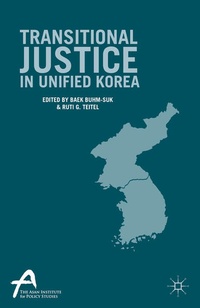
Transitional Justice in Unified Korea
Published on 29. September 2015
Book
Hardback
X, 274 pages
978-1-137-53702-7 (ISBN)
Description
How will a unified Korea respond to the Kim regime's crimes against humanity? Will North and South Korea be able to reconcile their differences after being divided for so long? Will China, the US, Japan, Russia, and U.N. drive the process? This book examines the challenges associated with Korean unification and human rights accountability.
More details
Series
Edition
1st ed. 2015
Language
English
Place of publication
New York
United States
Target group
Professional and scholarly
Product notice
sewn/stitched
Cloth over boards
With dust jacket
Illustrations
X, 274 p.
Dimensions
Height: 229 mm
Width: 152 mm
Thickness: 18 mm
Weight
553 gr
ISBN-13
978-1-137-53702-7 (9781137537027)
DOI
10.1007/978-1-137-53454-5
Schweitzer Classification
Other editions
Additional editions
Ruti G. Teitel | Baek Buhm-Suk
Transitional Justice in Unified Korea
E-Book
04/2016
Palgrave MacMillan
€128.39
Available for download

Ruti G. Teitel | Baek Baekbuhm-Suk | Baek Buhm-Suk
Transitional Justice in Unified Korea
Book
01/2014
Palgrave MacMillan
€96.29
The article will not be published
Persons
Mireille Affa'a-Mindzie, International Peace Institute, USA. Cho Jung-hyun, Korea. National Diplomatic Academy, South Korea Roberta Cohen, The Brookings Institution, USA. Lisa Collins, Asan Institute for Policy Studies, South Korea. Anna Dolidze, University of Western Ontario, Canada. Constantin Goschler, Ruhr University, Germany Frank Jannuzi, Mansfield Foundation, USA. Kim Yuri, Asan Institute for Policy Studies, South Korea Rajiv Narayan, International Commission against the Death Penalty, Spain Andrew S. Natsios, Texas A&M University, USA. Muna B. Ndulo, Cornell University, USA. Andrew G. Reiter, Mount Holyoke College, USA. Greg Scarlatoiu, U.S. Committee for Human Rights, North Korea. Lavinia Stan, St. Francis Xavier University, Canada.
Content
Table of Contents List of Illustrations Preface; Hahm Chaibong Introduction; Ruti G. Teitel PART I: JUSTICE FOR ALL: PEACE AND RECONCILIATION IN UNIFIED KOREA 1. Transitional Justice in Post-Unification Korea: Challenges and Prospects; Baek Buhm-Suk, Lisa Collins, Kim Yuri 2. External Actors and Transitional Justice in a Reunified Korea; Andrew G. Reiter 3. Transitional Justice: Response to Human Rights Violations by International Institutions; Muna B. Ndulo PART II: DEALING WITH HUMAN RIGHTS ATROCITIES IN THE DPRK 4. Human Rights in North Korea: Addressing the Challenges; Roberta Cohen 5. Peace, Unity and Justice for All: Problems and Prospects of Transitional Justice in a Reunified Korea; Greg Scarlatoiu 6. A Brighter Light into the Darkness: Identifying Human Rights Violations and Sources of Information in the DPRK in the Era of the UN Commission of Inquiry; Rajiv Narayan PART III: LEARNING FROM THE EXPERIENCES OF OTHER COUNTRIES 7. German Reunification and the Challenge of Transitional Justice; Constantin Goschler 8. Confronting North Korean Communist Abuses: Some Possible Markersl; Lavinia Stan 9. Beyond the Binary of Exogenous and Endogenous Transitions: International Actors and Transitional Justice in Georgia; Anna Dolidz 10. A Comparative Study of Transitional Justice: Learning from the Experiences of African Countries; Mireille Affa'a-Mindzie PART IV: TRANSITIONAL JUSTICE IN THE UNITED KOREA 11. Transitional Justice on the Korean Peninsula: Lessons from Cambodia; Frank Jannuzi 12. Transitional Justice in a Reunified Korea: Some Initial Observations; Cho Jung-hyun 13. Transitional Justice in North Korea Following a Change of Regime: An Exploration of Four Possible Scenarios; Andrew S. Natsios Epilogue; Baek Buhm-Suk, Lisa Collins, Kim Yuri Appendix: Asan Poll: Survey on South Korean Perceptions of Transitional Justice in Post-Unification Korea; The Asan Institute for Policy Studies Contributor biographies Bibliography Index