

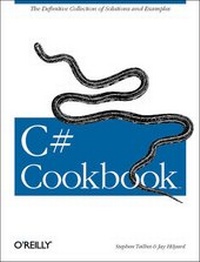
C sharp Cookbook
1st Edition
Published on 24. February 2004
Book
Paperback/Softback
856 pages
978-0-596-00339-5 (ISBN)
Description
You don't need to be an experienced C# or .NET developer to use this book. The C# Cookbook is designed for users of all levels with recipes targeted at the real-world developer who needs to solve problems now, not learn lots of theory first. With this guide, all developers will be able to learn and improve their mastery of both the language and the .NET Framework Class Libraries.
More details
Other editions
New editions
Book
11/2015
4th Edition
O'Reilly
€51.50
Shipment within 10-20 days
Jay Hilyard | Stephen Teilhet
C# Cookbook
Book
03/2006
2nd Edition
O'Reilly
€45.00
Article exhausted; check for reprint
Persons
Stephen Teilhet earned a degree in electrical engineering but soon afterwards began writing software for the Windows platform. For the last eight years, he has worked for several consulting firms on a wide range of projects, specializing in Visual Basic, Visual C++, MTS, COM, MSMQ, and SQL Server. Stephen currently works for Compuware Numega Labs in Nashua, New Hampshire, where he is immersed in the Microsoft .NET technologies.
Content
Preface; 1. Numbers; 1.1 Determining Approximate Equality Between a Fraction and Floating-Point Value; 1.2 Converting Degrees to Radians; 1.3 Converting Radians to Degrees; 1.4 Using the Bitwise Complement Operator with Various Data Types; 1.5 Test for an Even or Odd Value; 1.6 Obtaining the Most- or Least-Significant Bits of a Number; 1.7 Converting a Number in Another Base to Base10; 1.8 Determining Whether a String Is a Valid Number; 1.9 Rounding a Floating-Point Value; 1.10 Different Rounding; Algorithms; 1.11 Converting Celsius to Fahrenheit; 1.12 Converting Fahrenheit to Celsius; 1.13 Safely Performing a Narrowing Numeric Cast; 1.14 Finding the Length of Any Three Sides of a Right Triangle; 1.15 Finding the Angles of a Right Triangle; 2. Strings and Characters; 2.1 Determining the Kind of Character; 2.2 Determining Whether a Character Is Within a Specified Range; 2.3 Controlling Case Sensitivity when Comparing Two Characters; 2.4 Finding All Occurrences of a Character Within a String; 2.5 Finding the Location of All Occurrences of a String Within Another String; 2.6 The Poor Man's Tokenizer; 2.7 Controlling Case Sensitivity when Comparing Two Strings; 2.8 Comparing a String to the Beginning or End of a Second String; 2.9 Inserting Text into a String; 2.10 Removing or Replacing Characters Within a String; 2.11 Encoding Binary Data as Base64; 2.12 Decoding a Base64-Encoded Binary; 2.13 Converting a String Returned as a Byte[ ] Back into a String; 2.14 Passing a String to a Method that Accepts Only a Byte[ ]; 2.15 Converting Strings to Their Equivalent Value Type; 2.16 Formatting Data in Strings; 2.17 Creating a Delimited String; 2.18 Extracting Items from a Delimited String; 2.19 Setting the Maximum Number of Characters a String Can Contain; 2.20 Iterating Over Each Character in a String; 2.21 Improving String Comparison Performance; 2.22 Improving StringBuilder Performance; 2.23 Pruning Characters from the Head and/or Tail of a String; 3. Classes and Structures; 3.1 Creating Union-Type Structures; 3.2 Allowing a Type to Represent Itself as a String; 3.3 Converting a String Representation of an Object into an Actual Object; 3.4 Polymorphism via Concrete or Abstract Base Classes; 3.5 Making a Type Sortable; 3.6 Making a Type Searchable; 3.7 Indirectly Overloading the +=, -=, /=, and x= Operators; 3.8 Indirectly Overloading the &&, ||, and ?: Operators; 3.9 Improving the Performance of a Structure's Equals Method; 3.10 Turning Bits On or Off; 3.11 Making Error-Free Expressions; 3.12 Minimizing (Reducing) Your Boolean Logic; 3.13 Converting Between Simple Types in a Language Agnostic Manner; 3.14 Determining Whether to Use the Cast Operator, the as Operator, or the is Operator; 3.15 Casting with the as Operator; 3.16 Determining a Variable's Type with the is Operator; 3.17 Polymorphism via Interfaces; 3.18 Calling the Same Method on Multiple Object Types; 3.19 Adding a Notification Callback Using an Interface; 3.20 Using Multiple Entry Points to Version an