

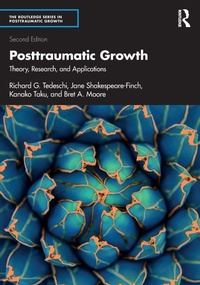
Posttraumatic Growth
Theory, Research, and Applications
2nd Edition
Published on 23. July 2025
Book
Paperback/Softback
364 pages
978-1-032-91324-7 (ISBN)
Description
The new edition of Posttraumatic Growth: Theory, Research, and Applications includes the latest developments in the science of posttraumatic growth, including responses to the COVID-19 pandemic, epigenetics, and new interventions to facilitate growth after trauma.
The book provides a wide range of answers to questions about the theory behind posttraumatic growth (PTG), its synthesis and contrast with other theories and models, and its applications in diverse settings. Posttraumatic Growth starts with an overview of the history, components, and outcomes of PTG. Next, chapters review quantitative, qualitative, and cross-cultural research on PTG, including in relation to cognitive function, identity formation, cross-national and gender differences, and similarities and differences between adults and children. The final section shows readers how to facilitate optimal outcomes with PTG at the level of the individual, the group, the community, and society.
The book provides a wide range of answers to questions about the theory behind posttraumatic growth (PTG), its synthesis and contrast with other theories and models, and its applications in diverse settings. Posttraumatic Growth starts with an overview of the history, components, and outcomes of PTG. Next, chapters review quantitative, qualitative, and cross-cultural research on PTG, including in relation to cognitive function, identity formation, cross-national and gender differences, and similarities and differences between adults and children. The final section shows readers how to facilitate optimal outcomes with PTG at the level of the individual, the group, the community, and society.
Reviews / Votes
"It has been over twenty years since the term 'posttraumatic growth' was coined by Richard Tedeschi and Lawrence Calhoun. In that time, these authors' pioneering and inspirational work has helped posttraumatic growth become a flagship theme of positive psychology, one that has garnered interest from personality, social, and clinical psychologists across the world. This is a milestone book written by the leaders in the field, and it will surely set the agenda for theory, research, and practice for the next twenty years. It is a must read for all students, academics, and practitioners interested in the study of traumatic stress and how to help people overcome adversity."Stephen Joseph, PhD, author of What Doesn't Kill Us: The New Psychology of Posttraumatic Growth
"This new book is a plentiful harvest of more than twenty years of international research and applied practice on posttraumatic growth. The two world-leading originators of the concept are joined by the two leading experts in international research on posttraumatic growth. What a stupendous work of diligence and scholarship!"
Andreas Maercker, PhD MD, chair and professor of psychology, Division of Psychopathology and Clinical Intervention, University of Zurich
"Posttraumatic Growth is the definitive and up to date guide on trauma and positive change written by the world's leading researchers on the subject. The remarkable depth and global reach of the book shows just how far Richard Tedeschi and Lawrence Calhoun's pioneering work has come in just a few decades. Posttraumatic Growth is required reading for anyone hoping to understand this fundamental human response to struggle."
Jim Rendon, author of Upside: The New Science of Post-Traumatic Growth
More details
Series
Edition
2nd edition
Language
English
Place of publication
London
United Kingdom
Publishing group
Taylor & Francis Ltd
Target group
Professional and scholarly
College/higher education
Professional Practice & Development and Professional Reference
Illustrations
1 s/w Abbildung, 1 s/w Zeichnung
1 Line drawings, black and white; 1 Illustrations, black and white
Dimensions
Height: 254 mm
Width: 178 mm
Thickness: 21 mm
Weight
706 gr
ISBN-13
978-1-032-91324-7 (9781032913247)
Copyright in bibliographic data and cover images is held by Nielsen Book Services Limited or by the publishers or by their respective licensors: all rights reserved.
Schweitzer Classification
Other editions
Additional editions
Richard G. Tedeschi | Jane Shakespeare-Finch | Kanako Taku
Posttraumatic Growth
Theory, Research, and Applications
E-Book
07/2025
2nd Edition
Routledge
€41.99
Available for download
Richard G. Tedeschi | Jane Shakespeare-Finch | Kanako Taku
Posttraumatic Growth
Theory, Research, and Applications
E-Book
07/2025
2nd Edition
Routledge
€41.99
Available for download
Richard G. Tedeschi | Jane Shakespeare-Finch | Kanako Taku
Posttraumatic Growth
Theory, Research, and Applications
Book
07/2025
2nd Edition
Routledge
€231.90
Shipment within 10-20 days
Previous edition
Richard G. Tedeschi | Jane Shakespeare-Finch | Kanako Taku
Posttraumatic Growth
Theory, Research, and Applications
Book
05/2018
1st Edition
Routledge
€69.51
Shipment within 10-20 days
Persons
Richard G. Tedeschi, PhD, is Professor Emeritus in Psychological Science at the University of North Carolina at Charlotte and Executive Director of the Boulder Crest Institute for Posttraumatic Growth.
Jane Shakespeare-Finch, PhD, is Professor in Psychology and Counseling at Queensland University of Technology in Brisbane, Australia, and has published extensively in posttraumatic growth.
Kanako Taku, PhD, is a professor in the Department of Psychology and Director of the Free-Form Tipping Point Lab at Oakland University in Michigan. She is the editor of the Journal of Loss and Trauma.
Bret A. Moore, PsyD, ABPP, is a board-certified clinical psychologist and prescribing psychologist. He is the Deputy Director of the Boulder Crest Institute for Posttraumatic Growth.
Jane Shakespeare-Finch, PhD, is Professor in Psychology and Counseling at Queensland University of Technology in Brisbane, Australia, and has published extensively in posttraumatic growth.
Kanako Taku, PhD, is a professor in the Department of Psychology and Director of the Free-Form Tipping Point Lab at Oakland University in Michigan. She is the editor of the Journal of Loss and Trauma.
Bret A. Moore, PsyD, ABPP, is a board-certified clinical psychologist and prescribing psychologist. He is the Deputy Director of the Boulder Crest Institute for Posttraumatic Growth.
Content
Part 1: Posttraumatic Growth Theory
1. What Is Posttraumatic Growth?
2. A History of the Concept of Posttraumatic Growth in Psychology and Related Disciplines
3. Religion, Spirituality, Philosophy, and Posttraumatic Growth
4. Posttraumatic Growth as Process and Outcome
5. Posttraumatic Growth as Common and Universal Experience
6. The Validity of Reports of Posttraumatic Growth
7. Components of the Theoretical Model of Posttraumatic Growth
8. Theories Related to PTG
Part 2: Posttraumatic Growth Research
9. Qualitative Research on Posttraumatic Growth
10. Quantitative Measures of Posttraumatic Growth
11. Cross-Cultural Research
12. Developmental Research on Posttraumatic Growth
13. Posttraumatic Growth and Neurological and Biological Mechanisms
14. Ideal Research Strategies for Posttraumatic Growth
Part 3: Application
15. Facilitation of Posttraumatic Growth through Expert Companionship
16. Intervention Models for Posttraumatic Growth
17. PTG Beyond the Individual
18. Vicarious and Secondary PTG
19. Non-Posttraumatic Growth
20. Final Considerations
1. What Is Posttraumatic Growth?
2. A History of the Concept of Posttraumatic Growth in Psychology and Related Disciplines
3. Religion, Spirituality, Philosophy, and Posttraumatic Growth
4. Posttraumatic Growth as Process and Outcome
5. Posttraumatic Growth as Common and Universal Experience
6. The Validity of Reports of Posttraumatic Growth
7. Components of the Theoretical Model of Posttraumatic Growth
8. Theories Related to PTG
Part 2: Posttraumatic Growth Research
9. Qualitative Research on Posttraumatic Growth
10. Quantitative Measures of Posttraumatic Growth
11. Cross-Cultural Research
12. Developmental Research on Posttraumatic Growth
13. Posttraumatic Growth and Neurological and Biological Mechanisms
14. Ideal Research Strategies for Posttraumatic Growth
Part 3: Application
15. Facilitation of Posttraumatic Growth through Expert Companionship
16. Intervention Models for Posttraumatic Growth
17. PTG Beyond the Individual
18. Vicarious and Secondary PTG
19. Non-Posttraumatic Growth
20. Final Considerations