

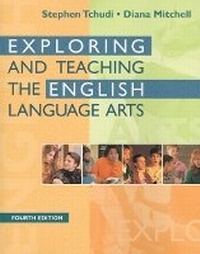
Exploring and Teaching the English Language Arts
4th Edition
Published on 3. September 1999
Book
Paperback/Softback
480 pages
978-0-321-00215-0 (ISBN)
Description
Written by a renowned author team bringing with them 50 years ofcombined teaching experience, this text offers a series of integrated,research-based principles for the teaching and learning of language.Provides an exploratory approach, recognizing that teachers must forgemethods for themselves based upon their personality, knowledge of thediscipline, and interpretation of individual student needs. Throughcontemporary research, classroom observation, and teaching experience, theauthors help student teachers discover and refine their sets of methods forteaching the language arts.
More details
Edition
4th edition
Language
English
Place of publication
United States
Publishing group
Pearson Education (US)
Target group
Professional and scholarly
Dimensions
Height: 234 mm
Width: 188 mm
Thickness: 20 mm
Weight
609 gr
ISBN-13
978-0-321-00215-0 (9780321002150)
Copyright in bibliographic data and cover images is held by Nielsen Book Services Limited or by the publishers or by their respective licensors: all rights reserved.
Schweitzer Classification
Other editions
Previous edition

Stephen Tchudi | Diana D. Mitchell
Explorat Teach English
Book
01/1988
3rd Edition
Longman
€100.46
Article exhausted; check for reprint
Content
Preface: A Documentary History of Teaching the English LanguageArts.
1. Exploring and Teaching the English Language Arts.
2. The Integrated Curriculum.
3. Creating Instructional Units.
4. Creating Classroom Community.
5. Engagement with Literature.
6. Literature and the Young Adult.
7. Organizing to Teach Literature.
8. Teaching Writing.
9. Writing for Here and Now.
10. Exploring Language.
11. Classroom Talk, Drama and Performance.
12. Language: A Mass Medium.
13. Assessment, Evaluation and Grading.
Coda: Idea(l)ism and Successive Approximation.
Bibliography.
1. Exploring and Teaching the English Language Arts.
2. The Integrated Curriculum.
3. Creating Instructional Units.
4. Creating Classroom Community.
5. Engagement with Literature.
6. Literature and the Young Adult.
7. Organizing to Teach Literature.
8. Teaching Writing.
9. Writing for Here and Now.
10. Exploring Language.
11. Classroom Talk, Drama and Performance.
12. Language: A Mass Medium.
13. Assessment, Evaluation and Grading.
Coda: Idea(l)ism and Successive Approximation.
Bibliography.